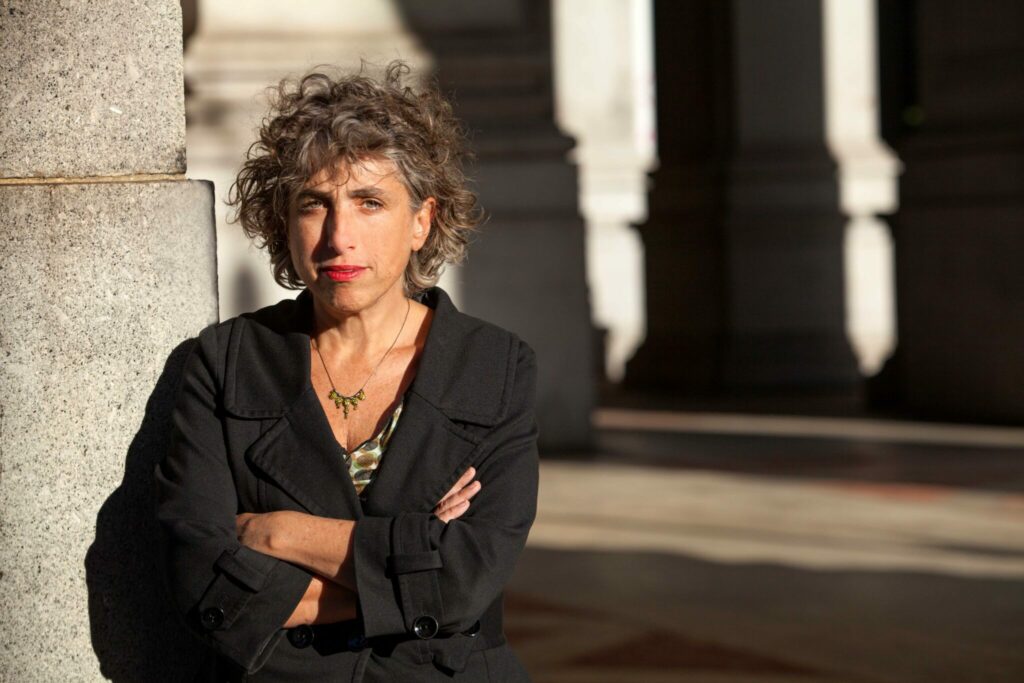
Andrea Bernstein is a hyphenate: she is an investigative journalist, an author, a podcast host, a radio personality, and a professor. Over the course of her career, she has covered topics ranging from national elections to Donald Trump’s criminal cases to the capitol riot on January 6th. Her book American Oligarchs: The Kushners, the Trumps and the Marriage of Money and Power is a New York Times Best Seller; her podcasts have topped the charts and won numerous awards for their masterful storytelling. This year, she was also a Presidential Fellow at Bennington College.
For the first seven weeks of the fall term, Bernstein taught one course—Campaign Coverage in an Age of Disinformation—and held a tutorial on the weekly Public Policy Forums hosted by the Center for the Advancement of Public Action (CAPA). I met Bernstein in the elegant CAPA faculty lounge, one of her favorite working spots on campus, to discuss her experience at Bennington, her multifaceted career, and her thoughts on this moment in politics.
“I worked in government and politics for a while after college and then decided I didn’t want to do that. The thing I liked the most was writing. I slowly evolved into a journalist realizing that I understood where the bodies were buried,” said Bernstein about the beginning of her career. She began freelancing at the public radio station WNYC and joined the staff in 1999, where she reported on government and politics in New York until 2021; she concurrently covered politics for the New York Observer from 1995 to 2003.
In the early days of the Donald Trump administration, Bernstein became aware of a certain journalistic vacuum concerning the new president: “There was some really good investigation into Trump, but maybe not enough. After the election, there was a real reckoning, a real feeling that we need to investigate him. I’d covered politics and government in New York, and I realized that Trump was very close to all of that. The real estate industry is very much a part of politics and government. But I also realized it was a huge job.” Bernstein began collaborating with other reporters on a project-turned-podcast called “Trump Inc.,” which reported on the conflicts that arose between Trump’s presidency and his private business. She went on to co-host two more podcasts: “Will Be Wild,” about the January 6th attack on the U.S. Capitol, and “We Don’t Talk About Leonard,” about conservative activist Leonard Leo.
Podcasting, and audio-based storytelling in general, is near and dear to Bernstein’s heart. “I love hearing voices. I love allowing audio to do the work,” said Bernstein. “Audio is such an intimate medium. People can get meaning from things like inflection, tone, gaps in speaking. The other thing I like about making a podcast is the same thing I love about teaching: it’s a collaboration. If you miss a class, you can do the readings on your own, but you’ll never be able to replace what you might have learned from a class discussion. Audio brings that to the table. I love the collaboration of making it and I love the satisfaction of listening to it. It’s really fun. It’s like theater.”
Bernstein found herself drawn to teaching because of her father: “My father, who had been a teacher all his life and taught until he was 90, taught his final classes on Zoom. After he passed I really thought about how I would like to spend more time teaching.”
She came to Vermont at the recommendation of her former colleague Laura Walker: Bennington’s President previously served as the President and CEO of New York Public Radio, which operates WNYC, for over 20 years. “I reached out to Laura Walker, who I knew from WNYC, and asked her if she had any advice. She said, ‘Why don’t you come here?’ It wasn’t quite as simple as that, but ultimately, that is how I became a Presidential Fellow here this semester.”
“One of the things I think is really great about Bennington is that it had a different approach from most places, which was: ‘What would you like to teach?’” This creative liberty allowed Bernstein to put together a course tailor-made for this moment in history and politics—and it allowed her to target it toward students interested in practicing journalism and those who simply wish to understand journalism better. “My interest is really in journalism and democracy, so I’m teaching the craft and the understanding, but also how they interact with the world that we live in. Bennington really encouraged that.”
Many of the central theses behind her course Campaign Coverage in an Age of Disinformation came from German philosopher Hannah Arendt, who wrote a piece on the tumultuous relationship between truth and politics—aptly titled “Truth and Politics”—for The New Yorker in 1967. Bernstein read Arendt’s book, The Origins of Totalitarianism, along with “Truth and Politics,” and discussed the meaning of both with her father, who was a Hannah Arendt scholar. “What Hannah Arendt was encouraging us to do was to look at history and our current situation, but to understand the inflection points in history where people could have made different choices to inform the way we act in the present,” said Bernstein.
She became specifically interested in the subject of mis- and disinformation while working on her podcast “Will Be Wild.” The project required Bernstein to interview experts in the subject, many of whom had previously worked for the Trump administration and were now seeking to bolster public defenses around mis- and disinformation—particularly when it comes to the electoral system. “I became very interested in the subject, and could obviously see where this [2024] election was going, and I knew it would be a big issue,” said Bernstein. “I simultaneously thought about that article, ‘Truth and Politics.’ What I would like to do in the course is think about those two things in conversation with each other: our current disinformation-misinformation environment and what Hannah Arendt wrote in 1967.”
Bernstein hoped for students to leave the course with a newfound understanding of the way information is used as a tool for political power—especially in the upcoming election—and a sharp eye for the mis- and disinformation that inevitably crosses their screens daily. “I think most citizens go through the world, and information comes at them, and people don’t have a chance to think: ‘Where does this information come from, how is it being used, how is it a part of our political system?’ What I’m hoping is that people start to understand our information environment in a critical way—which is just something I think all citizens should be able to do. I see that as a goal. Let’s understand our political discourse and all the forces that are acting on it, because that’s how we can really be effective citizens.”
Assigned class materials were diverse—in subject matter, in genre, and in historical context. They included the 1963 documentary Point of Order! about the Senate Army-McCarthy hearings; the introductory pages of the Mueller Report; Al Gore’s concession speech; Rachel Maddow’s podcast “Ultra.” Hannah Arendt, of course, is in the mix. Her writing served as the connective tissue, interlinking one instance of historical mis/disinformation to the next.
Bernstein previously taught investigative reporting and writing at City College and Hunter College. Fortunately, her experience at Bennington seems to be stacking up: “When I arrived here at Bennington, everybody was so nice to me. As a journalist, that is very unusual—especially the kind of [investigative] journalism I do, because people mostly don’t want me around,” she laughed. “I feel like the students are great and really interested. I want everybody to act like a journalist, even though it’s not a journalism course, so they must take the material seriously. I understand that college students have a lot going on, so I think there’s been a very high level of participation and thought, and I really appreciate that.”
When asked about the most exciting political event she has covered, Bernstein found it difficult to choose. “Everything is so exciting. I mean, some things are fascinating and exciting in a negative way—I just covered five Trump trials. I also covered Obama’s inauguration and that was a moment. But a lot of what I’ve done, which is also really exciting, is much more intimate. People telling me their personal stories, usually bad things that have happened to them, and feeling like I can bring it to public light. Making government change, which I’ve done a lot, or getting people indicted, which I’ve also done,” she laughed.
“Journalism can really have an impact on the world. I think it can have an impact in terms of concrete actions, but then I also think there is a real power of truth.” Bernstein described how journalism used to be a more potent means of holding leaders accountable because politicians used to have a greater sense of shame—something they have gradually lost, making reporting on them a more challenging task. “You might think, ‘well, what is the point of journalism in that context if it’s not going to actually change things?’ However, I just believe that—what we were talking about with Hannah Arendt—factual truth has power. And bolstering it is a powerful force in the world. I will always believe that.”
What Bernstein finds particularly fascinating about this moment in politics relates to one of Arendt’s central tenets: “I think we really are at an inflection point, no matter what happens with our democracy in November. It’s the thing that I was talking about with Hannah Arendt: what were the points in history where we could have made a different decision?”
On October 17, Bernstein moderated the final CAPA Public Policy Forum. The theme of this term’s forums was “Saving Democracy Together,” and Bernstein was involved in discussions around the programming of these forums with Bennington. Weekly speakers included Dr. Richard Haass, former president of the Council on Foreign Relations; Anthony Farley and Ciji Dodds, two professors at Albany Law School; and Kesha Ram Hinsdale, a Vermont State Senator. The topic of the final session was “Special Program on Media, Democracy, and the Rule of Law,” and the speakers were David Rohde, an investigative journalist and the Senior Executive Editor in National Security at NBC news, and the attorney and professor Andrew Weissman, who was a lead prosecutor on the Robert Mueller special counsel investigation.
Bernstein primarily served as a moderator for the conversation, which covered themes from the speakers’ two books—Weissmann’s Where Law Ends and Rodhe’s Where Tyranny Begins (the titles are twin pieces of a John Locke quote)—including the legal system’s function of upholding facts regardless of opinion, Trump’s plans to eradicate the civil service, the nation’s move towards tyranny, and how being on the side of truth is considered radicalism in the modern political sphere.
Bernstein did, however, answer a question about dealing with the frustration of reporting on a seemingly “bulletproof” figure like Donald Trump with the intention of bringing him to justice: “I was in the courtroom when I heard ‘guilty’ 34 times,” said Bernstein. “I was there when he was ordered to pay 83 million dollars to E. Jean Carroll, and when his company was found guilty of felony fraud. I was planning to go cover the sentencing of Trump on July 11.” This sentencing, of course, was delayed until after the presidential election, at Trump’s request. “It is enormously frustrating, but it’s pretty great to go to the courtroom and everybody’s forced to tell the truth, and you learn the story, and the jury says this happened—that matters. I feel a great sense of satisfaction because the truth is important and does mean something.”
She also warned against online mis- and disinformation, something she had previously told me people were ill-equipped to navigate. “I think that it plays on our emotions. These algorithms are incredibly powerful. They understand that when you see something that seems really bad or outrageous, it makes you angry, and you will want to share that. And people are busy. There’s this old adage that a lie is halfway around the world before the truth laces up its shoes. And social media is like—a lie is halfway to the sun. It’s so fast, how it circulates.”
During the CAPA Forum, she urged attendees not to spread misinformation on social media. “You are all getting it in your social media feeds,” said Bernstein. “Misinformation is not disinformation…it’s something that we participate in by layering on untruth. So read carefully what comes through feeds, think about what the sources are and if it doesn’t seem to you that it’s true, don’t share it.”
Bernstein returned to Bennington this past Friday for the Podcast Symposium in CAPA, an event she organized—speakers included the podcasters Matt Katz, Nancy Solomon, and Bennington alum Jason Moon. Next semester, she will be teaching investigative journalism at Princeton University.
Toward the end of our conversation, when I expressed my own fears about the future of journalism (given the obstacles of mis- and disinformation on social media and the shuttering of news outlets across the nation) Bernstein was quick to refute them—employing the same optimism as her favorite philosopher, perhaps, or simply drawing from the stubbornness required of her career: “I think that finding [new journalism] models is certainly challenging, but people keep straining to find a way. Humans have always wanted to tell stories. Telling stories and hearing stories is fundamental to being a human. People want to make sense of the world. I don’t think journalism can disappear for that reason.”







Be First to Comment