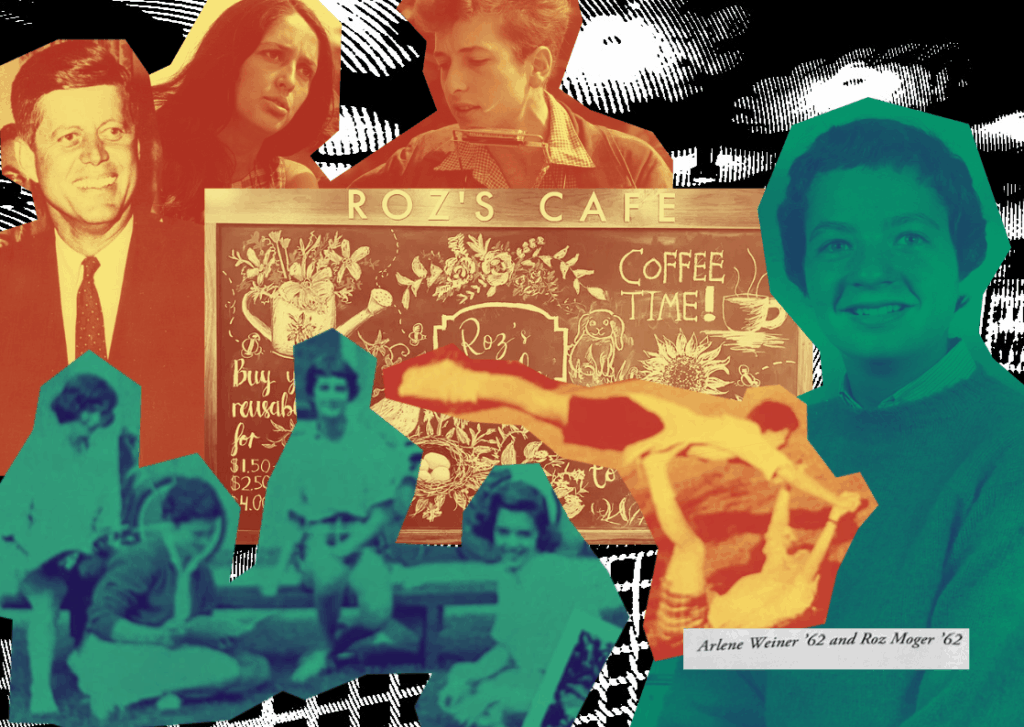
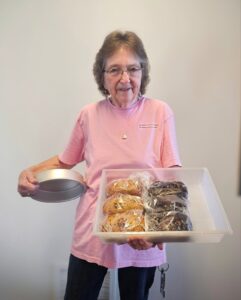
An Intimate Interview with Roz Bernheimer, the infamous namesake for Roz’s Cafe.
I originally set out to write a story about the history of the beloved Campus cafe, Roz’s. However, after interviewing the namesake herself, the story soon evolved into a piece that unfolded Rosalind Bernheimer’s life at Bennington during the late 1950s and early 1960s. At an interesting time in Bennington history, Roz witnessed and took part in historic events including a Joan Baez and Bob Dylan performance, the early years of Charles Webb, and more.
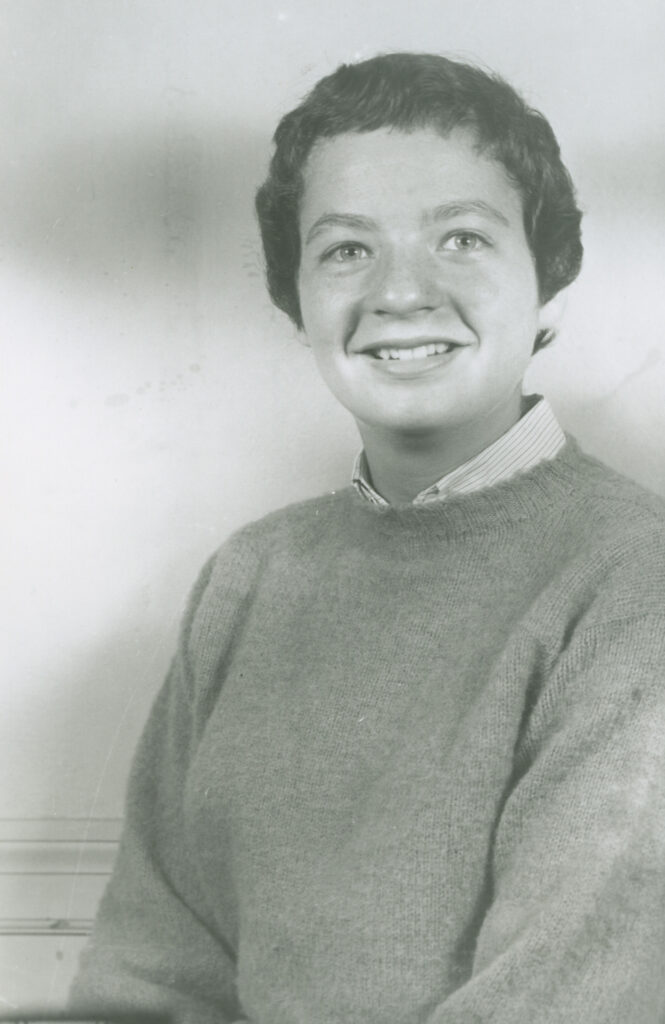
Born and raised in Brookline, Massachusetts, Roz Bernheimer graduated from her local high school in 1958, and decided to continue her education at Bennington College. She was encouraged to apply to Bennington by her high school English teacher, Francis Newsom. According to her, Newsom “talked up” the college and had close friends who taught there. I asked her “Why Bennington?” to which she replied: “It wasn’t until the 60s, that schools started to become co-ed. So it wasn’t so much of a choice.” Different from the seven sister schools, a group of notable historically women’s liberal arts colleges in the northeastern U.S., Bennington offered an alternative style of education both in its open curriculum and remote location.
At the beginning of her time at Bennington, Bernheimer intended to study pre-med but leaned more into the social sciences. She then switched her focus to psychology and American history. She was discouraged by the science courses’ early start times, saying “At 8:30 in the morning we’d have classes, and then there’d be labs from two to six. And I would sort of look out the window, and think, “I’d probably rather be playing tennis than trying to get a blood draw out of my finger.”
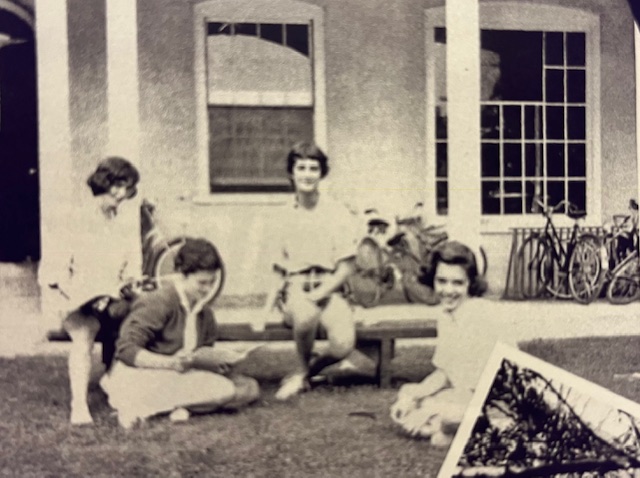
Placed in Booth as a freshman, Bernheimer lived there all four years with a few close friends. Back then, professors used to host classes in the colonial house’s common rooms, then called living rooms. “We’d sit on the couches and everybody smoked at that time. But it was really great, except I took an English class, which was in the Booth House living room. I actually slept through it which was embarrassing,”she recalls about the classes held in-house. Back in the 80s, Bernheimer returned to visit campus with her children and wanted to show them the house she had resided in the late 50s and early 60s. However, at that point, Booth had become the campus’s notable party house, known for its animal sacrifice rituals and carved pentagram on the floor. She exclaimed, “I guess it had gotten really wild and the furniture was in disarray– there were spray-painted male body parts on the walls!”
The “Plan Process” in the Early 1960s
Curious about what the Plan process looked like during the school’s single sex years, I asked Bernheimer about her experience. She explained that in her freshman year, she had been assigned an advisor, with whom she discussed her interests and what classes would serve her academic goals. According to her, at the end of your sophomore year, you identified a focus, but you didn’t declare anything until your junior year. Later on, you had to define your thesis idea and find a thesis advisor– someone to oversee your research and writing progress. She explained how she might’ve been perceived as more “traditional” compared to Bennington’s contemporary standards. “I think I was seen as very straight compared to the bohemian ethos of Bennington, which– in the 50s, 60s– was ahead of its time. I was seen sort of as a little bit more mainstream. I kept my room neat and I got my papers in on time,”she disclosed. Bernheimer wrote her thesis on enuresis– colloquially, bed wetting.
Field Work term, then called Non-Resident Term, has always been an aspect ofBennington’s unique education module that differentiates it from other liberal arts colleges. In her junior year, Bernheimer wrote a cold letter to the head of psychiatry at Boston’s Children’s Hospital to look for work. Intrigued by the idea, the psychiatry department developed a structured program where Roz worked in different departments of the hospital. “I ended up getting a job out of school that I wouldn’t have had without graduate school,” she emphasized.
After graduation, Bernhimer worked in the children’s unit at Boston’s Children’s and ran the program that eventually became Head Start, a federally funded program that promotes school readiness of infants, toddlers, and preschool-aged children from low income families. Adding to the advancement of psychological work done at Bennington, she notes that the Newcomb Study– a well-known sociological research study– took place at Bennington College from 1935 to 1939. The study aimed to examine the attitudes of students attending the then all-female Bennington College early in the college’s history.
A Collaborative Romance between Bennington and Williams
Almost instantaneously after Bennington College opened in 1932, a relationship began to form between Bennington and Williams. Since both schools were single-sex at the time, students often found romance with one another. This idea is confirmed by Roz’s own Bennington–Williams “love story” with her husband, Wally Bernheimer. Married for over 50 years, the two first met at Booth while Roz was in the middle of a heated discussion with another Williams student. Wally remembers the moment vividly., “She was destroying his argument. It was love at first hearing.”
“They’re totally different places, but I liked both. I spent a lot of weekends down there. And ironically, I think my husband spent a lot of time at Bennington, he wrote his thesis in the library, which was about three times as long as mine,” Roz went on to say when discussing her connection to Williams. “I think it gave me the best of both worlds.I could be whatever I wanted to be at Bennington, in terms of being with women and in classes, and have the weekends to go to a football game at Williams– to do things we didn’t have at Bennington, or just have a different social scene.”
Planned Parenthood & Bob Dylan in Commons
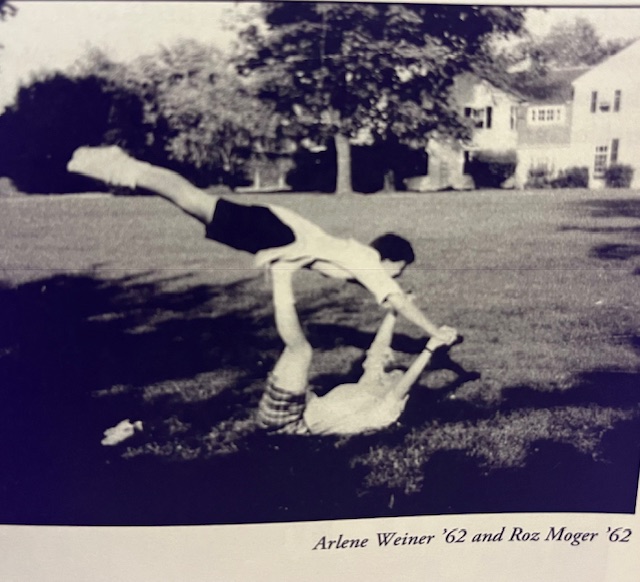
On the first night of Roz’s freshman year, the class of 1962 was told to go to Commons to speak with Dr. Alan Goodmacher about contraceptives. Goodmacher soon after became the founder and first president of Planned Parenthood. Due to the social climate being more conservative, Bernheimer remembers the conversation as awkward: “I remember my roommate– who was from St. Paul, Minnesota– looked at me, and I looked at her, and I’m like: what is this about? Why are they doing this?”
Another notable memory Bernheimer recalls is the night President Kennedy was elected. “The president of Bennington–Bill Fells– was there. That was a big deal to us. They served hot dogs and hamburgers in the dining hall.t was an all-American celebration.”
On the social committee of Bennington’s student government, she hosted movie nights and organized on-campus performances. Famously, Bernheimer was a part of the team that brought Joan Baez and Bob Dylan to campus. “We ended up having Joan Baez. Her first album had just come out, and some of us who were from the Boston area knew of her from Cambridge.” Her roommate had a cousin who worked in New York who knew someone who could perform.“He was a performer and his name was Bobby Zimmerman. Well, it was Bob Dylan.”
“We said “maybe he’ll come and open for her” because he was not well known at that time at all. And that’s what happened, and Bob Dylan was singing with her harmonica. People thought he was a put-on. They thought he was from Williams and it was a big joke,” she laughs.
“We [the students] way overwent the fire code up on the third floor of Commons and people started getting antsy. And finally: Joan Baez came, and it was a great concert. Who knew it was going to be historic in terms of what they both did with their lives?”
An anecdote that may or may not resonate with current Bennington students may be the dining hall’s need to oversophisticate meals. According to Bernheimer, dining hall food was served to you as you sat down– there was no buffet option to serve yourself back then.
“The head of dining services, Joe Perry, made kind of fancy meals. We would have been just as happy with the hot dogs sometimes. But finally, in my senior year, he opened a little snack bar in the Commons behind the mail room. We thought that was the best thing that ever happened, you could go there and get a Coke,” she reminisces.
After I mentioned living in Dewey, Bernheimer shared some fascinating unknown history about the house. Author of “The Graduate”, Charles Webb, lived in the attic of Dewey for several months. Students knew about this, but quickly accepted his presence. At the time, Webb attended Williams College and later married one of Roz’s classmates, Eve Rudd.
On the 1950s Party Culture and Student-Teacher Relationships
Bennington College served as a women’ s institution for 32 years.Because of this, students often found themselves in entanglements with their professors. Bernheimer remembers returning home to Booth after being at an all-night study room and seeing someone climbing out of the first-floor window. She then realized it was a teacher whom she recognized. “It was different then.There would be parties in Jennings on the weekend where there was plenty of alcohol and faculty would be there.”
Bernheimer and I eventually began discussing the reconstruction of Commons in 2018. After graduation, the Bernheimers continued to be an active part of the Bennington community.. Serving on the board of trustees and fundraising for various financial campaigns, Roz and her husband made generous endowments to the college. To honor her continuous support and contributions, Bennington offered to put her name on a space in the new Commons. Evidently, Roz chose a cafe: a communal space for students to gather.
“My life at Bennington was as much about having a good time as being a student. I thought about doing social activities and missing the fact that we never really had a snack bar. So the idea of a cafe was really appealing and captured what I liked about Bennington and what I think Bennington needs,” she explains. (She then confirmed that she has indeed tried Roz’s Cafe’s coffee and croissants and thinks they are delicious.)
Over the course of our discussion, we bonded over our appreciation for Bennington’s intimate class sizes and close-knit community. For Roz Bernheimer, there’s no better place to be. “Kids who go to Harvard, they’re in a lecture hall with 100 kids. At Bennington, you are up close and personal with the teachers– which can be good or bad, you know, depending on the teacher.”





Be First to Comment