
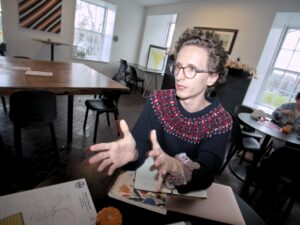
Mark Hunter has only been working as a carpenter at Bennington for five years, although he’s wanted to work here for much longer. He grew up in the area, back in the day, and he’s always liked the campus, and the idea of having all his jobs in one place, where he could get to them quickly and check up on them whenever.
Originally, Hunter was a potter. He spent twenty years doing handbuilding, mold-making, and casting at various potteries in Bennington and the Boston area. Then jobs dried up and he switched to cabinetry. He’d been working as a cabinetmaker in Albany for about seven years when the job at Bennington happened to open up.
I met Mark because of a particularly conspicuous maintenance job. The front door at Jennings had been sticking for days, and what had started as heavy pushes had turned into full-body shoves. Then, while heading to class one Thursday morning, I found that the door was gone—taken off its hinges completely, sitting on two sawhorses, surrounded by a small group of B&G employees.
I asked some questions, and soon I was talking to Hunter himself. He led the repair job, and explained to me that the door’s sticking had actually been a symptom of an even bigger problem—it had literally fallen apart. The door was installed about 20 years ago, he said, and is a replica of the original. But “it wasn’t very well built,” he continued. “You know, over time, moisture—we had a heck of a winter. It just started failing.” If it weren’t for the protective overhang, he added, it probably would have failed years earlier.
And so, over the course of a few hours, Hunter added some much-needed structural dowels, gave the inner edge of the door a little shave, pieced the door back together and then returned it to place—better than new, and ready to last for however many more decades.

The Jennings front door in its split-apart state.

The door’s new shaved edge.
A few days later, I visited Mark in his shop, where he showed me some other things he’d been working on. One of his latest projects was constructing a set of brand-new doors for some of the colonial houses. If these doors had been purchased new, Hunter said, they’d have cost about four thousand dollars apiece. He was able to make them for just the cost of materials—just four hundred each.

Hunter stands in his shop with the new doors on prominent display.

Hunter shows a podium he made for a senior dance show.
Other pieces of Mark’s work can be found all over campus. The leaf-filled table in the bookstore and the epoxied old clock that hangs in the Commons atrium, for example, were both made by him, and that’s not to mention all the other mundane things he’s done, like kitchen cabinetry, and small patches on doors. And he helps with senior work sometimes, too. He recently finished making a wooden podium with a see-through panel for a dance student’s senior show.

Hunter’s table placed prominently in the bookstore.


Some in-progress class keyrings.
Hunter does some non-carpentry projects, too. For the past few years, he’s been hand-casting class keyrings to give to seniors at graduation. They’re made entirely out of old pipes and other unused metal collected from buildings around campus.
Repurposing and salvaging is a theme for Hunter. Whenever he can, he said, he likes to reuse materials. “I really try my best to repurpose things back into the campus,” he explained. “So it has a story.”
After the Barn was remodeled, Hunter turned the old timbers into a desk and a conference table, for the admissions office and the President’s conference room respectively. And he’s also built entirely new things using wood harvested on-campus. Most recently he turned some trees that were being cut down into a big, solid bench. He said he’s still trying to figure out a good place to put it.

It’s not yet clear where Hunter’s bench will end up going.
Besides his more interesting projects, Hunter told me, much of his effort is spent just trying to keep the campus from falling apart. Back when the college was in direr financial straits, there just weren’t enough people or resources to keep things properly maintained. “They didn’t have the money to do it,” Hunter said. “So they deferred it, and deferred it, and deferred it.” Now, years later, he’s still dealing with the consequences.
Maybe a tree is a good metaphor for our campus itself. It’s historic, but not like a statue in a museum—it’s much more like an old, living organism. The leaves and branches come and go, but the trunk stays—a bunch of little parts, constantly changing, but united in a place, and underneath a shared project. Trees decay, and they grow, and sometimes they do neither. It’s people like Mark whose job it is to keep our campus alive—repairing, repurposing, maintaining, and expanding.
For the moment, Hunter is spending a lot of time at the Student Center, where they’re working on redoing the floors. And he’s also trying to find a way to convince college leadership not to make him paint those new doors he made. They’re supposed to be green to match the others—but don’t they look so nice already?





Be First to Comment