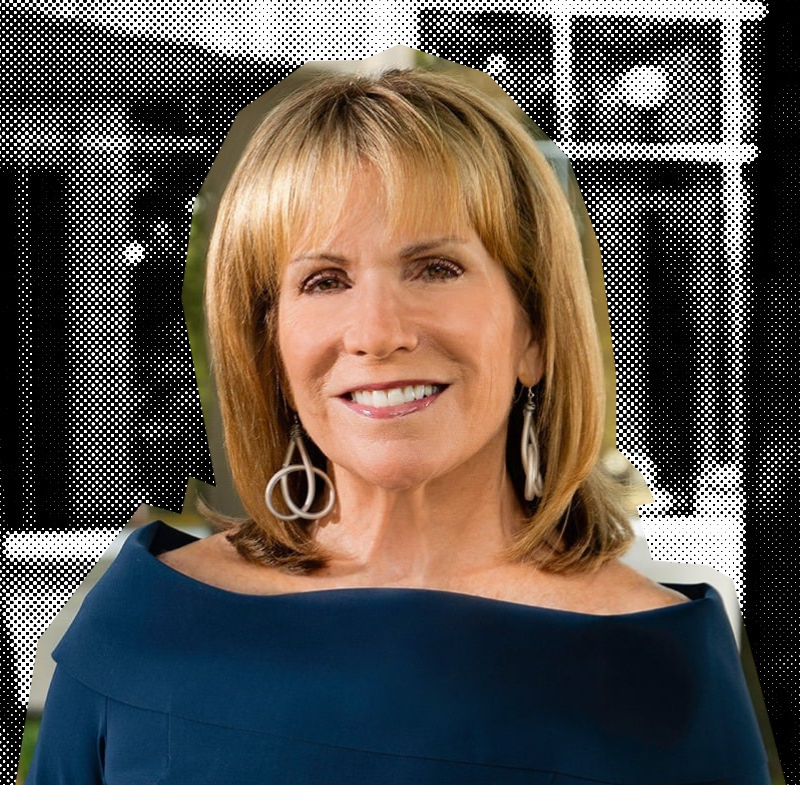
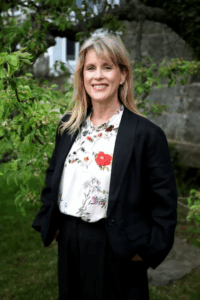
After it was announced on August 29 that Laura Walker, current President of Bennington College, would be retiring from her position at the end of the Fall 2025 term, the question on most students’ minds (besides the natural “why?”) was who her replacement would be. The answer came via email only three days later, when Elissa Tenny was announced as the college’s newly-elected Interim President. Tenny, who previously served as President of the School of the Art Institute of Chicago (SAIC) for eight years, had enjoyed her retirement for a mere handful of months before she got the offer from Bennington. “I love being retired,” said Tenny. “There is probably no other institution for which I would have agreed to come out of retirement.”
Tenny, who will serve as Interim President from January through August 2026 (at which point a permanent replacement will be announced), is eager to return to the institution where she had “one of the most formative experiences” of her life. Having served as Provost and Dean of Bennington College from 2002 to 2010, Tenny has fond memories of the school’s longtime traditions: she remembers when fire trucks blared their sirens to signal the arrival of midnight breakfast, she met with Student Educational Policies Committee (SEPC) reps, and she attended her fair share of house “coffee hours” (only when she was invited, she emphasized).
During our conversation, Tenny conveyed her admiration for the college’s ethos and her optimism for its future, citing Bennington’s finances as a major, yet solvable, issue. She also discussed her career at SAIC, including her fundraising successes at the Chicago school, the experience of leading a college through Covid-19, and her involvement in the arrests that occurred during a 2024 student protest for Palestine (something that has grabbed the attention of Bennington’s student body).
Tenny has been involved in higher education for the entirety of her career, having worked at The New School in New York City in various positions from 1977 to 2002. As Provost and Dean at Bennington, Tenny took on a supervisory role, with units such as IT and the MFA in Writing program reporting to her. “I felt as if I grew enormously—personally, professionally, and intellectually—and understood, by the end of my time there, the core DNA of Bennington, and the concept of interdisciplinarity and integrative learning,” said Tenny. She was most inspired by Bennington’s unique structure and “Plan Process,” and cited her experience at Bennington as one of the main reasons she was hired as President of SAIC.
“I don’t say this to people at SAIC, but it’s kind of like the ‘Plan Lite,’” joked Tenny. “Students are responsible for the trajectory of their education just as they are at Bennington.” She noted that this process, which requires students to take “anchor courses” throughout the four years, is less “robust” and more traditional than Bennington’s Plan Process.
Before becoming President of SAIC, Tenny was Provost and Senior Vice President of Academic Affairs at the college; this position was established “to oversee its [the college’s] strategic priorities and to strengthen its administration,” according to the SAIC website. One of Tenny’s initial goals was to unite the administrative offices, as she believes an integrative approach creates a better experience for students. She was also in charge of implementing a “strategic plan” that was drafted before her arrival at the college. According to Tenny, this plan focused heavily on admissions, and identifying the defining characteristics of a prospective SAIC student. It also focused on infrastructure issues, and Tenny was instrumental in creating the Earl and Brenda Shapiro Center for Research and Collaboration at SAIC.
Tenny’s fundraising efforts at SAIC were highlighted in the email announcing her appointment to the Bennington community: “During her tenure, SAIC completed its first-ever major fundraising campaign at 110% of the goal and advanced initiatives that expanded student scholarships, strengthened wellness programs, and expanded the Institute’s paid career-building experiences.”
During the Covid-19 pandemic, Tenny said she developed a fundraising initiative that was focused on students and equity; this initiative involved raising money for scholarships, developing a first generation fellows program, and funding students so they could take unpaid internships. “During that period of time, we had a goal of raising $25 million dollars, and we ended up raising $27 million,” said Tenny.
Financial issues have long plagued Bennington College, most recently manifesting in the layoffs of 15 staff members this past summer. Given the college’s lackluster endowment—in 2020, Chairman Nick Stephens stated the college has had “almost no endowment” for decades—it is all but tradition for Bennington to select Presidents based on fundraising potential. It is common knowledge within the Bennington community that Laura Walker was hired for her background in fundraising: during her previous job at New York Public Radio, Walker worked on four capital campaigns that raised $160 million. Elizabeth Coleman, who served as President from 1987 to 2013, was brought on during a time when Bennington carried a $1 million deficit. Some of her strategies—including the firing of 26 faculty members—were highly contentious, but she reportedly managed to secure significant donations that kept the college afloat.
Although Tenny said that she wouldn’t be heavily involved in fundraising initiatives due to the brevity of her term at Bennington College, and noted that her knowledge of Bennington is 15 years out of date, she did name unstable finances as the most pressing issue facing the college. “There are challenges with admissions,” said Tenny. “I feel like there are things that I can work [on] with the admissions people that would strengthen it. You know, strengthen the number of students who accept admission and actually come.”
She also highlighted improvements that could be made in terms of “stewardship,” which refers to the way fundraisers court their big donors. “You make sure they are attended to and that they know what’s going on at the college, which typically means that they continue to give [money] in the future,” said Tenny.
The main challenge, she stated, is selling the idea of Bennington. “I do think one of the greatest challenges is how to explain to the world the uniqueness of Bennington. This idea of ‘interdisciplinarity’ is thrown around even by institutions who don’t have a clue of what it is. I think that if we could figure out a way to very successfully send the message about what it means to have a Bennington education…that message, for a new president, could be a very powerful tool. I think it is possible to raise more money for Bennington.”
Tenny was willing to discuss the SAIC student arrests that occurred last year during a protest for Palestine, something which has prompted concerns about free speech from Bennington students. Tenny said that during the protest, which took place in a sculpture garden at the Art Institute of Chicago, students were climbing scaffolding on the building and blocking an emergency exit; they also stole the walkie-talkie and keys from a security guard. According to Tenny, there was a large police presence in the area due to the coinciding Polish Constitution Day Parade.
SAIC’s Provost went to the protest site and attempted to negotiate with protesters on behalf of the museum (which was disgruntled with students’ behavior). During negotiations, which lasted roughly 5 hours, the Provost offered to relocate protesters to school property, which they refused. At this point, students were warned that if they did not move, the museum was going to call the police. “Our Provost also explained that if there were any international students there, [it was] highly recommended that they leave, because in all likelihood, their visas would be revoked,” explained Tenny.
The museum eventually decided to call the police, at which point 68 people were arrested– 31 of these were students. “We convinced the museum not to press charges,” said Tenny. “I spoke to the district attorney’s office and asked them to please drop the charges. We told the students that there wouldn’t be disciplinary action against them.”
“It was a very, very difficult day for me,” Tenny continued. “If it had been my decision, I wouldn’t have called the police, but they were on museum property, and the museum was fearful about the emergency exit, about damage to the sculptures, and about what happened to the security guard.”
Despite the years she has spent away from Bennington, Tenny is most looking forward to the familiar things upon her return, including an old habit that brought her closer to students. “Some of my fondest memories are visiting classes. I always visited classes, and I always told the faculty beforehand, ‘I’m not here to evaluate you. I just want to see what it feels like to be in a classroom at Bennington.’ I’m looking forward to doing that again, if the faculty are up for it.”
“And although this may sound trite,” added Tenny, “I loved going to the dining hall and just being there with students and faculty and staff. Students weren’t particularly interested in talking to me, but I loved watching the students go up to a faculty member and have a conversation. It was a very special, intimate experience.”








Be First to Comment