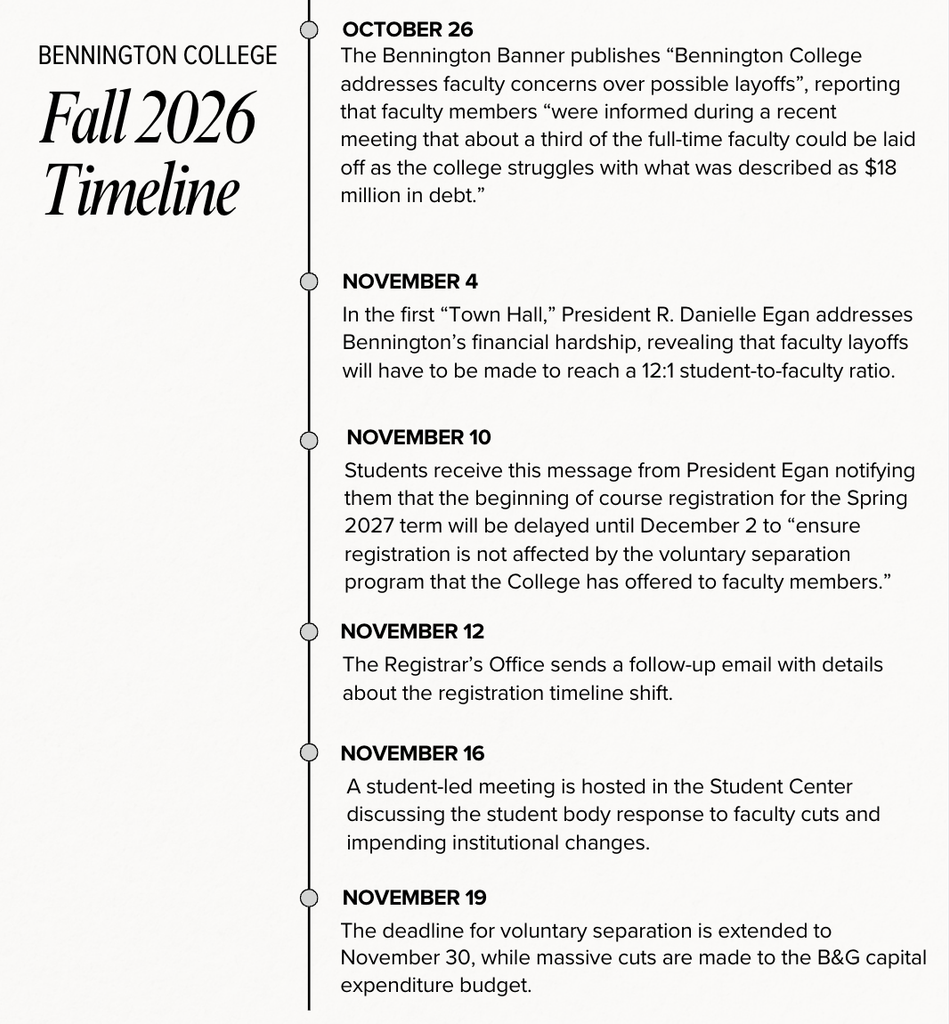
On Thursday, November 19th, it was revealed that after a conversation with student advocates, the deadline for faculty to accept voluntary incentive programs has been extended to Monday, November 30. The same day, the Lens was notified by an anonymous source that a massive cut of $300,000-$400,000 has been made to the $900,000 Buildings and Grounds (B&G) capital expenditure budget.
Capital expenditure (CapEx) covers long-term growth and physical assets used for more than a year, such as heavy machinery, vehicles, buildings, land, company-owned hardware, and facility renovations. It differs from monthly operating expenses (OpEx), which include employee salaries, rent, utilities, and property taxes. Apart from the $150,000 set aside for emergency CapEx funding, anything over the B&G CapEx budget must go through an extensive permissions process before approval to move forward with repairs for unforeseen infrastructural issues. For example, in the winter of 2026, an unexpected steam leak occurred. While funding was being addressed, the college had to rent around 50 space heaters using the B&G OpEx budget.
As for the faculty cuts? The college estimates that up to 12 full-time positions will be eliminated. The voluntary programs include an early retirement package that was previously negotiated with BCU, Bennington’s faculty union. They were created to reduce the number of layoffs as Bennington works to cut 23 full-time equivalents (FTE) from the faculty, effectively raising the student-to-faculty ratio from less than 8:1 to 12:1. Due to the different arrangement of hours, 23 FTE does not necessarily equate to 23 faculty layoffs. Decisions will be announced to faculty in January. Laid-off faculty will continue to teach through the Spring 2027 term, with a final separation date of June 30, 2027, and two months’ severance pay.
For many new members of the Bennington community, these faculty cuts appear as an alarming sign for the future of the institution. But the timeline has always been dire.
As President Egan first explained at the Town Hall on November 4, these layoffs are driven by Bennington College’s $18 million structural deficit, meaning the college spends $18 million more each year on operating costs than it makes through tuition. NECHE (New England Commission of Higher Education), which accredits over 200 institutions, including Bennington, is taking precautions now more than ever, as many small, liberal arts colleges have closed in the past two years. While Bennington College is currently stable, if the College’s five-year financial projections are deemed inadequate, the school could be on the brink of receiving a notation. Despite rigorous fundraising efforts and a full evaluation of operating costs, administration has exhausted its options. Progress, in this case, can only come in the form of faculty cuts.
These layoffs follow the loss of 24 full-time staff members in the Summer of 2025: 9 voluntary separations and 15 position eliminations. After President R. Danielle Egan took office in summer 2026, the administration has been more transparent with the student body about the college’s finances and revealed that faculty reductions were considered necessary for years and under discussion for at least a year before the information was publicly announced.
Multiple meetings have been held between the United Student Body and President Egan this week, and emotions have been running high. Nobody wants these cuts to happen; many administrators are Bennington alums, and the professors now facing the layoffs were once their professors too. This closeness is part of the beauty of our school, and it is also what makes this moment so painful amid a nationwide higher-ed crisis and attack on liberal arts.








Be First to Comment