
In the Fall semester of 2021, Allen Shawn taught a course on the History of Music at Bennington College. Nine students, myself included, spent the term researching the music department’s various alumni and faculty, even interviewing some, in order to build a cohesive collection of information for the music library’s archive. This process inevitably began to weave a narrative of the department’s progression from 1932 to the present, and though there were several moments that stood out in this history–such as the Black Music Division that thrived in the 1970s under faculty Bill Dixon and Milford Graves–none were as singular as the 1994 Symposium. Some alumni mentioned it with awkward laughter, some preferred to call it “the Purge,” and others refused to discuss it at all.
For the final project of the course – a group lecture on our findings – I, somewhat masochistically, chose to take on the Symposium. A history of music at Bennington would be incomplete without discussing it, which is a difficult task given the closeness of the subject matter. Writers at The New Criterion or the New York Times could observe the college from a distance, criticize and praise it freely without intimate knowledge of a crucial truth: that the roots of Bennington’s struggles are often the same roots of its successes. We are not afforded this distance. That being said, many of us who arrived post-94 do not entirely understand what the Symposium was, why it happened, or what people felt about it at the time.
I interviewed Allen Shawn on the subject in preparation for my presentation, and what was scheduled as a brief interview turned into a nearly two-hour conversation – there was simply too much to say. His perspective was valuable. From the very beginning, he prefaced: “to state things that I know are true is not easy, because I knew everybody involved.” Listening to a recording of our conversation a year later, I am still struck by the care with which Allen chooses his words in an attempt to articulate a pain that is still very present. It is his perspective on the Symposium, first and foremost, that feels necessary to preserve in writing. Others who lived through it may disagree; even twenty-eight years later, the wounds are very raw.
For one of the initial assignments of the class, Allen had us read John Dewey’s philosophy of progressive education, as it is one that Bennington has historically striven to follow. The crux of his position is this: ‘progressive education’ can’t simply be a rejection of the usual model. It must replace traditional education with an even more effective, compelling alternative. Progressive institutions (and progressivism in general) have long suffered from reactivity usurping actual innovation. Bennington, in its disposal of the regimented pillars of traditional education, chose to implement a small number of faculty and a small number of students at any given time. Lectures were swapped for discussions, bureaucracy for direct lines of communication, and social breadth for academic and emotional intimacy. These principles were important to keep in mind as we discussed the events of 1994, because it is precisely these measures towards our ideal education that made its execution so hypocritical and catastrophic.
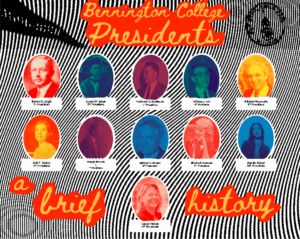
As for the history itself, a new era began for Bennington when Elizabeth Coleman became the president of Bennington in 1987. There are conflicting perspectives on how she conducted herself as a leader, especially since the aforementioned nature of this college has always been deeply personal. When a president makes a bad call, they have to face the anger, resentment, and vitriolic attacks head-on. That is a difficult position to be in, even when the anger is earned, as it often was with Coleman. “She had a very positive effect on individual students, and she was personally kind to me,” Allen said. “Nevertheless, because of the Symposium, I was also furious at her. We had many discussions in which she had to listen to how angry I was.”
Coleman is an intelligent and poised woman, by all accounts. She carried herself well in conversation, and a career spent in academia equipped her well for intense conversations with faculty regarding their subjects and scholarship. She could often connect with people well one-on-one – depending, of course, on who the other “one” was. The issue arose when she had to connect with a large mass of people. Allen joked to me that it would have taken “Nelson Mandela” to lead the 1980-90s Bennington, “to find a way to have a collaborative relationship with the faculty at the very moment when this school was in big trouble. She was not Nelson Mandela in terms of her ability to be at ease when she was being attacked. She was not at her best leading a discussion of large groups of people. She couldn’t deal well with criticism.”
It can be easy to see a president as the sole cause of disastrous decisions like the 1994 Symposium. Despite her creation of CAPA and the other ways she managed to build a sturdier foundation for Bennington College, many people to this day view Liz Coleman as a president who conducted a hostile takeover of a vulnerable institution. They have good reason to. Bennington is also – and has always been – a particularly difficult place to be president. Policies that would fly by unnoticed at a large institution will be felt deeply and criticized brutally when implemented here. There is no bureaucratic buffer between administration and school populus. Few who came before her were fit for it either.
Coleman is quoted as saying, “What happened quite understandably, I suppose, was that [the faculty and students] needed a villain, and the board wasn’t convenient. You need a person. So I found myself in the eye of the storm. […] Much rougher than I imagined it would be. I was amazed at the vitriol.”Allen was sure to remind me that the board was still a central driving force behind the Symposium. “The trustees are really crucial in this,” he said, “because they had been proposing all kinds of changes for many years. They are the crucial players in this story.”
Bennington had for a long time suffered the same crisis that every liberal arts college faces at least once in its history: financial instability. With a reported 1 million dollars of debt and a reputation for the highest tuition in America, enrollment began dwindling by the early 80s. Liberal arts colleges that emphasize creative exploration often find that its alumni, rather than highly paid doctors and lawyers who can reliably support their alma mater, are artists and creatives whose incomes can’t feasibly support frequent donations. Hampshire College had to take a year out of operation for this reason – creative institutions are no strangers to debt, and Bennington had a history of being even more off-beat than most.
“Nobody that I can remember ever said there was something that needed to be changed in the Bennington ethos,” Allen reflected when we spoke, “but I see now that society was telling the school that, in terms of people not applying, etcetera.” Whether or not the school should take these numbers into account was a subject of great debate; in many ways, Bennington likes to consider itself “above” statistics. The board, on the other hand, had long been attempting to make Bennington more “normal,” for the sake of financial success if nothing else.
This “norming” process has continued through the three presidents who have followed Coleman: Mariko Silver (2013-2019), Interim President Isabel Roche (2019-2020), and now Bennington’s current president, Laura Walker (2020-).
Though rumors of an impending financial crisis had been mounting for years, there was a substantial segment of the faculty and student body who did not believe it. It seems to Allen, at least in hindsight, that the school had reached the point of a massive “existential crisis,” and that the faculty were simply not buying it. They were convinced that the college was fine: it always had been and always would be. “All of this is murky and complicated,” Allen admitted. “A lot of it has to do with numbers and things that I know nothing about. But I lived through what happened next. And I think that was handled appallingly.”
“All of this is murky and complicated. A lot of it has to do with numbers and things that I know nothing about. But I lived through what happened next. And I think that was handled appallingly.”
The Symposium was an attempt to address, name, and discuss the cultural issues Bennington was facing. It wished to gather the entire community in one place to discuss mounting concerns and changes to the college in order to build a consensus, an ironic intention given that these schoolwide meetings were largely driven by the trustees. Literature teacher Jonathan Haynes recalls the meetings as an “unambiguous failure.” The first few were well attended but unproductive – there was no balance between structure and free conversation. Soon after, people stopped bothering to come. The final meeting had to be postponed because no one showed up, but this was not due to disinterest. Alumnus Mark Edmunson explained that many students and faculty were “staying away because they suspected that the Symposium process was a charade: they’d come to believe that the trustees and most especially [the president] already knew precisely what they intended to do.”
Whether or not this is the case remains unclear, but it does seem apparent that the eventual decision to make deep cuts in faculty was not the direct result of the Symposium itself. Neither “Symposium” nor “Purge,” in Allen’s perspective, were accurate descriptors; “what happened was both legitimate and illegitimate at the same time.” The college was in crisis and action had to be taken, but the notion that these decisions came as a result of sober contemplation and consensus was entirely contrived and furthered the burgeoning idea that these talks were simply for show.
“Do I really think that the conversations we had led to any of what happened?” Allen said, “I can’t really see the connection.” Whatever the decision process was, the ideas presented at the Symposium meetings seem not to have been heavily factored into them.
Once graduation had passed and the campus was mostly cleared, a legally terse letter was sent to all faculty. It explained the pedagogical and infrastructural changes the College would make before the academic year, including the abolishment of the academic departments and presumptive tenure. (Presumptive tenure was a form of job security that fell just short of actual Tenure.) Allen recalls standing next to his colleague Peter Golub ‘74 as they read their letters simultaneously. They were identical apart from the final sentence, where Allen was welcomed back for the following term. Peter was not.
A third of the faculty was terminated. All teaching positions in art history, politics, economics, foreign languages, and instrumental music performance were eliminated entirely, as well as significant cuts to crucial disciplines. Literature faculty had been diminished most severely. They had also been the department most united and vocal in their criticisms of Coleman, and most averse to the “norming” process encouraged by trustees. It seemed to many that the Board was able to fold a purge of a “troublesome” department into their attempt to save the college from financial crisis, and the concurrence was not lost on anyone. As for music faculty, the cuts felt less vengeful as many individuals were regarded as “non-political”. Allen described them as “collateral damage” and were not, to his awareness, anything beyond a cost-saving measure.
Philosophical changes to the school were not unpopular in theory, but many found that their letter read more like a parody of clichés about progressive education than a genuine pedagogical proposal. There was one line in the letter addressing the “human cost” of such a decision, but that was all. Allen articulated it best in our interview:
“Here’s what I think was so appallingly handled: here you have a place that is predicated on the close relationship between faculty and students. Then you cut a third of the faculty, and you have one line about that in the Symposium document, acknowledging that there was a ‘human cost’ to the cuts. And you describe it as a move towards new mentors, those who really do what they teach, thereby invalidating the lives of the former faculty members and the education that people who studied with them had, as well as that of your current students… And then to offer no words of regret, or honoring of former faculty work, or expressions of appreciation, and not to show any signs of interest whatsoever in the feelings that were pouring in from students and alumni, exactly the kinds of feelings the school had always prided itself in fostering.”
The letter was, simply put, strategically swift and morally insufficient.“In taking possession of a state, the conqueror should well reflect as to the harsh measures that may be necessary and then execute them at a single blow.” This Machiavellian precept (and many others) have been used to describe the 1994 letter time and time again. The harshness of its language, though largely due to legal advising, is perhaps the most disrespectful facet of the college’s decision. Much of the letter discussed the “restructuring” of the College, and while they certainly did restructure some departments, the attempt at justifying firings as a move towards a better, more progressive education is both inaccurate and insulting. It explained that the cuts were made not just for financial safety but “to permit restructuring and enhancement of programs in order to increase competitiveness.” It suggests the fired faculty were not teacher-practitioners; that they were not innovators in their fields, and were not accomplished artists, writers, or thinkers in their own right. It attempted to turn firings with little benefit other than financial into pedagogical sacrifices.
For the time following the memo, Bennington is said to have felt like an ongoing wake. Publications covered the Symposium as a laughable failure in academia’s most indulgent college – one New Criterion article was titled “Bennington College, R.I.P.” Prominent alumni like novelist Donna Tartt, whose first book The Secret History had been a runaway bestseller, swore never to set foot on campus again. A college that emphasizes relationships as part of learning will inevitably be hurt by mass layoffs, but an environment as delicate and intense as Bennington was distraught. Allen himself held a discussion in his small office in Jennings for over sixty-five students to grieve the loss of their favorite professors. The structural cuts made in music,” he reflected, “destroyed a special and innovative music program with ties all around the country and internationally. They were also a complete contradiction of the founding documents of the College, which proposed making music and dance performance academic pursuits on a par with the humanities.” The effort to dissolve academic disciplines for the sake of fluidity neglected the strengths and multitudes these departments possessed within themselves, as well as the bonds formed within said departments. “In terms of the music faculty, I loved my original colleagues. I still do. Some of them are alive, some of them are not. But these were very important people in my life. They’re my family of origin here. That puts me in a strange position because I’ve been here much longer since the Symposium than I was here before it.”
The students and faculty (both fired and remaining) were beyond upset; they felt their work and time at Bennington had been irreparably dishonored. The College has not adequately addressed its own tragedy, neither in 1994 nor since. From Allen’s perspective, “the College betrayed its own principals and spirit in the heartlessness with which it carried out its plans and publically papered over what had happened. The lack of historical honesty about it all now, all these years later, always makes me squirm.”
The wounds of the Symposium have not entirely healed. When we talked to alumni and faculty, 1994 was either not discussed at all or tiptoed around with great sensitivity – some have moved on, and some are still livid. But Bennington survived, and we are able to have this conversation at the very college that was previously on the verge of collapse.








Be First to Comment