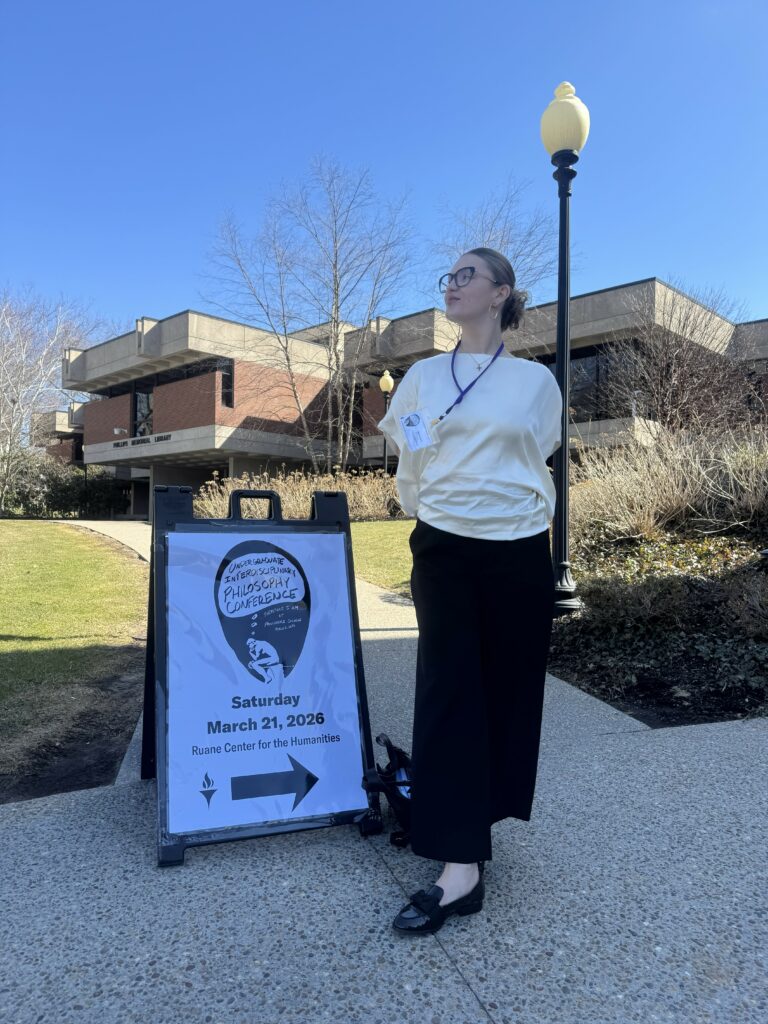
On March 21st, Providence College held its first annual Undergraduate Philosophy Conference after an extended hiatus. The event celebrates original work in undergraduate philosophy and accepted participants are invited to read and discuss their papers. Among those accepted was Bennington senior Bianca Burz.
The day started early with a complimentary breakfast in the Great Hall of the humanities building. Precocious undergrads piled into the immense room in their finest dress with parents and mentors in tow. Most had traveled from across the East Coast, with a handful coming from farther afield—we encountered one student from California. Demeanors ranged from jittery anticipation to the easy composure of seasoned presenters ready to take the stage. Everyone sipped orange juice and ate tinfoil-wrapped breakfast sandwiches that bled American cheese. Students spoke in exuberant tones about the next event, a keynote address from John Russon.
After some celebratory group photos, the conferencegoers were ushered into a lecture hall two doors down. John Russon, Distinguished Presidential Professor and Research Leadership Chair at the University of Guelph, directed his opening remarks to the encouragement of the young scholars in the room. Russon then moved into the bulk of his address, a talk on the treatment of anger in Plato’s Republic. “Nothing taught by force stays in the soul,” he argues. The room was congested with suit-jacketed philosophers and Providence College students who, the day revealed, were there for extra credit.
Providence College is a private Catholic university, which became apparent during the keynote when a priest in full regalia entered the room, regarding the students. He appeared to be an almost anachronistic apparition, floating through the fluorescently lit aisles, past Gap backpacks, while Russon pressed on with the Plato.
After the keynote, conference goers were turned loose, and the student talks began. The conference was arranged in four time blocks of about an hour each, with multiple lectures happening simultaneously during each block. Attendees stood in the halls under the oil paintings and crucifixes, deliberating over which talk was most compelling. Undergrads presented papers on Christ’s resurrection, digital panopticons, and numerous interpretations of Nietzsche. Bianca’s talk was slotted into the third time block, right after the lunch break.
Bianca and her small Bennington entourage exited the humanities building to make our way to the Providence College dining hall. It was an unseasonably sunny Saturday, the second day of spring, and as we made our way across the Catholic school campus, we were confronted with a green mass of raucous students. It was St. Patrick’s Day weekend, and the campus was celebrating.
Waves of party-goers flowed out of dorm buildings, moving from one location to another in massive units like decadent schools of fish. Students wore Ray-Bans and Celtics jerseys or otherwise didn’t wear shirts at all. Almost everyone was clutching a pea green borg. We made an attempt to recruit the stragglers of this crowd to come to Bianca’s talk, though it was a hard sell.
The procession from the philosophy conference moved through the middle of this scene, kitten heels clacking. Our group began to feel a feverish glee at the polarity of the campus that day. The Rhode Island sun was beating down, and outside of the lecture halls the world was drunk and blithe. We took this to be an auspicious omen for the success of Bianca’s approaching talk.
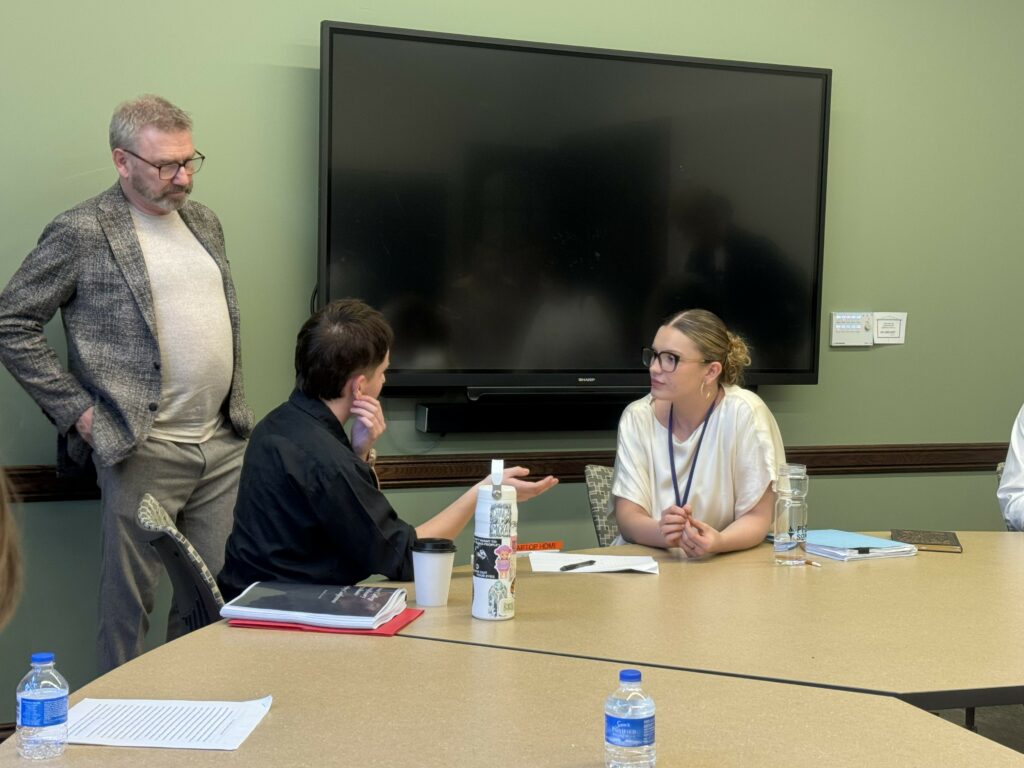
After lunch in the college’s impressively large dining hall, we returned to the humanities building for Bianca’s talk. The room quickly filled past capacity with both undergraduates and esteemed professors. Her paper “Love, Attention, and the Limits of the Will” addressed the problem of how to love well. “If love is the realization that there is a reality outside of you, then a ‘loving gaze’ is really one that embraces this realization, a continuous attempt to see the world as it is,” she spoke. The subsequent Q&A was lively on the part of the audience. The topic being “on love” personally implicated everyone in the room who had their own conception of it. Listeners used the Q&A to square their own ideas about loving well against Bianca’s philosophy.
After her time was up, both inquisitive students and professors lingered, including the conference organizer Peter Costello and keynote speaker John Russon.
At the end of the day, we found ourselves in a conversation with Peter Costello. We spoke about humanities and pedagogy. He commended Bianca on her talk and Bennington for their guidance. We joked about St. Patrick’s Day and the just-passed Ides of March. We seem to be, Costello said, living in a perennial Ides of March. That this was the first conference after a long hiatus lent it a certain weight. In a time that feels perpetually on the brink, the conference’s return offered at least the small reassurance of continued conversation.








Be First to Comment