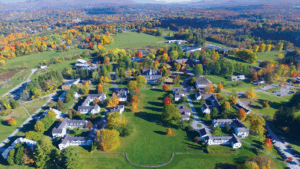
The arrival of fall at Bennington doesn’t just beckon us to pull out our thickest sweaters from the back of our closets or feed our habit of meticulously checking the weather app before heading out for the day. Rather, it’s also an annual call to leaf peepers everywhere to road trip down historic Route 7A and take in the fall foliage in its various hues. Students on campus will no doubt begin to notice the appearance of families, dog-walkers, and the general populace dropping in for a quick stroll around the school grounds, perhaps stop at the End of the World for a quick picture, and collect a few leaves as souvenirs.
While we see the impact of fall tourism by running into the occasional unfamiliar face on our way to class, the town of Bennington and the surrounding areas of Shaftsbury and Manchester feel the impact much more intensely. The term leaf peeping itself first appeared in print in the Bennington Banner around the mid-60’s. Even before then, native Vermonters understood that a drop in temperature meant the official arrival of tourists into town.
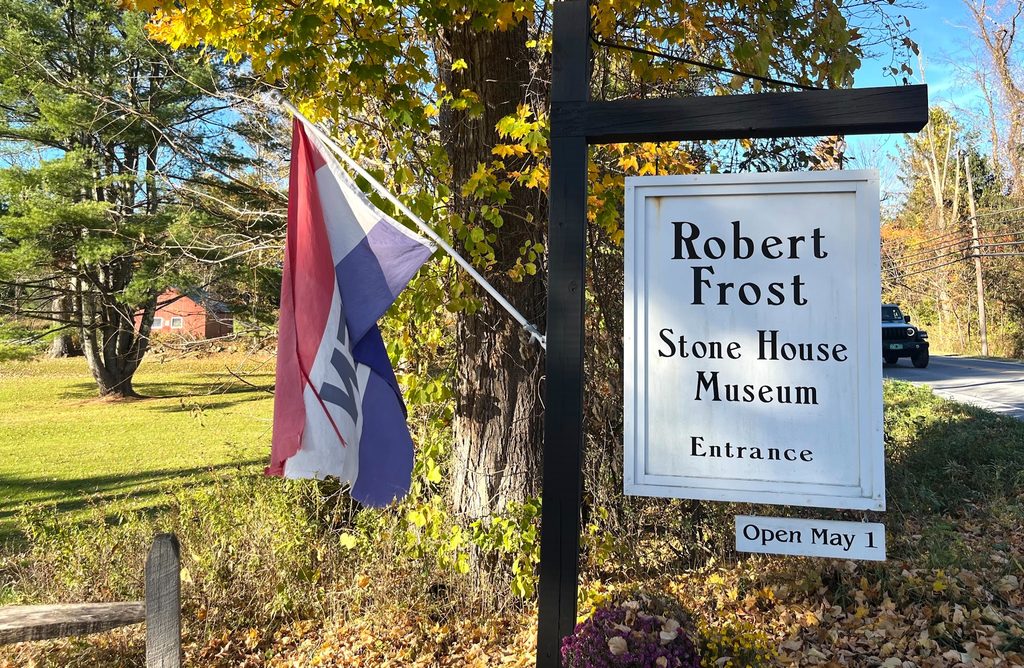
For local business and community organizations, it signals a major transition into the busy season. In a conversation with the Director of the Robert Frost Stone House Museum located in Shaftsbury, Vermont, Erin McKenny shared that the museum sees over 3 timesx the normal amount of traffic in the autumn months compared to the summer. The line for admission goes past the doors, and parking spots are filled shortly after opening. The influx of visitors greatly benefits not only the museum but the surrounding businesses as, according to McKenny, they work together, adopting an almost symbiotic relationship through word-of-mouth advertisement. “It’s great…” said McKenny, “we certainly try to also connect people visiting with other places that are local, whether it’s a museum or they want a restaurant, advice or recommendations… I think it’s really important.”
It is no secret that Vermont tourism plays a huge role in the state’s economy. The most recent Vermont Tourism Economic Impact report notes that over 16 million people visited the state in 2024, spending over $4.2 billion on lodging, food, entertainment, and more. Just recently, in July 2026, Vermont’s Agency of Commerce and Community Development launched its first tourism-dedicated brand, “State of Inspiration,” to promote Vermont “to a global audience.”
While state leaders describe the $275,000 spent on the project as a small investment for its projected return, for many Vermont residents it continues to augment lingering concerns on where the state’s priorities lie.
“I think that the state really caters to people outside the state and fails to provide for the people in the state,” said Manchester local Kate, voicing their opinion on the new campaign. As a longtime resident, they expressed their frustration with tourists who disrespect the natural environment in their quest to memorialize their trip, recounting instances of people yanking leaves off trees to take with them across state lines. Kate also expressed the heightened difficulty in managing rural roads as traffic jams become increasingly common in the fall season. “It is chaos…There are people walking in the middle of the road, and they don’t know where they’re walking, and they’re crossing in places where they really shouldn’t, and it’s unsafe. People are pulled over on the sides of roads at random places.”
Vermonters find that the discussion on tourism needs to pivot to addressing the question on how to find a balance between facilitating economic growth with community-well being. For businesses in Bennington County, finding this balance between catering to out-of-state visitors while engaging with local residents has facilitated enduring collaborations. For Erin McKenny, fall serves as a great way to bring two important populations together. “We do want to encourage people to come to the museum, we want to take advantage of having folk in the region… Summer gets, in some ways, a little trickier, at least locally. They [locals] tend to be leaving more, whereas we tend to get more local [residents] and visitors in the fall, which is great.”
In the past, this collaboration has taken the form of a sticker program, offering discounted entry to those who present their old admission stickers as evidence of their patronage at historic and cultural sites in and around Bennington. In gift shops, it materializes as art prints and books for sale produced by local artists or writers. Not only does this contribute to Vermont’s well-established tourism industry, but simultaneously alleviates an economic strain felt by in-state residents that see an inflation on prices due to high-seasonal demands in the fall.
“Everyone should participate in tourism, it is good to get into different areas and talk to different people and everything. But you gotta be respectful,” Kate succinctly summarized.
As the peak fall colors on trees begin to fade, and the traffic on Route 7A shrinks to welcome in the winter, Bennington County and its residents will continue to sort out the challenges that come with living in a state shaped by its appeal as a travel destination, without exhausting the people who call it home.






Be First to Comment