This article was published in collaboration with Williams College’s student newspaper The Williams Record. Read their article about a Williams student’s experience at Bennington College here.

Last week, The Bennington Lens took a trip to Williamstown, Massachusetts, to explore the historic Williams College. For a day, I lived the life of a Williams College student and observed the dynamics of campus life, classes, and resources the college has to offer. Last Friday, I shadowed Dalia Levanon, an English and psychology student at Williams College, as she visited her favorite campus spots; I also sat in on her classes and discussed campus culture with other students.
On the half-hour car ride to Williamstown, I sat discussing cultural and academic differences between the schools with Levanon, a student writer and editor at The Williams Record. We shared stories about each other’s schools and the history that links them together. She mentioned that a Williams alum told her a story about dating a Bennington girl back in the 70s: in short, he asked out a Bennington girl, and despite thinking Williams guys were stiff, she agreed to go out with him. When he arrived on the Bennington College campus, he was surprised to see a body painting date set up for the two of them.
Levanon also spoke on the persisting “rivalry” between Williams and Amherst College. In 1821, the former president of Williams College, Zephaniah Swift Moore, left Williams with 15 students and a portion of the library to start the institution now known as Amherst College. “One of the presidents at Williams decided that they wanted to build a school that was not in the middle of nowhere, so they decided on Amherst. They took half of Williams’ student body and half of our library and went to Amherst, where they built a school. So they built Amherst College! That’s why we’re rivals; it’s a funny rivalry,” she said.

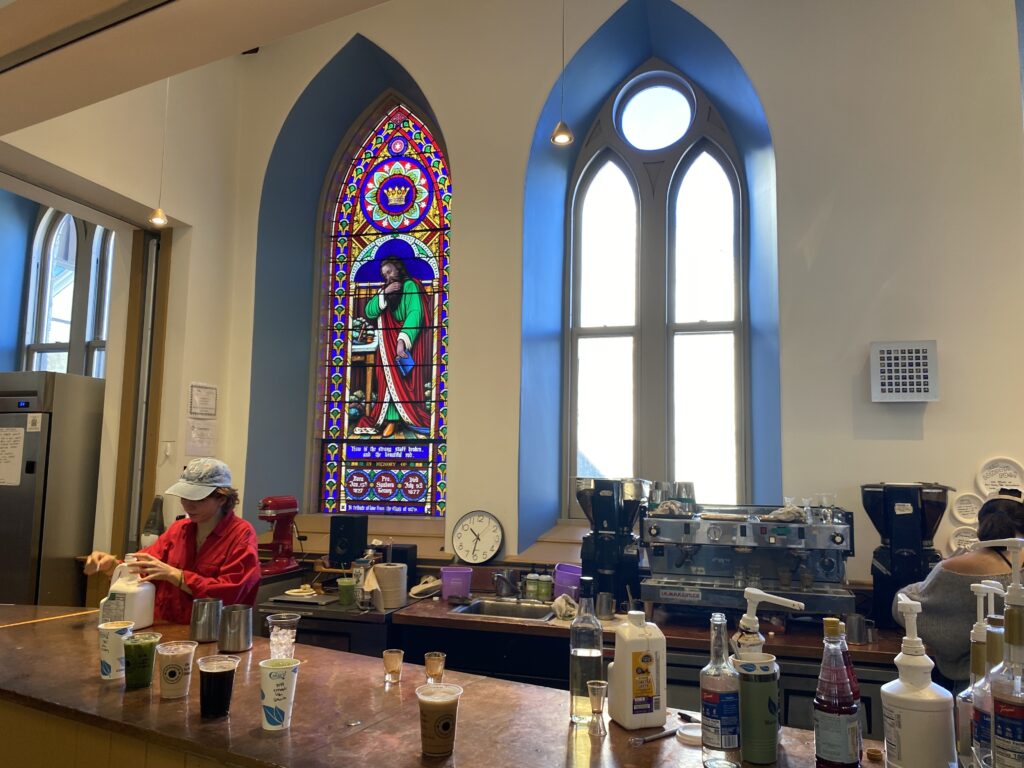
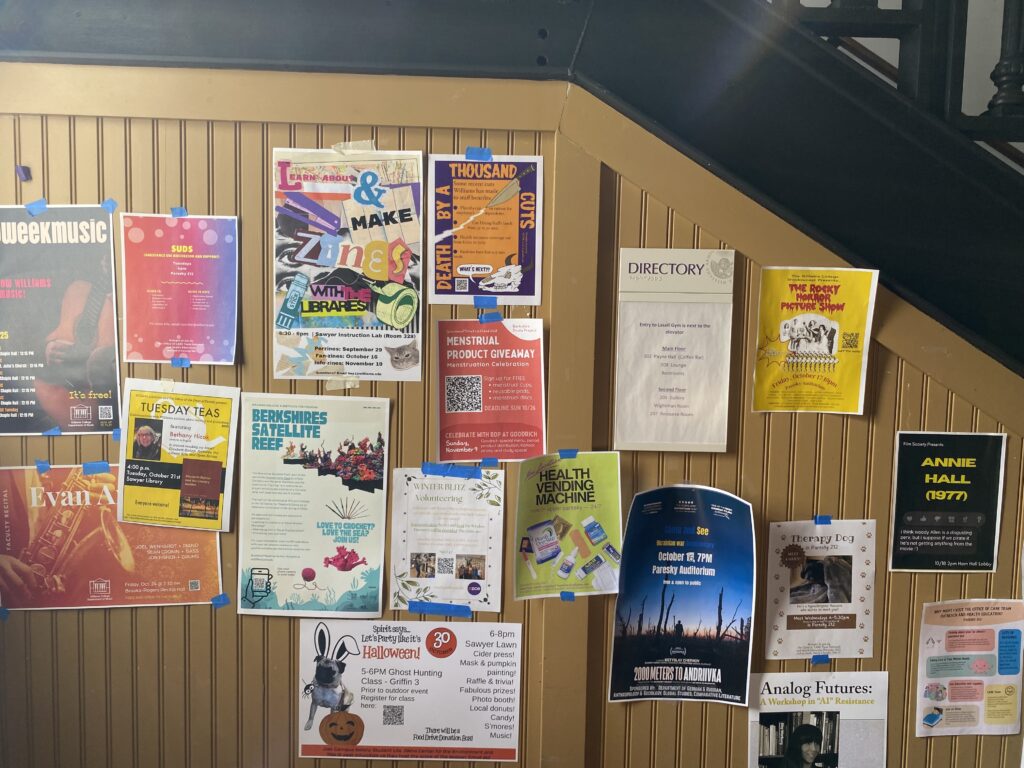
Around 10:00 a.m., we arrived on campus, where I was given a quick tour and began familiarizing myself with various buildings and campus spaces. Our first stop was Goodrich Coffee Bar, one of three cafe and lounge locations on campus. This spot was particularly interesting because of its ecclesiastical architecture. Converted from an old church, the coffee bar still holds remnants of its past, including stained glass windows and old oak staircases circulating through the building. This establishment is completely student-organized and run, its staff being composed of all working Williams students. Goodrich Hall also hosts many student events, including theater performances and comedy shows, and is a weekly meeting spot for clubs.
After breakfast at Goodrich Coffee Bar, we headed to Levanon’s first class of the day: Experimentation in Statistics. According to Levanon, every psychology major at Williams is required to take a statistics class. This class demonstrated the functionality of statistics in daily life and how to implement it in decision-making. As someone who hasn’t taken statistics since high school, I found it very interesting and left wanting more context to understand all the material.
Around 12:00, Levanon and I picked up lunch at the main dining hall on campus, Whitman’s Dining Hall in the Paresky Center. Friday was burger day, which is a Bennington Monday tradition. We dined in the upstairs seating area, where I became familiar with more of Williams’ student body, some of whom were staff members on The Williams Record and competed on the college’s ultimate frisbee team.
Next was an English literature course titled The Nature of Nature, taught by Shawn J. Rosenheim. Roughly 20 students attended this class, and all students participated actively in discussion.
Discussing Richard Prum’s book The Evolution of Beauty: How Darwin’s Forgotten Theory of Mate Choices Shapes the Animal World—and Us, the class bantered about his argument, whichclaims that beauty and desire are co-evolving forces in nature, and that animals have subjective experiences and possibly aesthetic appreciation similar to humans.
Students discussed whether animals can perceive beauty or act for reasons beyond survival or reproduction. Then, eighteenth-century philosopher Immanuel Kant’s concept of “purposiveness without purpose” was introduced, contrasting utilitarian survival behaviors with aesthetic or self-fulfilling ones. Additionally, the class discussed how neo-Darwinism can be strict and resistant to theories like aesthetic evolution because it complicates “clean” models of natural selection.
Later in the discussion, the class discussed dogfighting, horse racing, greyhound racing, and gladiator fights. They questioned whether human entertainment at the expense of animal pain reflects superiority and control. Some students raised the idea of telos (the philosophical concept of an animal’s natural purpose) and asked whether it’s moral to prevent animals from doing what they’re bred to do if it causes them distress. “In a lot of cases, those dog breeds are bred for aggression. For the interest of the animal, we should be for dogfights theoretically, but we aren’t—the majority of people don’t like seeing that animal in pain or seeing that animal brutally fight to the death, when that might truly be an exhilarating feeling for both the winning and the losing side,” said a student in the class.

After Rosenheim’s class, I parted ways with Levanon and began conversing with other students. On Spring Street, we met at Tunnel City Coffee and chatted about campus culture, academics, and our personal lives. Art history student Eliza Ault shared concerns about a financial and social divide between two groups of students at Williams: those who attended public high schools and those who attended private high schools. According to Ault, Williams College has a first-generation club called “First,” multiple minority coalition groups, and an international student organization, but nothing that meshes these identities together. Bonding over our working-class identities, Ault shared:, “That’s a big reason why I applied to Williams, because of the great financial aid. It’s much easier for them to give you financial aid and be generous with that.”
After talking with Williams students, I became familiar with the college’s policy on Federal Work Study; which is to say, there is none. Rather than granting a specific number of work hours per student, Williams provides a grant every term to each student, which allows them to opt out of working. This way, every student has the opportunity to get a job whenever they would like, regardless of their financial status. “I have a job, but if you’re on financial aid, they give you a personal expenses grant each semester. I think that’s really nice, because it’s not a barrier. If you need financial aid, you need financial aid. They’re not going to make you work for it,” said Ault.
After further discussion with Ault, I became curious about the class workload, as Williams is known to follow a traditional education module. The academics are rigorous, and courses require a lot of attention. “It’s suggested that they give you 10 hours outside of class per week for each class. So that definitely adds up. If you’re taking four classes, that’s 40 hours a week of work outside of class,” she said.
Something that particularly stood out to me was Williams’ “winter study.” Similar to Bennington’s Field Work Term, the college reserves a few weeks after winter break for students to complete an internship, work, travel, or take a pass/fail class relating to their academic interests. Students must complete a winter study each year they attend Williams College. Last year, Dalia Levanon worked with LIFT (Learning Intervention for Teens), a program connecting college students with teenagers in the juvenile justice system located in Pittsfield, MA.
Like Bennington, Williams College has its fair share of weekly events for students to interact with professionals in specific fields. Levanon informed me of weekly environmental discussions held on Spring Street. “Every Friday there’s something called Log Lunch, which takes place at this restaurant on Spring Street. Williams students who work at Log Lunch make a fresh vegetarian meal, and then an environmental studies speaker will come and talk about environmental justice/science.”
To wrap up my time at the college, I participated in a weekly tradition called “Forest Fridays,” where Williams faculty host a walk through Hopkins Forest. This week, retired faculty member Scott Louis accompanied us on the walk, sharing meaningful stories, relevant quotes, and information about the inhabitants of the forest. The hike was about 2 hours long, covering about 2 miles of the woods. We participated in a group meditation, lying on outdoor mats surrounding birch trees for 15 minutes. Ending my outdoor adventure, Scott Louis concluded with a Robert Frost poem titled “Birches” in reference to the forest, which hit close to my Bennington roots.
Williams College has a miraculous amount to offer to a fellow New England college student. While it’s located only 30 minutes away, Williams’ atmosphere is different from Bennington’s in several respects. I enjoyed discussing the different programs the institution has to offer, the college’s unique traditions, and its historic upbringing and architecture. From different campus fashions to larger class sizes, Williams maintains its rigorous academic reputation while incorporating sporadic acts of fun and amusement in its daily life. Going from the isolated hills of Bennington all the way to the middle of Williamstown, I can now say all of us would benefit from a trip to our neighboring colleges every so often.





Be First to Comment