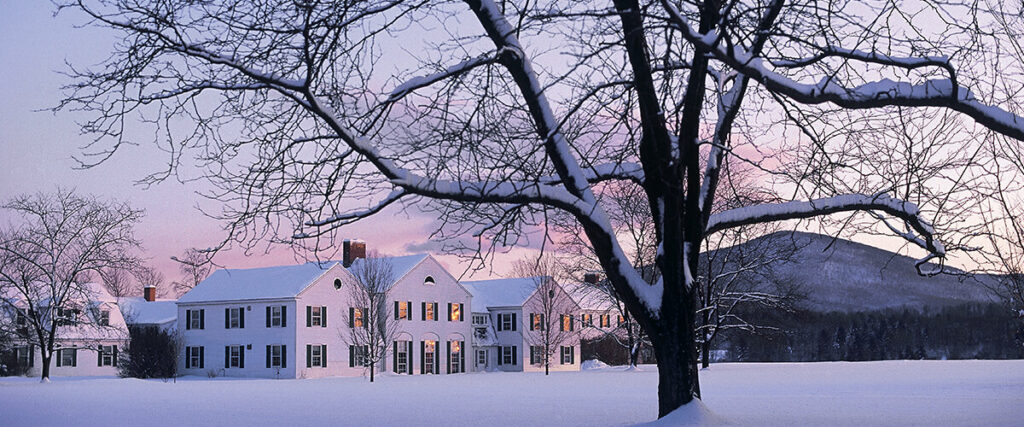
Donna Tartt’s The Secret History opens with it. A plethora of melting mountains, a white outstretching canvas, trimmed with crystalline trees; the quintessential New England landscape. It is part of the Bennington social scenery, and an important attribute to such rural schools.
This year however, despite the snow continuing its pattern of starting in slow impermanent bursts, it has yet to stick. Only accumulated in fast fading patches, icebergs amongst the evergreen, leaving February and March of the new term to resemble the mud seasons of spring and fall. In recent years this pattern has become increasingly prolific, fueled by anthropogenic climate change; even the snow packs of five years ago are dwarfed by those of decades past.
Historically the flurries have started in October, the first flakes twirling down from the sky onto campus, prompting an informal celebration of sorts. Students peering out of classroom windows, and making messy snow creatures, too immature to yet call men. By December, it is here to stay and continues into late March.
“Compared with today, there was just a sense of consistency,” says J Blackwell, a faculty member and class of ‘95 alumni. “You understood that time was passing because the seasons came and went.”
In Vermont, snow is critical to maintaining local ecosystems. During the colder months, it serves as an insulation layer for the soil biome, meaning that the current freeze-thaw cycle creates a much colder environment for the microbes, roots, and small mammals that reside beneath the surface. Caitlin McDonough-MacKenzie, a current faculty member whose research pertains to plant ecology and climate change, notes that these extreme changes can damage root systems, making them more susceptible to disease.
Beyond just relevance in annual events such as maple sugarings, snow is cultural. Weather impacts the on-campus community, whether through extreme events like power outages which mandate resourcefulness, or regular sunny day picnics and chances to study outside. In the case of snow, according to third-year student Max Weiss, outdoor activities such as sledding, snowman and igloo building help provide students with opportunities to interact outside of their normal social circles.
“I definitely do miss the camaraderie that usually comes with it,” says Weiss, who observes that underclassmen tend to rely more on social media platforms like Jodel as means of interaction. “[First years] definitely have different ways of building that camaraderie. I don’t want to be like, back in my day, but then it actually was a relatively common practice to see people sitting on the lawn with their blankets or building snowmen and going up to them saying, ‘Hey, can I help? Hey, can I join you? Hey, this looks like fun.’ And then all of a sudden you have new friends.”
According to the weather, light snow is predicted for Monday, March 11th though it is doubtful that it will stick. It is also common enough to experience snow storms late in the season.
“We need to remember that climate change includes having a frost after trees have started to leaf out,” says Mcdonough-Mackenzie. “We had that last year with apples in Vermont and many apple orchards lost their crops, because the apple blossoms froze.”
In the long term, this is unlikely to be the last we see of cold winters. Rather it is likely to cause extreme fluctuations and increasing weather inconsistency. As a result, places like Vermont will see increased events in flooding, heat waves and sudden cold snaps to an extent much physical and cultural infrastructure has yet to adapt. Less Bennington students will experience the campus winter wonderland once memorialized by generations before.




Be First to Comment