“We’re holding these jars of maple syrup that we watched come out of the tree, and we boiled; we got to see the whole process from the beginning to the end.” – Ethan Laird (third year student)

It is a late Saturday morning and you are rushing out the door to make it to brunch before it closes. You put on your shoes and run across Commons lawn to be met with eggs, french toast, and maple syrup. You ladle yourself some syrup and go about your day but wonder, where does maple syrup come from? That is what a selective group of Bennington students set out to explore this term.
This term a tutorial was offered to explore the production of maple syrup. Ethan Laird, a member of the Maple Sugaring Tutorial, shares his perspective: “The tutorial is really an opportunity to take advantage of the maple sugar bush that we have on campus. It’s out in the forest behind Jennings, and it’s been tapped for decades.”
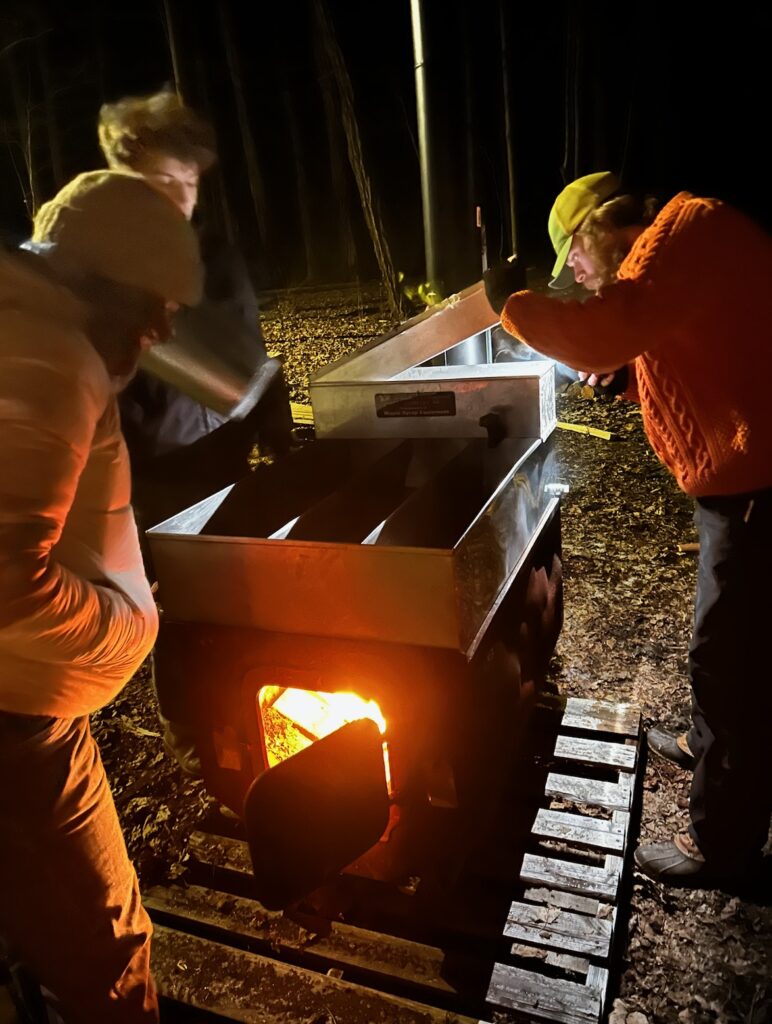
The three-step process of maple sugaring is time consuming, and requires full attention for days on end. In the initial stage, the pure sap is collected through the tapping of the trees. As Ethan explains, a spigot is hammered into the tree on the side that gets the most sunlight, and a bucket is hung from the tap to collect the dripping sap. Next comes the first stage of the boiling process.
“It takes forty gallons of sap to make one gallon of syrup, which is pretty intense, which is why one session of boiling, of refining the sap, takes about nine to ten hours or so,” Ethan says.
The boiling process would begin late at night and last well into the following morning. Groups of students take turns in shifts so the others can sleep in set up tents, while some students consistently tend to the fire, and others add sap. While the process is long and seems daunting thanks to long hours and cold temperatures, students found ways to enjoy themselves. Many brought guitars and other instruments to gather around a fire and sing to keep them preoccupied on these frigid February nights. Alex Libby, another student in the tutorial, explains to us that the tutorial will be holding a taste test at the Science Workshop, to discuss the difference between the college-made maple syrup and store bought syrup.
Caitlin McDonough MacKenzie, the faculty member leading this tutorial, spoke on the long term goals for the tutorial: “What kind of research we can be involved in, how we can support local food ways; what other colleges are doing that offer similar types of maple sugaring programs and maybe kind of tapping into longer term projects since this seems like something students are going to want to do for a long time.” She also touched on global issues and how interesting it would be to follow the effect they have on maple sugaring: “How can we build up a data set of what we’re doing, what we see on the landscape, and how we’re watching climate change impact our sugar bush right here.”
Students also are taught aspects of history that go into the production of maple sugaring and the roots of maple syrup. Alex explains: “It has indigenous roots and has been a part of their cultures for a long time. It has continued to the modern day. I really enjoyed learning about that connection from the past and the techniques that have been used in the past to do it.” Ethan touches on this as well, “A part of also learning the history of maple syrup is recognizing there’s a really large, colonial part of that, of this process: the image that people have when it comes to making maple syrup is this burly, white lumberjack guy holding tin buckets and it’s just important to note that we found out about how to make maple syrup through indigenous practices. This was something that they’d been doing for, for years and years and years”.
As they come to the end of the tutorial, students can make a piece of french toast and sappily reminisce about the late nights tucked away in the forest behind the Jennings building making maple syrup.


Be First to Comment