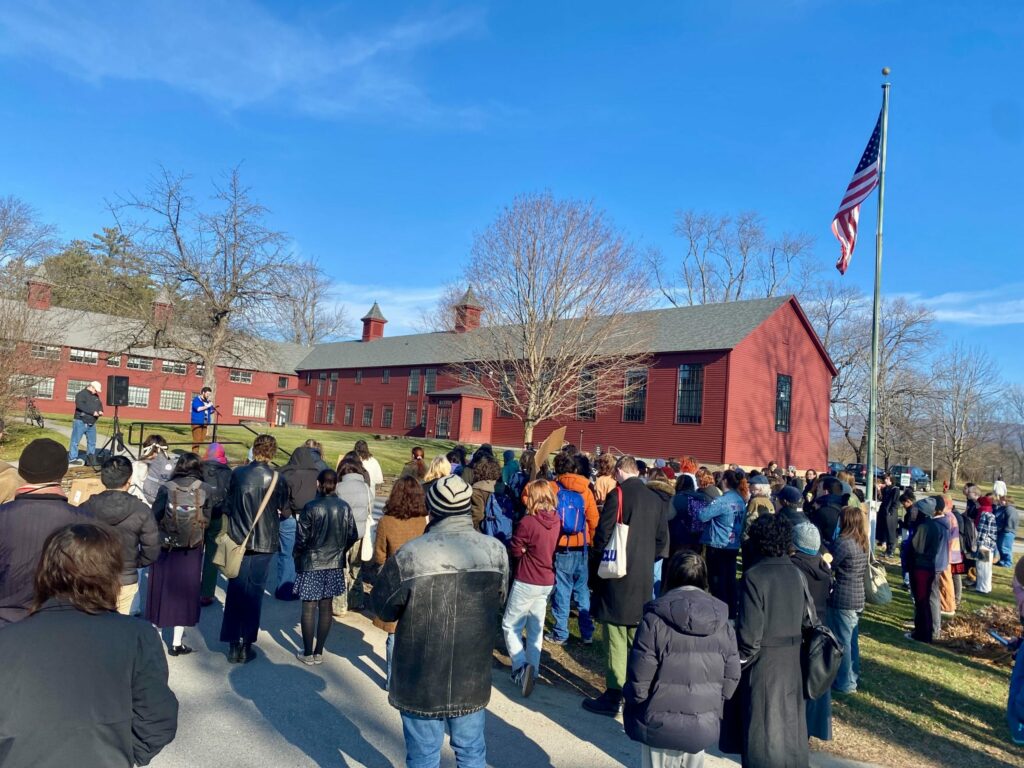
In the Spring 2023 semester, house chairs employed by Bennington College began the organizing process which would lead to full unionization. More recently, the now-recognized House Chairs Union (HCU) has begun the process of renegotiating the house chairs’ contract.
The unionization process began in the spring in large part due to dissatisfaction among the house chairs with the manner in which the administration responded to a series of tragedies affecting campus. Feeling that they had not been given the support they needed, several house chairs came together to call for new policies encouraging support, and to alter the terms of house chairs’ compensation.
According to union president Nat Frederickson, the way that the College attempted to support the house chairs that semester was lackluster at best. While house chairs were struggling to process the events of the spring semester, they were still required to offer support to other students and to continue fulfilling their other responsibilities as house chairs. The dissatisfaction which those house chairs felt with this policy was a core reason for their unionizing, and stands as a keystone in their recent negotiations.
Specifically, the HCU has requested a codified policy by which the College would support house chairs in response to future traumatic events. Designed to allow house chairs the space and time required to process those events, tenets of this policy would include the option for house chairs to step away from their responsibilities for a time, the option to be replaced by a temporary house chair, and access to support services and wellness housing.
Beyond the new support policy, the union made several other requests, many regarding alterations to their compensation. These requests include an increase in salary ($2,700 per term for new house chairs, $3,500 for returning house chairs), an additional stipend equivalent to the cost of housing (currently $5,060), and hazard pay for the risks associated with in-home support and of “vicarious trauma” experienced in their capacity as chair. There is also a request for an Employee Wellness Stipend of $100 monthly for “expenses related to gym memberships, yoga classes, massages, and other wellness activities,” intended to recognize the physical and mental strain of the employment.
The final series of requests would affect the relationship between students, house chairs, and the administration. Namely, the request calls for the ability of house chairs to challenge policies enacted by the college which would affect students’ residential lives, and to enable house residents to hold a vote of no confidence for the removal of their house chairs.
These requests – made in November 2023 – were responded to by the administration on February 22, 2024. The response provided by the administration includes proposed terms for several of the house chairs’ requests and omits mention of others. Included in the proposed agreement are terms for a house chair relief period (2 weeks with pay), priority for single occupancy rooms (though not guaranteed), and a developed system of grievances and arbitration.
Several requests made in the November 2023 document were refused or ignored; for instance, while the house chairs requested that house budgets be increased to $280 – $20 per week – the proposal from the administration offered only $150. Additionally, a request by the HCU to supplement existing lawn maintenance practices by introducing “local shepherds & their herds” to campus was not responded to by the administration. The administration also did not respond to a request by the HCU which would grant the Office of Diversity, Equity, and Inclusion the right to veto any “campus policy” made by the administration.
The closest the administration came to responding to any of these requests was in Article II of their response, which clarifies the scope of the contract. This article makes it explicitly clear that the contract being negotiated pertains exclusively to the terms of employment for House Chairs, including “wages, hours, benefits, and other terms.” The article specifically excludes “all standards, policies, and procedures related to student conduct and their administration and associated procedures.” As such, policies like those requested by the HCU – those referring to the introduction of livestock and of a DEI veto – are irrelevant to the negotiations at hand.
According to Frederickson, debate about which issues are the purview of the HCU has been the subject of some debate. As this is the first organization of its kind in Bennington’s history, it is somewhat unclear what issues fall under their consideration, and which are better explored or resolved by the office of Student Life or by the existing Student Council.
Among the most pressing issues discussed by the union was that of the house chairs’ compensation. A proposal regarding compensation and salary was absent from the administration’s Feb. 22 response document, but will be provided to the union at a later date. As such, no determination can be made at this time regarding the College’s position on an increased salary or stipend for house chairs.
Beyond the specific terms of the proposal and its response, there has been some difficulty in the negotiation process in general. During our interview, Frederickson explained that it had, at times, been a struggle to convince the administration to treat house chairs as employees instead of students.
“They’ve sort of been wearing kid gloves with us,” Frederickson said.
Though both the proposal and the response include stipulations for the separation between a house chairs’ academic standing and their standing as an employee of the college, there remains an attitude among members of the union that the administration sees this negotiation process as, first and foremost, a teaching opportunity. It has seemed at times that the administration considers itself to be walking the HCU through this process as an educational experience, rather than taking them seriously as a bargaining organization.
Roadblocks like that, ultimately, are an inevitable part of this process. The union recognizes that perhaps the most important part of this negotiation process – more than any particular term or request – is that it establishes clear guidelines for future negotiations, and ensures that house chairs be treated fairly as employees of the College. These obstacles in mind, the HCU has not at all lost its motivation for this process.
“Honestly, it’s a great job,” Frederickson said, “when we’re fairly employed and compensated.”







Be First to Comment