House Chairs come together to ask for better communication from administration and higher wages.
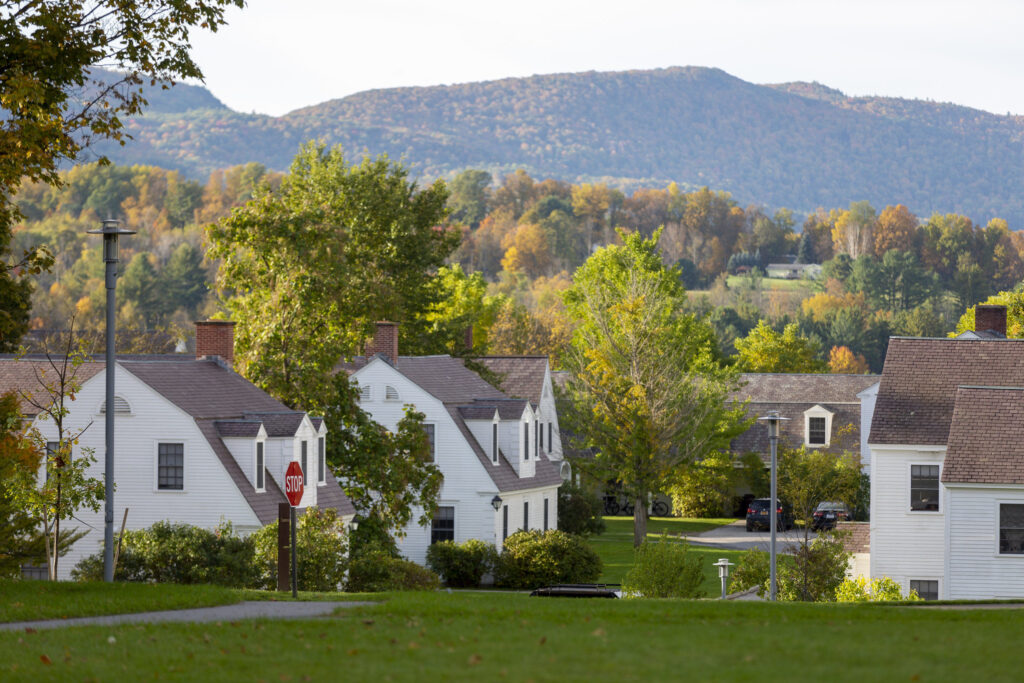
One of the College’s most popular appeals is the structure of its on-campus housing. The residential buildings are divided into four streets: the first two boast the College’s trademark colonial houses while Third and Fourth Street offer alternatively contemporary layouts. Though their cohesive architecture makes campus houses recognizable in photos spanning decades, every house community is distinct from the rest, and each is tasked with upholding their unique traditions and maintaining the house’s social conditions. Credit for these aspects of house preservation is owed to their House Chairs.
Each year, every house on campus designates two students to co-chair the house community. The role of house chair blends the responsibilities of the more traditional role of Resident Advisors, replacing the surveillance role with a larger emphasis instead on emotional support. The position of House Chair is offered as an on-campus job, but the selection process is more complex than the typical online Handshake application. Most applicants are put through an interview process with members in the Student Life office, then paired with an appropriate co-chair to complement their strengths as natural leaders. Once assigned, House Chairs are awarded with a single room in their designated house.
Students who take on the role of house chair may not realize they are stepping into a fraught tradition; historically, the battle for better pay, transparent communication with administrators, as well as clear parameters with a fair description of their responsibilities have become the scripted complaint for generations of House Chairs. Unlike the role of an RA, House Chairs still pay full room and board, and are awarded a stipend in place of hourly wages. The stipend pays for their time to complete the clearest obligations of the role: attending weekly meetings with fellow street co-chairs as well as campus-wide conferences, in addition to running coffee hour meetings within their house every Sunday. However, this modest stipend covers only six hours of work per week at minimum wage, which is an inaccurate reflection of the pressures placed on House Chairs who are often responding to situations within their 30+ member households at any hour of the day, outside of their already frequent and time-consuming meeting schedules. While many have organized to confront the shortcomings of one of the most important roles contributing to the health, safety and wellbeing of life on campus, their victories have been few and far between.
Ade Byron, a Sophomore and current Bingham House Co-Chair, estimated the average hourly pay for a House Chair, as reflected by their stipend, would be only $7 per hour, half of Vermont’s current minimum wage. Recently, with the support of signatures from over half of the current House Chairs on campus, Byron led a new charge in putting pressure on administration to be held accountable: they applied to start a Union. We spoke with Byron about their recent efforts in championing student workers’ rights at Bennington College:
“When I get upset or angry about things, my way of dealing with that is to, like, do something with that, and make something happen.” Ade met us on the indoor brick patio of VAPA. In addition to her job as a House Chair, Ade works as a DEI intern, CAPA Director’s Assistant Intern and SEPC Representative, and is running for Student Council for the upcoming school year. They study restorative justice, conflict resolution and photography – roles which inform her motivation to not only inspire, but also enact change.
Ade was not inducted into the role of House Chair through traditional means – an administrator in the Office of Student Life suggested they apply for the job after a house conflict fell into their lap. After accepting the offer, Byron noticed frequent instances of miscommunication and subsequent disregard for the House Chairs’ requests for better communication and a more explicit outline of expectations: “There was one meeting in particular, a few weeks ago. We were talking about housing and House Chairs were on a bit of a different page than Student Life. It was really frustrating because during that meeting we made all these suggestions, and then as we were walking out we heard some Student Life Administrators talking: one was like, can we make this happen? And the other was like, no absolutely not.” House Chairs are tasked with being the school’s most direct mode of contact between the student body and administration, so Ade’s distress from this interaction was directed not as much towards this individual circumstance, but rather that this stood as a symptom of the larger neglect experienced first hand by House Chairs. “Why are you pretending to listen to us when you don’t have any intention of actually making anything happen?”
Ade described experiences of having to put her own needs aside in order to fulfill the duties of being House Chair: “It’s highly emotional labor, and it takes a lot out of you.” “It’s highly emotional labor, and it takes a lot out of you.” Student residents’ needs for emotional support have increased, especially towards the end of term and with two student deaths to process within a two week period in May. The President’s Office made an announcement with the available resources to students in need of support after the tragic loss of our classmates, but the message was erroneous and provided inaccurate numbers for on-call therapists. A corrected message was sent five hours after the initial email addressing these mistakes.
As the designated point-person for directing students to campus resources, House Chairs are expected to have answers. Unfortunately, many of the school’s policies have become muddled with the rapid turnover in administrative offices, with many House Chairs having been a part of the campus community for longer than their own supervisors. The resulting deficit of resources places direct pressure on House Chairs to create community support using their own limited training. In Ade’s words, “It’s hard. It’s a hard job.”
Last spring, after receiving pressure from students for a higher wage, the newly appointed Director of Student Life announced during a full body meeting that the school’s budget meeting had provided a raise to House Chairs – which, they discovered later, would only increase their bi-weekly paycheck by $20. Ade shared a few suggestions they had presented to admin to bolster the fairness of expectations versus treatment that House Chairs receive: “We had talked to [administration] about cutting [House Chairs’] housing costs, or even just offering us a Flex-7 meal plan, and they said no to both of those. So we’re at this point where part of it is wages, yes – we believe that we deserve more for this job. But, I feel like the biggest part of it – and the House Chairs that I’ve spoken to are on the same page – is just communication.”
The suggestion to unionize followed. Ade, who previously had no experience or knowledge of the intricacies of the process, took it on as a research project:
“I keep saying, I was not sure what I was getting myself into. I didn’t know anything about unionizing at all, so I spent a few nights doing all this research – reading some articles that people had sent me. I couldn’t really navigate the National Relations Board website, so I just called them.” After the phone call, Ade understood the next step would be to choose between joining a pre-existing union, or starting their own. After speaking with organizers from other National Labor unions, Ade brought their research to the House Chairs during a shadow meeting: after collectively deciding that the amount of responsibility attached, in addition to paying dues to an established union would amount to an unsustainable expense, Ade collected signatures from well over half of students currently employed as House Chairs to start their own union. “Then you fill out a form, and serve the form and other blank forms to your employer – I gave them to Donnie Redd. Then, you can send the forms electronically to the NLRB [National Labor Relations Board]. Within 48 hours, you have to send in all of the original copies of the signatures on the petition.” Ade said once this part of the process was done, they breathed a sigh of relief. But her work was far from over. “It was just starting. There was so much more.”
“The school did hire a lawyer. I have a conference on Tuesday with this guy from the NLRB who’s, you know, not taking me seriously as a 20-year-old female bodied person – and, the school’s big corporate lawyer.” A scramble to find a lawyer to represent the House Chairs ensued. “We asked around– I asked some faculty, and one student is planning to speak with members of Migrant Justice. We had one student whose father is a union lawyer – and, we haven’t had anyone who’s been like, yes, I’ll represent you. But I’ve been in touch with a few people who have been really helpful. So, I’ve got my papers prepared for this big meeting on Tuesday.”
When asked about the decision to form an independent union over joining another, Ade emphasized the precarity of either decision: “It has its ups and downs. We don’t have the power– or, we don’t have a lawyer. Or an organizer – we have me. But I’ve been reaching out to different Union Organizers and I’ve learned that a lot of them are more than willing to help.” Ade expressed that their urgency in forming the union before the end of term was deliberate. “The other thing is that Undergrad Students Unions are very, very new. Before the Biden administration, there were only two in the entire U.S., and now it’s catching on a bit.” The Trump administration passed legislation which made it extremely difficult for undergraduate students to be considered employees. “Especially for RAs, since RAs usually don’t get paid– they’re compensated with discounted housing or meals.” This trend has changed since the Biden Administration reversed the restrictive language of this legislation. “When I started putting the work into this, there were only nine [Undergrad Student Unions] in the U.S. – and now, there’s a whole bunch.”
Ade said their only official reaction to the news from administration was the email sent out to the Bennington College Community from President Laura Walker on May 10th, commending their efforts:
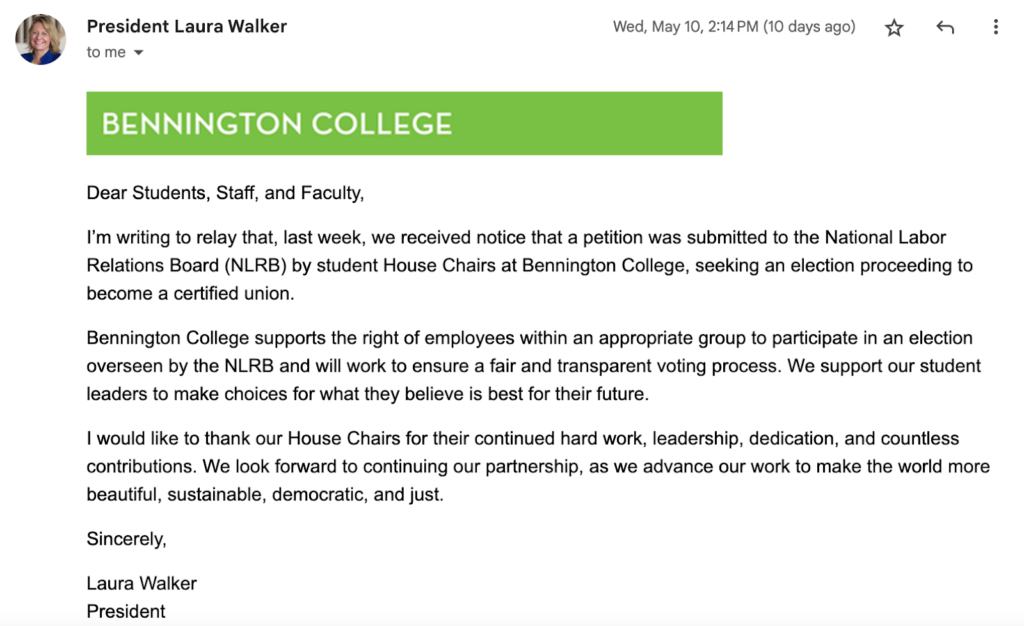
No other official communication ensued. In terms of next steps, Ade shared they are currently establishing an election date. “There will have to be at least over 50 percent of the House Chair body voting in favor of forming a union. We’ll be setting the date for that, hopefully Tuesday.” The official union election date has since been set for May 31st.
Our conversation with Ade concluded with their hopes regarding the process, and moving forward: “I hope to get this established, for one. But honestly, even if it doesn’t – it’s inspired a lot of other people and workers at the school. It’s been a learning process for me, and a lot of the other House Chairs.” A small portion of the staff at Bennington is already unionized through the Service Employees International Union (SEIU), and faculty and non-unionized staff are in active discussions to form their own union as well. One common concern among students, faculty and staff is greater transparency from the administration. “Our number one ask is just for better communication, and more say in decision making. We want to be seen as equals rather than looked down upon. And, we also don’t believe our wages are totally fair.” The work of House Chairs is essential to the continuity of Bennington’s unique house culture – put simply, the school can’t do what House Chairs are doing. “Yes, we are undergraduate students but we are also employees of the school, and we were hired by administrators because they believe we can do this job.”






Be First to Comment