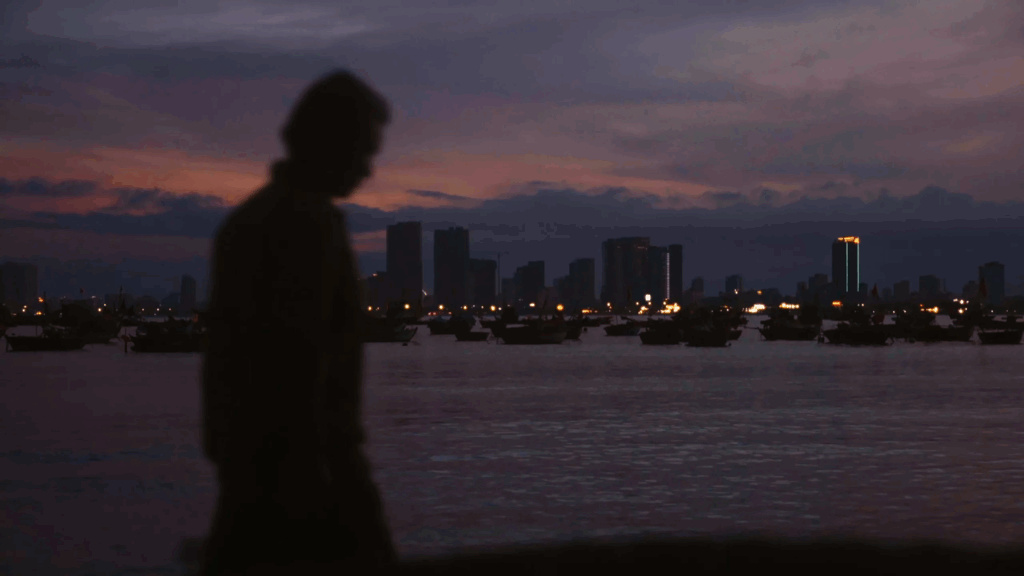
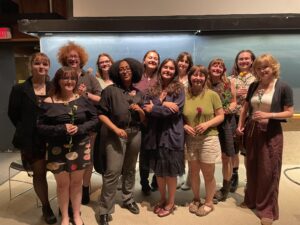
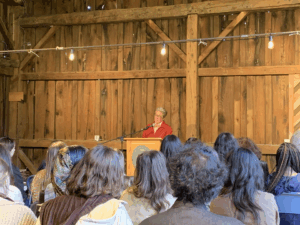
On Wednesday, March 18th, Cathy Linh Che opened the Spring 2026 Poetry at Bennington series with a question that would anchor the entire evening: What does it mean to feel real?
The night began with a screening of her short film “We Were the Scenery,” which won the Short Film Jury Award: Nonfiction at the Sundance Film Festival and was shortlisted for an Academy Award. “We Were the Scenery” is carried entirely by her parents’ voices as they recount their experiences as Vietnam War refugees and extras in Francis Ford Coppola’s 1979 film Apocalypse Now.
“We Were the Scenery” was eleven years in the making, developed in tandem with her poetry collection Becoming Ghost. The process took Che on multiple heritage trips to Vietnam and to the Philippines to visit the refugee camp her parents had fled to in the war’s aftermath. Coppola, she explained, sought out “real” Vietnamese people to appear in the film and recruited refugees from that same camp. But Che’s aim was never merely to document their exploitation. “I want to bring whole Vietnamese bodies into the room,” she said. “Not just trauma.”
The camera zooms in on her mother as she feeds the old VHS tape into their TV. The sound of static, loaded anticipation, a nostalgic whirring of a machine accepting the past. Che’s parents lounge on their floral upholstered sofa, blue light flickering across their transfixed faces, a previous version of themselves reflected in the lenses of their glasses.
What follows is not a portrait of victimhood. “My parents laugh a lot in the film,” Che noted. It’s true; the film truly wouldn’t be the same without it. “I write towards silences,” she said, “The new silence I’m working towards is addressing is the erasure of joy, and laughter, and clownishness.” Pairing laughter with language is central to her work.
One particular image kept surfacing when her parents spoke about Coppola: a mango.
“He’d bite into the skin the way you eat an apple,” her father recalls. “We peel it. We’re civilized. Vietnamese people would never,” her mother adds, in horror. This detail — Coppola wandering around set shirtless, mango juice dripping down his chin — struck Che as quietly revelatory. “Every single time I ask them about Apocalypse Now, that’s the one thing they’ll never forget,” she explained. “It’s central to their experience.”
The materialization of memory lies at the heart of Becoming Ghost. The title is not a reference to individual ghosts, Che clarified, but to “the idea of ghost as a condition — the condition of being ghosted, of being forgotten, of becoming immaterial.” Her work returns, again and again, to the question she opened the evening with: What does it mean to feel real? To exist fully — to be seen, to be present, to have one’s life affirmed?
Part of navigating these questions involved an ethical challenge: how to represent her parents’ experiences authentically in her writing. “I am uniquely situated in that my parents don’t read my poetry,” Che admitted — a freedom she holds carefully. Her approach is what she calls a “ghostly séance,” speaking in voices other than her own. “I try to approach it with a sense of looking through others’ perspectives,” she said, “and if everyone in the work is as human as I can perceive, it makes me feel like I’ve done my job.”
There are no clean answers in her work, nor should there be. Instead, Che offers a collage of moments, art, and reflection that, together, become a testimony to a larger experience — one of ghosts and embodiment, erasure and return. Both “We Were the Scenery” and Becoming Ghost resist the gravity of exploitation narratives, becoming stories of self-recognition instead: as individuals, and as part of an intricate collective. As much as they bear witness to one chapter of her parents’ lives, they are an ode to each in its entirety.
The film ends on her mother’s voice, laid over a montage of images that dissolve as quickly as they appear— grainy, filmy shots of Che as a child stumbling over herself, her siblings kicking their feet in the grass, her mother scooping her up. “When I first came to the United States, when I slept, I’d often have nightmares about the war,” her mother says. “I was scared. Now, not anymore. I think because I’m old, I’ve forgotten those memories. They’re gone.”
Then a video: her family celebrating young Cathy’s birthday. They move around her, fully realized, smiling and clapping. Not the scenery, but stars in a scene of their own. “The head can only hold so much,” her mother continues. “Maybe when new stuff enters, old stuff leaves… But you slowly forget. Now when I sleep, I don’t see it in my dreams anymore.” The screen goes black.
“We tend to think of trauma as forever,” Che said, “a life forever ruined. But that’s not true of my mom. Through storytelling, raising kids, cooking food, she’s built a whole life that has supplanted these memories. Old things leave.” She paused. “People talk about intergenerational trauma all the time, but they don’t talk about intergenerational healing. To me, that story shows that what we feel now may not be what we feel in a few years. You can change the trajectory of your life.”
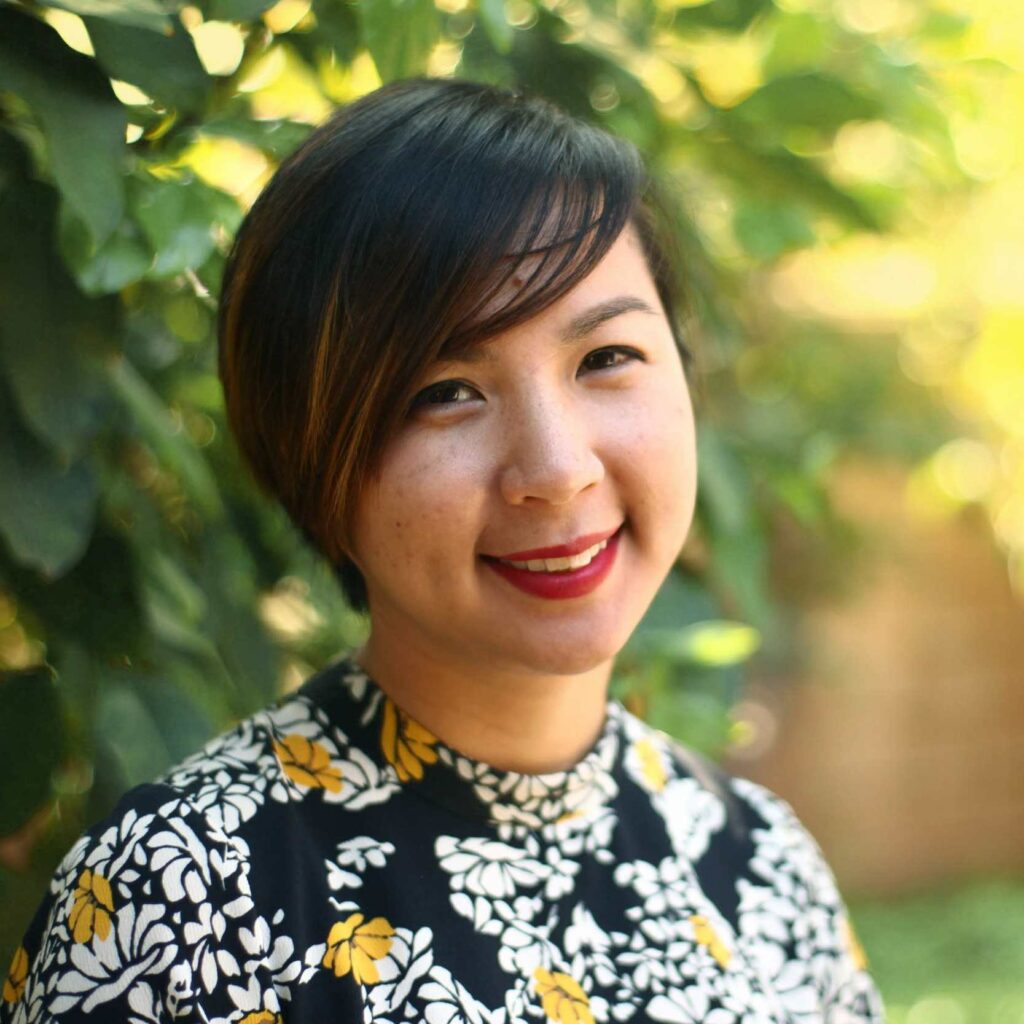
Cathy Linh Che is the daughter of Vietnam War refugees. She is the author of Becoming Ghost (Washington Square Press, 2025), a finalist for the National Book Award, winner of the APALA Asian American Poetry Award, an NPR “Books We Love” selection, and Electric Literature’s Best Poetry Collection of 2025. Her debut collection Split (Alice James Books, 2014), won the Kundiman Poetry Prize, the Poetry Society of America’s Norma Farber First Book Award, and the Association of Asian American Studies’s Best Poetry Book Award. She is also the co-author of the children’s book An Asian American A to Z: a Children’s Guide to Our History (Haymarket Books, 2023). Her film We Were the Scenery won the Short Film Jury Award for Nonfiction at the Sundance Film Festival and was shortlisted for an Academy Award. She lives in New York City, teaches in the MFA program at Antioch University in Los Angeles, and is the Executive Director of Kundiman, a national organization dedicated to the creation and cultivation of Asian American creative writing.


Be First to Comment