On Wednesday, March 25th, the third Ben Belitt Colloquium commenced. The Colloquium is a place to discuss prominent and influential writing through exploring and discussing vital literary issues that are often unexamined.
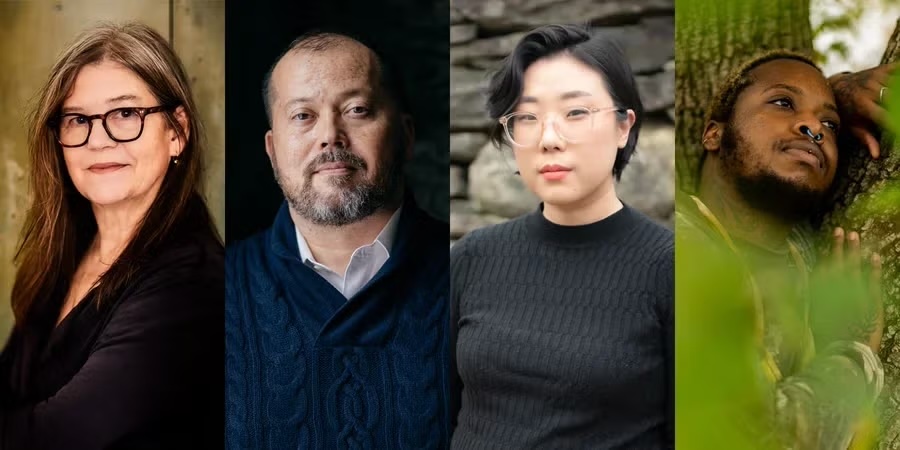
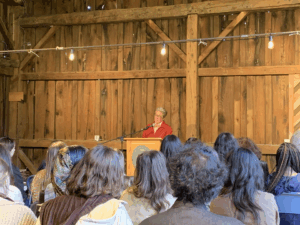
Benjamin Anastas began the grand evening by introducing the panelists: Alexander Chee, author of Revolutionary Road and editor of The Best American Essays anthology; Jo Ann Beard, 2026 Ben Belitt Distinguished Visiting Faculty and author of Festival Days, The Boys of My Youth, and In Zanesville; and Bennington literature faculty members An Duplan and Franny Choi.
The event was centered around one vital question: “How will the essay adapt to the age of digital avatars and artificial intelligence? Will the algorithm for the personal essay be a new model for another kind of being?” posed Elissa Tenny as she spoke about Ben Belitt’s history.
The panel began to explore this question by delving into their past and present with the personal essay art form. Beard started her literary career writing fiction, yet all of her short stories were truly autobiographical. She wanted to pursue an MFA at the University of Iowa’s fiction program—a classic path for fiction writers—but Beard was not accepted. Beard said that she was rejected “semester after semester after semester.” It wasn’t until the director of the program told her she was “never going to be allowed in this program” that Beard began to change her view of her writing. So, she took her autobiographical short stories and submitted them to the non-fiction writing program next time, where they were accepted. “It was like, if you wanted to come learn from them, they wanted to teach you…and they caused me, in the very first semester, to fall in love with the form of the essay,” said Beard, with a sense of finality and arrival. Beard’s journey to the personal essay mimics one that many writers go through to find their genre and the space where their writing is meant to live.
Duplan went to school for poetry and, following suit, wrote densely and more shortly. Graduate school teachers tried to get Duplan to elongate one poem in particular, which led him to try the personal essay, but he found it to be “very difficult.” Once he got it, “it was like a permanent switch” had gone off, leaving a beautiful appreciation for sentences and a mastery of the personal essay.
When asked the same question about his origins, Chee said that he “fell under the spell of an evangelist by the name of Annie Dillard.” He applied to her class at Wesleyan “like a punk,” taking the class because he wanted to be able to say that he had studied with Dillard. He got into her class, studying Best American Essays 1988, and this, combined with her teaching, taught Chee that “whatever you are writing, you should be writing personal essays”, because it’s a writer’s “survival tool.” Chee and Dillard both said that writing personal essays pays more than fiction, and is a great way to introduce yourself to an editor if you want to write freelance or on Spec. Dillard gave Chee the skills to make his way forward in the literary world.
Choi related to the core themes of Duplan’s origins, saying that she started writing personal essays “as like an exercise or something” to try and produce something different as a writer. An editor at the journal where she had previously published poems asked her to write a monthly column, and she jumped at the opportunity to learn a new genre.
Chee’s personal essay hinges on its use as a survival tool, while Beard’s Personal essay hinges on its lineage and access, while Duplan and Choi utilize the personal essay to expand further from their origins of poetry.
Yet, how does all this fit into the present and the future of the personal essay in this digital age, dominated by artificial intelligence?
Beard feels like she “hasn’t changed at all, but the world has changed around [her], and even sitting here at this panel, we find ourselves now talking about online things instead of essays.” But on the other side of that, she “believes in the form of the essay, in all its forms.” She brings up two recent examples of personal essays to emphasize the dissonance between the AI that the panel is discussing and these two essays.
Beard especially focused on Tatiana Schlossberg and her essay that appeared in the New Yorker, just five weeks before her death. Beard found this essay, exploring Schlossberg’s motherhood and cancer, to be “simple and unadorned,” and that Schlossberg “just told her story about the tragedy of what it felt like to be that human being in those circumstances, touched people in a way that many, many other pieces of writing haven’t touched.” To Beard, “the personal essay is really about a single, solitary, beautiful story in every case.”
She then brought up the op-ed essay Daryl Hannah recently wrote in the New York Times. A piece about Hannah’s portrayal within the Fx show Love Story, which has been opening up conversations about how people do have control over their own image anymore, Beard even says “Yeah. Maybe few young people saw that.” but knew that the audience would more likely have read the Hannah piece, which is interesting to see the different reach the personal essay can have, and how pop culture influences its reach as well.
Chee reflected on how AI has transformed his teaching and his life in the classroom. According to Chee, this is something that runs through his mind all the time. “Some of my colleagues, at other institutions, maybe even the one I teach at, are using AI to give students comments,” said Chee, which shows how deeply AI has infiltrated the writing world. Now, Chee is realizing he doesn’t have to just ban AI from writing papers, but also to protect students’ work, to stop students from using ChatGPT to comment on other students’ work, because of “the privacy concerns.” He wants to keep students’ work within the sacred space of the workshop.
Duplan wondered what the point was of using AI to give comments in a workshop, because a workshop, in its essence, is the sounding board and is very crucial to the development of any writing, “because we’re just alive and we’re together.”


Be First to Comment