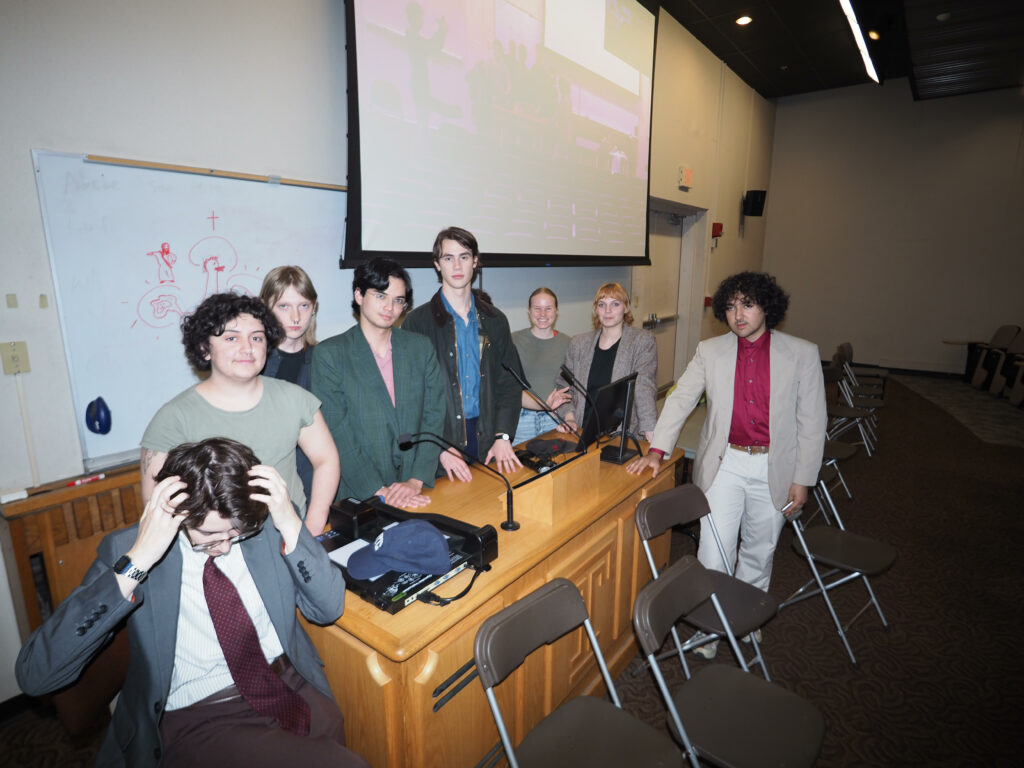
On April 26th, Bennington College’s Philosophy Club attended the 35 Annual Greater Philadelphia Philosophy Consortium Undergraduate Conference. The funds came from a grant for the SCT department, and the idea was originally suggested by philosophy professor Cathrine McKeen. Lil Montevecchi worked tirelessly to plan logistics and make sure it happened.
The conference was one day– Saturday– between two days of long bus rides where the club ran from stop to stop as our navigators proved themselves to be more than capable. On the way from Albany to Port Authority New York, the bus driver realized the air conditioning was broken. He offered us great consolation when the passengers democratically voted to push through: “I love America!” This exclamation was attentively heeded in the city of the revolution: Philadelphia. Democracy was utilized much throughout the conference, perhaps not including when we chaotically attempted to decide on a place that would accommodate all of us for dinner once we arrived in Philadelphia (apparently, we are supposed to be philosopher kings– Plato was onto nothing in this instance).
The conference was a great experience for the club to see how philosophy is taught at other schools.
“We were able to see what academic philosophy actually looks like at places besides Bennington. This was eye-opening and also quite encouraging. I think it’s easy to imagine that, because Bennington is so tiny, we are somehow worse off than our peers at bigger, more resourced schools. The conference made many of us realize that’s not the case at all. Our approach to education actually sets us up uniquely well to think critically, be self directed, create clearly written and tightly argued papers, and the like,” club chair Owen Musser reflects.
The other philosophy departments we encountered shied away from some influential thinkers integral to philosophical instruction at Bennington, such as Immanuel Kant. To use Kant as an example, many of the papers presented danced around his ideas using secondary sources. Such as Roger Lin’s article, “There for us Qua Us: Perception as Act, Art as Affordance”, which was both close to a Heideggerian assertion of art’s purpose, and circling the Kantian notion of how we engage with art.
There was a litany of philosophical discussion, but many articles and their presentations were unclear. As Musser said, “None of the presentations really stuck out to me. I enjoyed many of them, but [none] more or less than others. Some were clearer, and some were less polished, but there weren’t any standouts. Maybe my favorite was this one on neural implants, only because I thought their argument was very bad– bad in a way that I could easily articulate.”
The presentation, “Killing Patients: An Analysis of the Existence and Implications of the ‘Burden of Life'” by an undergraduate philosophy student and (as she titled herself) “future trauma surgeon” stood out due to the fact it, “baffled every attendee,” said club member Jace Foster. He went on to say that what the presentation “seemed to assert that there is a moral imperative for a doctor to consider doing some sort of ethical evaluation of every patient that they encounter to deem them worthy and unworthy of living.”
Hailey McDowell, when asked, reviewed that presentation in particular as such: “While it raised questions on the reality of medical actions, and doctors conscious of their own morality, her argument suggested superseding due process. It tried to make the argument for doctors being judge, jury, and executioner.”
Personally, as an attendee, my critique is that she tried to make an ethical imperative while evading Kant because she did not want to make it universal– which was completely confounding, as it is an oxymoron. Many approached her after the presentation to voice concerns.
The keynote speaker was Peter Baumann, professor of philosophy at Swarthmore College. In his address, he criticized the popular skeptic thought experiment Brains in a Vat. He proposed his belief that it is simply a scary story that does nothing to forward skepticism. In his opinion, the actual language of the thought experiment– “evil scientist,” for example– is used in a way to scare the thinker, and is not actually constructive. Delgado reviewed, “his message was simple and concise, it was wonderfully reassuring [to me] that maybe it doesn’t matter if we were a brain in a vat.” McDowell critiqued that “he’s correct that the brain in vat scenario is manipulative language and does not contribute anything substantial to epistemology, but he tried to conflate the invalidity to the brain in vat thought experiment to the validity of epistemological skepticism as a whole which he failed to do.” His research on the topic can be found here.
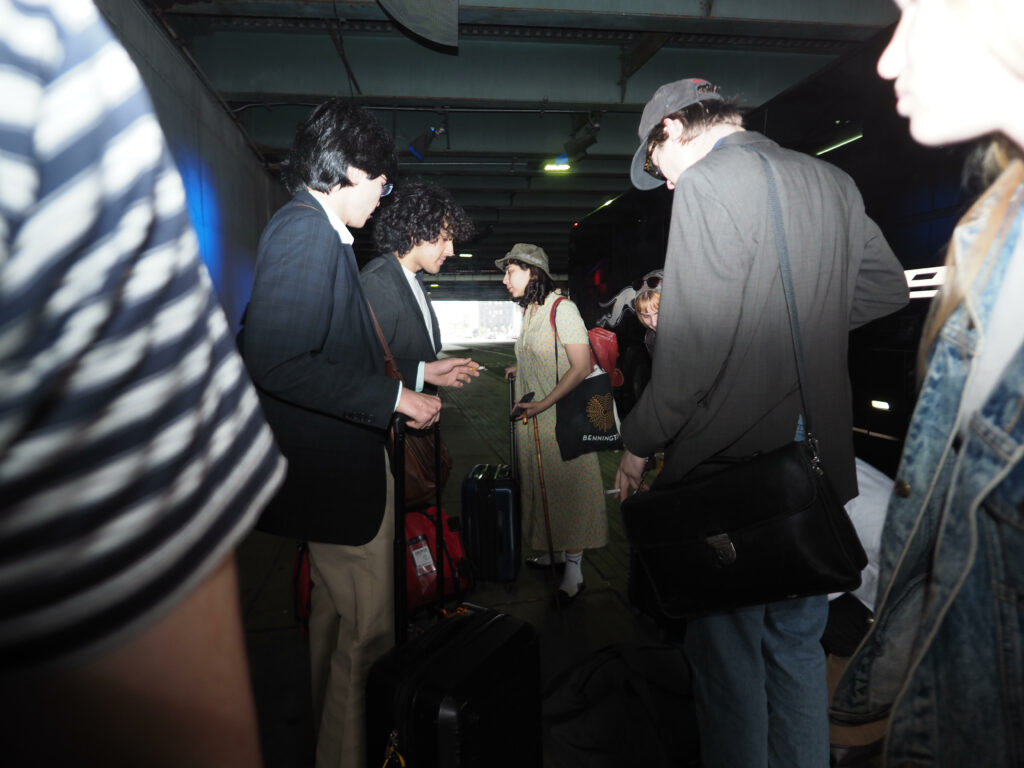
Upon walking from the conference to our accommodation, we realized something: the person who locked the door might have locked the deadbolt we did not have the keys to. After approaching our doorstep, we noticed it was blocked by a towering man with a ponytail and his dog lying down, as if gravity was concentrated ten fold in its breast. The bad omen confirmed what many of our pessimists already decided was true: we were locked out.
“Let’s go president,” the man barked. They passed by, revealing the dog’s neckerchief embroidered with Prez. We were, in fact, locked out, and the keys did not work. The already split up group split up more as myself and two other club members, Jace and Ruby, explored the city. We came to the unanimous decision that it is one of the most beautiful cities in America, and the Armenian American Muslim Associations cook out smells delicious.
Eventually the door was opened by the owner of the Airbnb, and we were no longer expelled to the streets of Fishtown. The wise and benevolent philosopher monarchs– Lil and Owen– worked out a plan to deliver Chinese food to the newly-housed exiles: the first group meal of the trip, as organization proved to be sisyphean in a democracy. Over the take-out bowls of lo ming and various vegan options, we reviewed the presentations with the harmonious agreement that Bennington’s Philosophy Department is surprisingly superior for only having two professors. Some members then retired to the basement, colloquially known as “The Fish Bowl,” for a symposium, where we came to no conclusions.
The club is thankful to the school for the opportunity. Philadelphia is a beautiful city; the people of Fishtown are lovely.










Be First to Comment