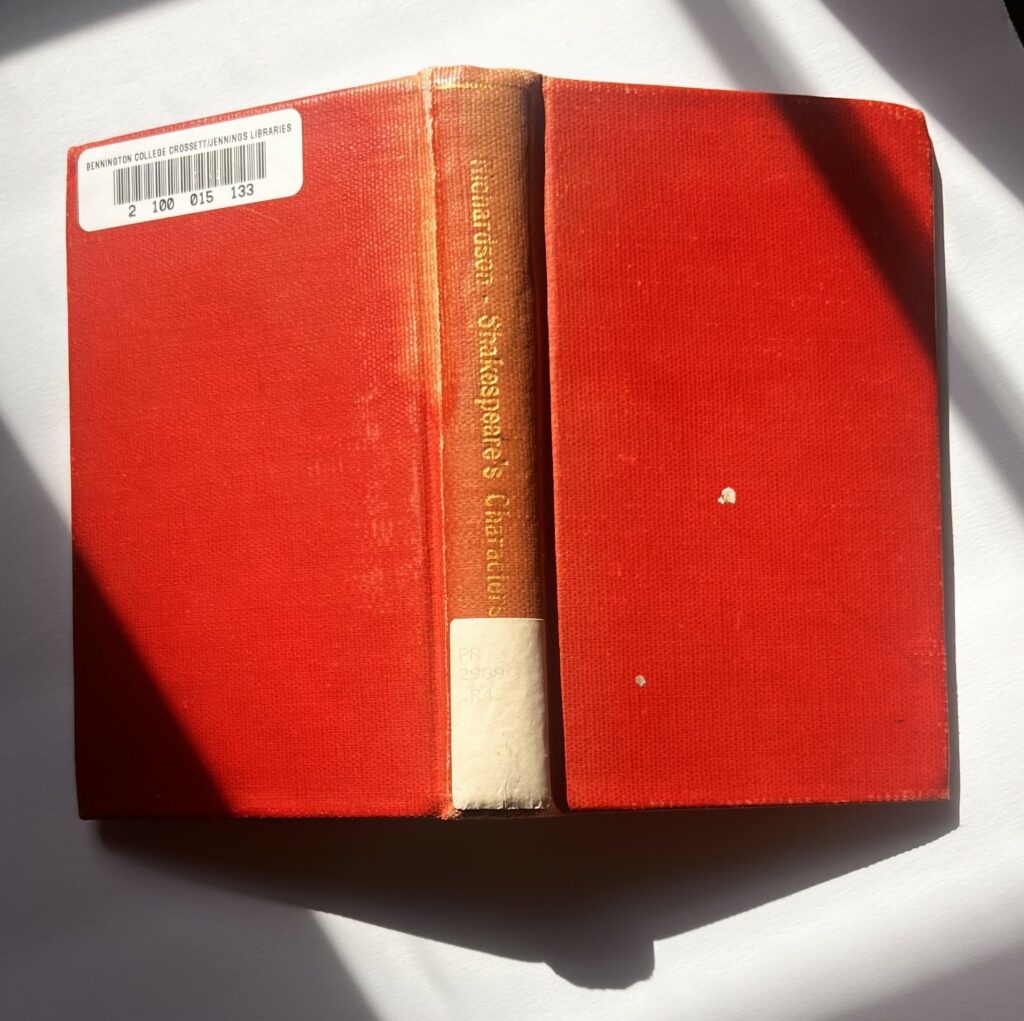
The oldest book in Crossett Library is an unassuming thing. Bound in red vinyl, holding it you would never guess its publication date of 1774. When Joe Tucker, Director of Library Access and Research—who graciously investigated my query of Crossett’s ‘oldest book’—set it in front of me on his desk, I admit I was at first confused.
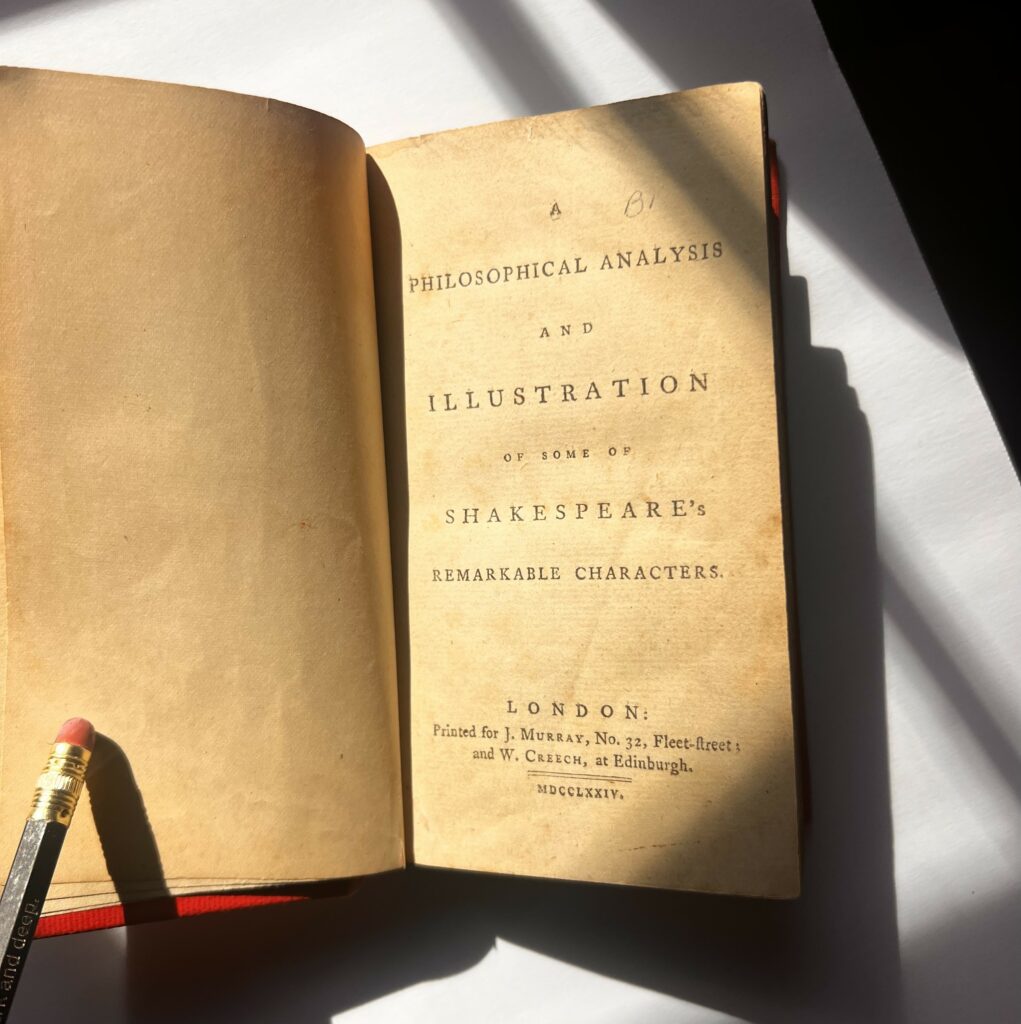
The book is pocket-sized, the cover blank; the type-face on its spine simple and leafed in gold: “Richardson – Shakespeare’s Characters”. The complete title, found a few thin pages into the book is A Philosophical Analysis and Illustration of Some of Shakespeare’s Remarkable Characters. Tucker noted that the way the spine is formatted, with the author’s name followed by an abbreviation of the full title, is an indication that the book may have been sent by the college’s library to be rebound—a practice, he explained, that the library hasn’t engaged with for several decades now.
“It’s hard to say [what year the book was rebound]…I’m guessing like the sixties, maybe the seventies,” Joe had leant back in his chair, holding the book in both hands with an unsure expression. He noted throughout the interview that it was difficult to gauge why some decisions regarding the books in their collection were made or when. The plate inside of Richardson’s exploration of Shakespeare’s characters indicates that it has been in the collection prior to the construction of Crossett Library. My first guess was that new construction and a bigger space prompted past librarians to evaluate what books in the collection needed care—but there is no way to know for certain.
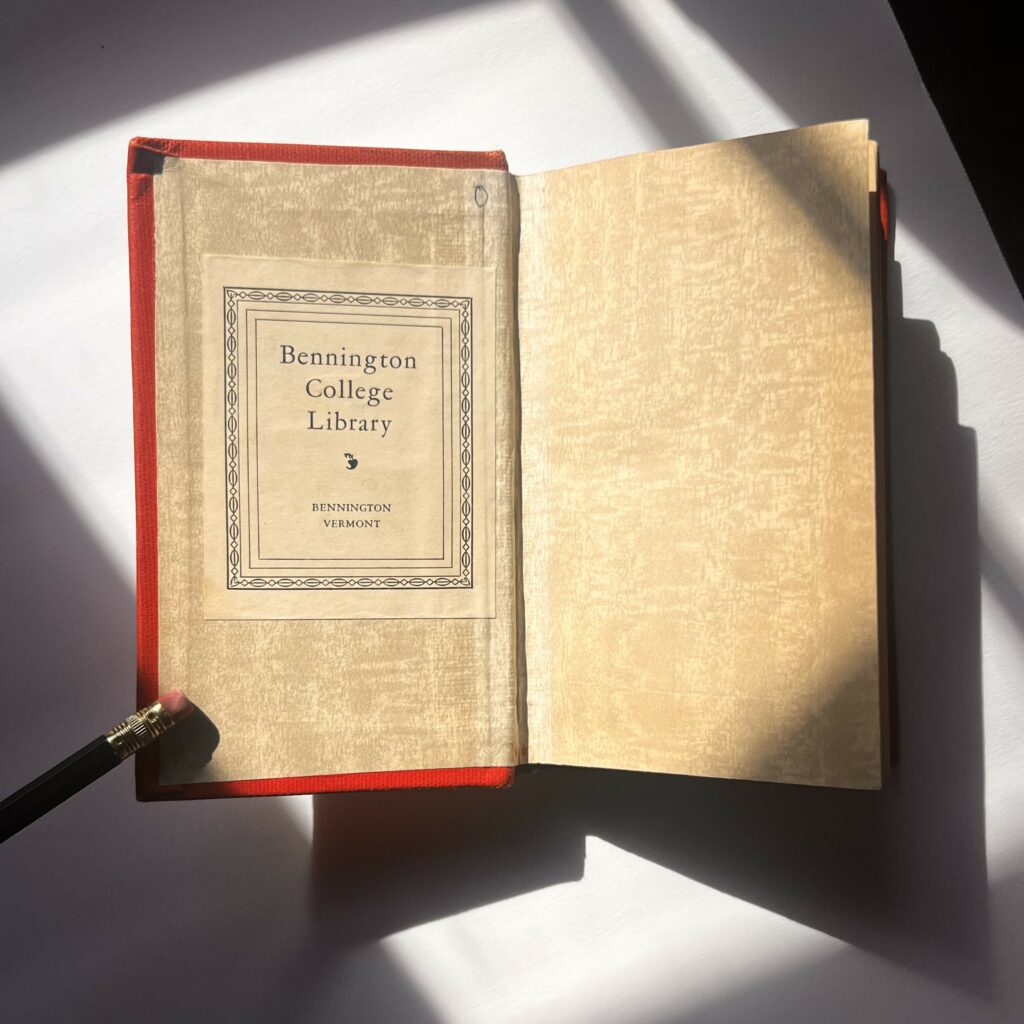
Following my conversation with Joe Tucker, we spoke with the Dean of the library, Oceania Wilson. As Dean, she is responsible for outlining the academic and social purpose of Crossett: she decides what we need, why, and how to best use the library’s resources to students’ advantage. Thus, she has a series of databases and information at her finger tips regarding each title on our shelves. She printed me a list of 34 libraries that had copies of Richardson’s text, bound and rebound at various points. Given the publication date of 1774, we were interested in what it was originally bound in. None of the libraries I reached out to have responded, yet, but through my own research, I found a copy for sale online. The one listed on AbeBooks is bound in half-calf and marbled boards. This means the spine is leather, as are the corners, but the front and back covers are a board covered in decorative paper.
One thing unique to Crossett Library is the manner in which books like Richardson’s Shakespeare’s Characters are stored. They are shelved alongside contemporary scholars, nestled into the back shelves of the oversized section or beside new prose, and require no extra contact with library staff in order to retrieve. The only books that are in a ‘restricted section’ of any sense are newer, more expensive art books (still readily available upon request). It was this lack of traditional boundaries between students and older, perhaps rarer, texts that interested me most. By allowing books like Richardson’s to be books, students can interact directly with the history of the college.
In the case of Richardson, it allows students to interact with a history beyond the college. Its print date is listed in Roman numerals, the edges of its paper peppered with now faded colorful florals, and the typeface inside slanted from the way the press likely pushed against the paper hundreds of years ago.






Be First to Comment