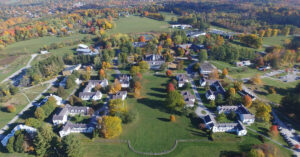
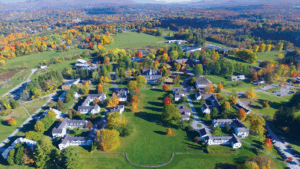
The addition of Orchard Houses and Jennings Cottage late last spring garnered much attention due to them having faculty residents at the time as well the lingering question as to what would happen to the students who moved there. When it was announced to the campus that it was mostly singles and designated senior housing, it cut off many students who were hoping to get medical singles. It was also a lottery, meaning the best rooms within the houses were taken right off the bat by the students with early lottery times, and made any other students getting up there difficult. The residents of each house moved around a lot over the summer with already affirmed student residences swapping who was in what house but with all the students settled in, this update comes at the perfect time.
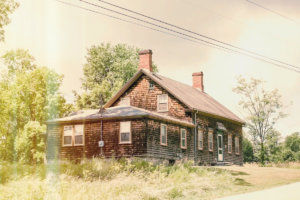
The seniors living in Orchard B and C as well as the cottage enjoy some perks like slightly larger rooms and fewer housemates. The inside of the orchard houses include a master suite with two closets and an attached bathroom. Orchard C has a single room with a half bath attached as well. This means three residents within the houses have private bathrooms. The houses do have a small shared bathroom as well and with fewer house residents the size doesn’t affect the residents much. There is a double in each of the orchard houses with the rest of the rooms being singles. The cottage has one full bath and one half, neither of which is attached to a room. This building is also one of the buildings with a room that is accessed through another room which means that you have to be comfortable with someone else walking through your living space to take those rooms. These two rooms are referred to by housing as a “suite”. The cottage also has a small front porch which is particularly useful on rainy days. The current residents of this particular house are all well acquainted with each other and get along quite well.
The houses also include a full kitchen and living room space and are furnished with a table, a couch, and two chairs. The laundry is located in a very spacious basement that the residents are using as storage and event space. The orchard houses in particular are planning events for their friends to come and spend time with them, and to be invited to these events students must be invited by residents. If you do come to hang with a friend up there, either let them know ahead of time or knock at the front door. The houses are no shoes houses during wet, cold weather to minimize tracking mud and dirt through the house which in turn limits the amount of overall cleaning the houses have to do.
The students living there have also put into place their own community guidelines, just as the rest of campus housing has. There’s no smoking in the houses, and they are currently courtesy houses. Residents can’t have more guests in their rooms than residents in the houses without checking with the rest of the residents first so as to not shock or overwhelm them. Due to living amongst faculty, the houses aren’t able to host campus wide events like parties in the houses, but small, personal events can be held in-house, and both types at the secret garden. Events that happen in house are by invite-only due to limited space with the house chair, Nat Fredrickson, having said “it sets an interesting tone for the house.” The budget for all three orchard houses and the cottage is smaller than that of the rest of the campus due to a smaller number of residents but that budget isn’t per house, it’s for all three houses. As of the moment, the administration have to decide if the orchard houses or wellness houses have to move out over the winter Field Work Term due to the increase of MFA students that have come in due to the merger. The students living up there are hoping to not have to move out and have stated they would rather it not be them. If the wellness houses are chosen, the orchard students are hoping to argue to stay with the fact their environment is so up in the air and their living situation is already rather fragile due to how new the houses are. With the decision not being in their hands, however, all they can do is hope for the best and that their voices will be heard.
The houses are not without their own issues. As this is the first year students are living in the houses, it’s also Building & Grounds’ first year interacting with the rooms. Some of the flooring is torn up in the rooms due to frequent use and the kitchens don’t have any house cookware. All of these issues are being solved — the college and B&G are doing their best to keep up. Some of the issues– such as the flooring– can’t be fixed while the students are living in the rooms, while other issues are mostly there due to demand on campus being high. Parking and grounds rules include no more than 4 cars in the driveways, no parking on the grass, and no disturbing the trees and landscaping too much as the groundskeeper for the area is very proud of the landscape they created by the houses. The residents are so far more than content to follow those guidelines.
While the student residents of the houses are settling in and creating their own rules for the space and adding their own ornaments, one must remember that in order for students to occupy the spaces, faculty members were told they had three months– if not less– to find housing. Literature faculty member Jenny Boully spoke about being notified she had to move out of her housing to make space for students. Here is how that went:
Lauren Bertinato (LB): How has your week been? Let’s start with that.
Jenny Boully (JB): Well, my week’s been a bit stressful, honestly– but I’m here, and I’m good.
LB: That’s good, at least.
JB: And I enjoy my classes, and I enjoy teaching, so.
LB: I’m happy you enjoy it here. So, I’m currently living in Orchard B, which used to be your house.
JB: Correct.
LB: How do you guys feel about getting kicked out?
JB: Well, I will say that while I myself wasn’t necessarily kicked out, I will also say that I probably wasn’t ready to leave financially, just situation-wise, and I know that other faculty members in the past have been able to extend their time here and that was never an option for me, so it was just very rushed. And trying to move out of a place and get everything settled… it takes up your whole summer. So, I am exhausted, and I had to do everything, you know, as quickly as I could with every ongoing issue also happening in real peoples lives so. I do think that faculty getting kicked out of faculty housing is a larger issue at the college because it’s a retainment issue for faculty because many faculty– whether they choose to live in town or not; even if you’re living in town it’s difficult; if you’re living out of town it’s difficult so some people, you know, choose to live elsewhere and have to commute and commuting means that they’ll have to stay overnight if they’re gonna be here two days a week, or two nights if they’re gonna be here three days a week. [W]ithout the convenience of campus housing for these types of faculty members, it’s really gonna limit who will be open to coming as a visitor and it’s gonna be limited to… it’s gonna limit retention I think, of any new full time faculty members because I will tell you, getting settled in Bennington County has been one of the most difficult… I guess, quality of life situations I’ve ever been in, right? And I’ve lived in very expensive cities like New York City and whatnot and the, the rates here are tantamount to what they would be in a major city, right? So– that said– the housing here provided a bit of a lifeline while we were able to assimilate into Bennington County, assimilate our children… and I’m just not sure how a new full time faculty member will be able to do that without the lifeline of faculty housing. So, I always thought it was so wonderful when the students would come back after summer and the new students would arrive earlier; I’d be walking my dog and welcome them to the college and say “if you ever need an emotional support animal you can just pet Totoro”, you know, and I… it was just nice. It was also nice to see families with children playing and running in the orchard and just feeling that wider sense of community, you know? Where I went to school for undergrad, we had faculty living on campus and it just really made us all feel like we were together and we were one. I remember some students having to, like, babysit someone’s toddler while they were teaching and they were happy to do that and, you know, just moments like that…I don’t know if we’ll have that sense of community anymore– that we’re all in this life together, and that we’re all learning and living in a very sacred place.
LB: Did [Bennington] give you guys any help in terms of finding places for you outside of the college, or providing any form of assistance?
JB: No. No. I’ve not ever heard of that happening. I know that with my other colleagues who were in the orchard, they were finally able to move out once they secured permanent housing, but that’s a difficult thing when there’s maybe, you know, two or three available houses in the whole year listed for sale. So, it’s like, you can live in a place that’s gonna need a lot of renovations that you won’t be able to afford and isn’t move-in ready, or you can spend $400,000 on a place that is, but what professor has that kind of money, right? Like who can afford even, like, a 5% downpayment with that, right? Maybe, you know, academic couples can, but like, people like me who, you know– single mothers [who were] always the primary breadwinner: how am I gonna do that? I’m just… I’m just worried about new faculty coming in, and [that] we’re not gonna be able to keep them.
LB: Do you think if the school moved some of their budget to new housing for the students and building newer houses on some of the land we own that’s not conservation land, would that benefit the college more than what they’re currently doing in transitioning faculty housing to student housing?
JB: I think that if they were really looking ahead like they’re always saying they are, then they will look ahead and not just at the brick wall that we’re at. First of all, those orchard houses are so run down, and I will tell you, I am still getting deductions from my paycheck because [of] the utilities. I was paying so much in oil for a house that would not heat up no matter what– those houses need to be fixed up, and they should have been fixed up for faculty as a show of respect. Now they’ve moved students into a building where they will now have to face the really cold, drafty housing but, you know, if they had fixed up those houses and invested in them over the years, we wouldn’t be looking at this dilapidation. At the same time– look into the future. Plan a student housing, a new student housing facility, that showcases all of the college’s values. Our values of diversity. Our value to the ecosystem here. We could do something imaginative, something creative, something beautiful. [Think about it:] what do students need? I know [Bennington has] this money, right, but for some reason it’s all about trying to do piecemeal grabs at “maybe this”, “maybe that”. Well, this is all here. You don’t gotta piece it together– it’s here, the fabric is here. What do you have to do with what you have? Well, you have to keep it up. I don’t believe that rearranging by way of subtractions is a way to keep the spirit of the campus intact. I just, I think this place has such a powerful and lovely zeitgeist that compels me here, right, and I think It’s worth preserving that.
LB: Moving into the orchard houses the floor of my room was screwed up– like, I got splinters in my feet walking across that flooring and I had B&G come in to take a look at it to be like “hey, this is an issue” and they said: “this is our first time working in these houses, we don’t know if we even have the proper boards to fix these floors”. Nothing in there is at all up to code, at all.
JB: Imagine children there! Luckily mine weren’t putting things in their mouths anymore, but I know infants and toddlers were raised in those houses.
LB: When you were living up in the orchard, did you ever think about students living up there at all? Or like having the community of students just around up there that would have like, applied?
JB: Well, you know, living in the orchard, I felt like I saw students all the time. We’d see the students come into the, the orchard to talk about the apple trees and pick the apples for community events and whatnot. [I]t wasn’t ever a place that I felt like, “oh, this is faculty’s,” like, “this is our turf”. I always felt like this is a community space, as it is. I never envisioned that students would be occupying those buildings. I just tended to think about all of the very talented faculty throughout history who have lived in those houses and like, thinking like “I’m living in the house that such and such poet had a mental breakdown in.” There was just something lovely about that: knowing that you’ve joined this lineage and you’re really feeling embraced by the place. I mean, I was very grateful for the time I had there. It was some of the most beautiful memories of my life in that house and living on campus. It was so special and I remember I would always tell my kids, “y’all know how lucky you are?” Like, you get to live on the Bennington College campus, just roam around and go to Roz’s, and go and play with the Deans’ kids across the way! It was just so lovely. So, yeah, it’s sad to see that go. But, that said: I love my students, and I love that I know the students are occupying my former shell. I know it has good energy, and y’all will put more good energy into that place.
LB: In terms of this upcoming winter the official announcement has gone out that the orchard houses have to move out.
JB: What?
LB: Orchard housing has to move out for the winter.
JB: Why?
LB: They want to use it for MFA housing. The MFA Program has expanded, so they want to use the orchard houses, the Jennings cottage, Welling Townhouse, most of the senior student apartments, [Welling], McCullough…
JB: I’m not… I’m not exactly sure how you move out of a dorm mid…
LB: So, for the winter term, they have houses that do this already– that they have to completely move out of their rooms for the MFA students to occupy them while they are here on campus for the winter. Now, we are against opening up the orchard housing to that because it’s so new to student occupation and because it is within faculty housing and the MFA students are known for being rowdy. But the official notice has been sent out. Do you think that that’s a good idea to implement that, or should it be done differently?
JB: Oh no, hells no! That is the worst thing I’ve heard in my life! I actually didn’t know that the students were subjected to that treatment. That is cruel. Who does that to people who are stressed after finals, who only want to go home and get under their sheets and cry and eat brownies? Who’s gonna– like, that’s terrible. Who wants that with all the stress of the end of the term? Nobody! Nobody wants that! See this is what I mean. They’re like oh we’ll fix the problem with a patch. And what does the patch do? It makes us upset and feel uncared for, discarded. The morale of students and faculty is gonna go down and you know what? This is just one stone on top of the pile and the piles gonna go crashing down. It’s not gonna stand anymore. It’s gonna be like, goodbye Bennington after a series of terrible choices and terrible ideas in the treatment of faculty and students. The wall [is] gonna crumble.
LB: It’s why we have unions.
JB: We have a union, but no progress is being made. And I don’t even have money to join the union. I cannot afford to get deductions from my paycheck. I just can’t. So, I’m screwed if I do, I’m screwed if I don’t.
LB: This immediately tells us, “okay they didn’t think it through, they didn’t inform faculty, they probably haven’t informed the faculty that are living up in the orchard about this”. The students were barely informed, we didn’t know what would be required of us, we didn’t know how much we had to move out, we were just told, you need to move out completely.
JB: Okay so, here’s the thing right: the eyeballs get big when they see money. And they’re like, “oh well, we have to make room because we got a bumper crop of students”, or whatever it is, right. “So, let’s just take them all cause, you know, the eyeballs are so big for the dollar signs”. But you know what always collapses a college? When they don’t think about the right size, and you only see the dollar signs. And you know, I taught in the MFA program. I came here for residencies as a faculty member, and there was designated faculty housing that was already in use for commuter faculty. Like, nobody had to move out. Do you know what I mean? So, I’m just not sure how any of this can be good. Because it’s only about procedures and dollars and not about the human that these decisions impact. It’s almost as if we’re objects to be moved around and not living breathing creatures that are already so stressed because is there any other way to be here? We’re so intense about our work, you know? Which is a good thing right? So, let us be stressed over the good things and not like, the failures of planning… and leadership. We shouldn’t be stressed about those things. I’m so… you’ll have to go and get everything out of your kitchen. Like what is that?
LB: We have to remove all of the decorations we were told we can put up.
JB: No, this is a waste of everyone’s time. This is a waste of everyone’s time and time is money. So you know who’s doing the labor for the college? You are. You’re doing the college’s labor. And that is not fair. But this is how they’ve tricked us all into doing their work because they refuse to build, they’re making us do everything. It shouldn’t be happening to any college student anywhere. You pay your room and board, you keep your room during breaks. That is unheard of. I’ve gone to a lot of schools, okay, I have majored in schooling and I have never been told that I have to pack up my entire dorm room. That is a lot of work. Because when I [would] do it at the end of the term, it would take weeks.
LB: We have three days, not even.
JB: Okay that is ridiculous. No. If they want you to do it, they give you the money and the muscle to do it. You say no. We say no. Don’t you move a thing. You say no.



Be First to Comment