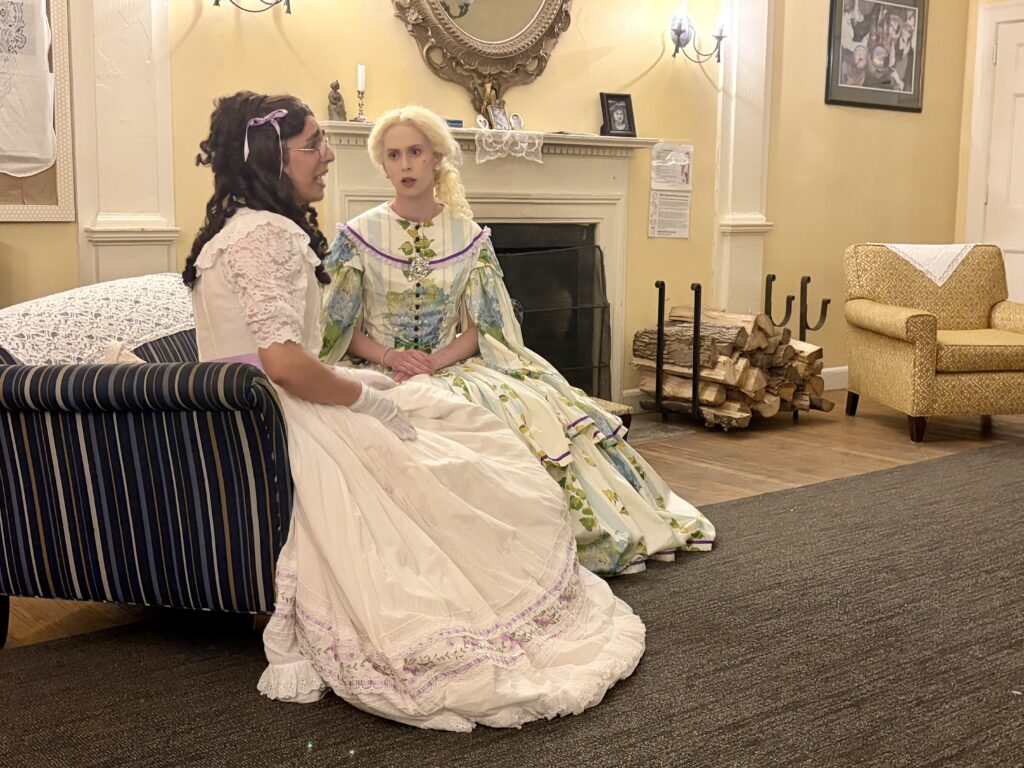
A student-produced adaptation of The “Ladies’ Man” premiered last Friday and Saturday night in the Booth common room.
The production, an adaptation of the 1894 French play by Georges Feydeau originally titled “Notre Future” and translated into English by Norman Shapiro, is a farce in one act. The story follows Angelique, an elegant worldly widow played by Chirstopher Burnside, with a sharp wit that drips with acidic contempt, and Valentine, her younger naive cousin who has just been proposed to. As Valentine, played by Aiden Dillen, reveals more and more about the man who proposed to her, it becomes clear that the same man was to propose to Angelique at the party happening the same night.
“Ah! Candlelight,” Angelique said at the top of the play as she turned on the Booth Common Room lights, “I simply adore it!” Over the next 35 minutes the two cousins dueled, cried, flounced, exaggerated French names, and decried those “unprincipled cads” and “scoundrels” of Paris; Ultimately Angelique and Valentine ended the play both single but still bonded.
“Ladies’ Man” in Booth was conceived by Burnside, who wanted to bring the farce to the college, something he says is less performed.
“I feel like the big drama scene at Bennington is very, not gloomy, per se, but very dramatic, rather than comedic,” said Burnside, who is a junior studying theater. He’s been acting since he was a child and says comedic roles have always been his biggest interest.
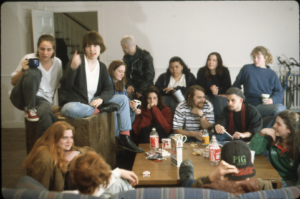
Both shows were performed to students curled around the Booth common room, which was transformed into a set: doilies placed over the couches, period details such as a shelf clock stage left and an ornate stepping stool below the mantle. Both Valentine and Angelique wore dresses that flounced as they delivered their lines. The set and costumes in particular were the brainchild of Dillen, who used many of his own items to make the production come to life.
“I have sort of an informal interest in period dress, so this was a great project for me to have been a part of,” said Dillen, who is a sophomore studying playwriting, acting, and history. “Doing all sorts of research into Feydeau, who he was, and just French life at the time, and sort of reconstructing Valentine’s day-to-day life.”
Valentine’s costuming, in a simple white dress paired with oval glasses and bratty, Shirley Temple curls, were inspired by characters like Cole Escola’s Mary Todd Lincoln in “Oh, Mary!” and Andrew Lloyd Webber’s Christine Daae in “Phantom of the Opera.” Her innocence contrasted Angelique, who sported a full crinoline, floral dress dripping in diamonds with an updo. Dillen tried to style both close to styles en vogue in 1890s Paris.
“I knew Valentine should have her hair down, and Angelique should have her hair up. It was just a matter of figuring out what that would entail for each of them,” Dillen said. He’s been acting since high school and was previously involved in an independent production of “Little Women,” and staging a play set in a drawing room in a college common room felt natural.
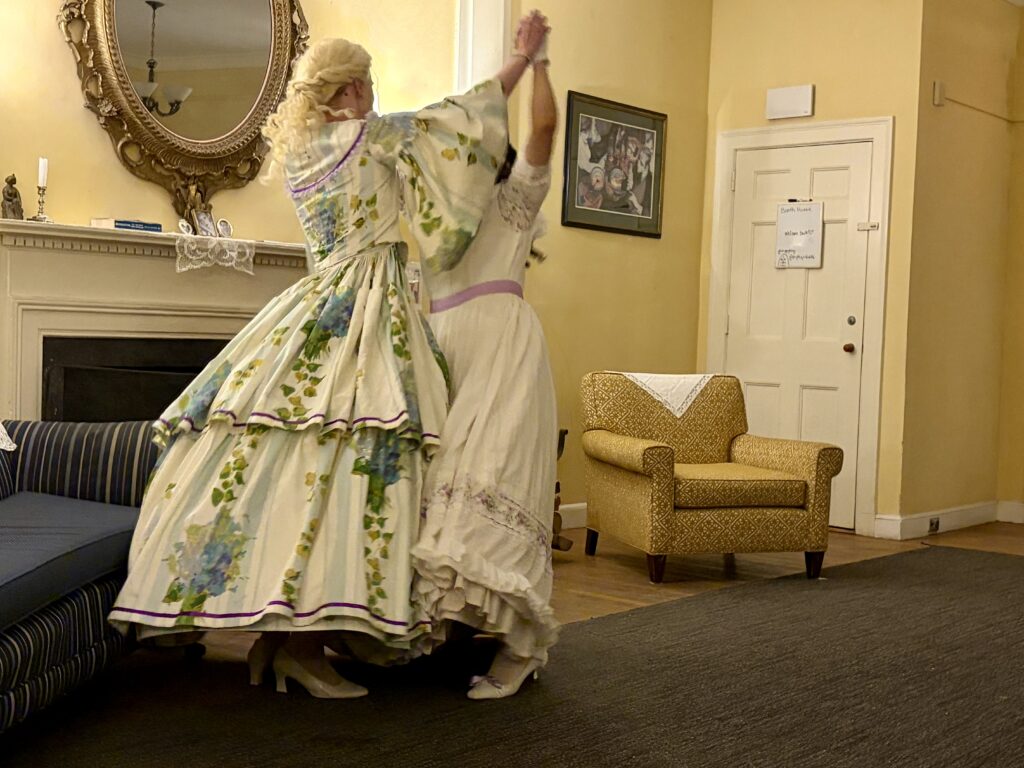
The role of Valentine was something new in particular for Dillen—”The ingenue, so to speak”— a character who is at the start of love being guided by her wiser cousin.
“I feel like I’m not as excited about love or consumed with love as Valentine is. So it’s kind of difficult for me to get back into that headspace,” Dillen said.
Although period accurate in dress and set, a more contemporary feel was present in the acting, which was baudier and more explicit that it would have been in the original. One scene in particular involves Angelique humping a pillow while imagining her love interest.
“In 1894 it probably would have been just purely innuendo,” Burnside said, “which we kind of made it more overtly sexual to make it more funny.”
Both nights, audiences laughed throughout the play before giving long ovations to both actors and the director Sophia Wollbach, supporting both the success of the production and independent student theater on campus.
“I keep thinking that people didn’t actually like it after they told me that they liked it,” Burnside said, “but then I have to remember that people were actually laughing, which is a tell-tale sign.”




Be First to Comment