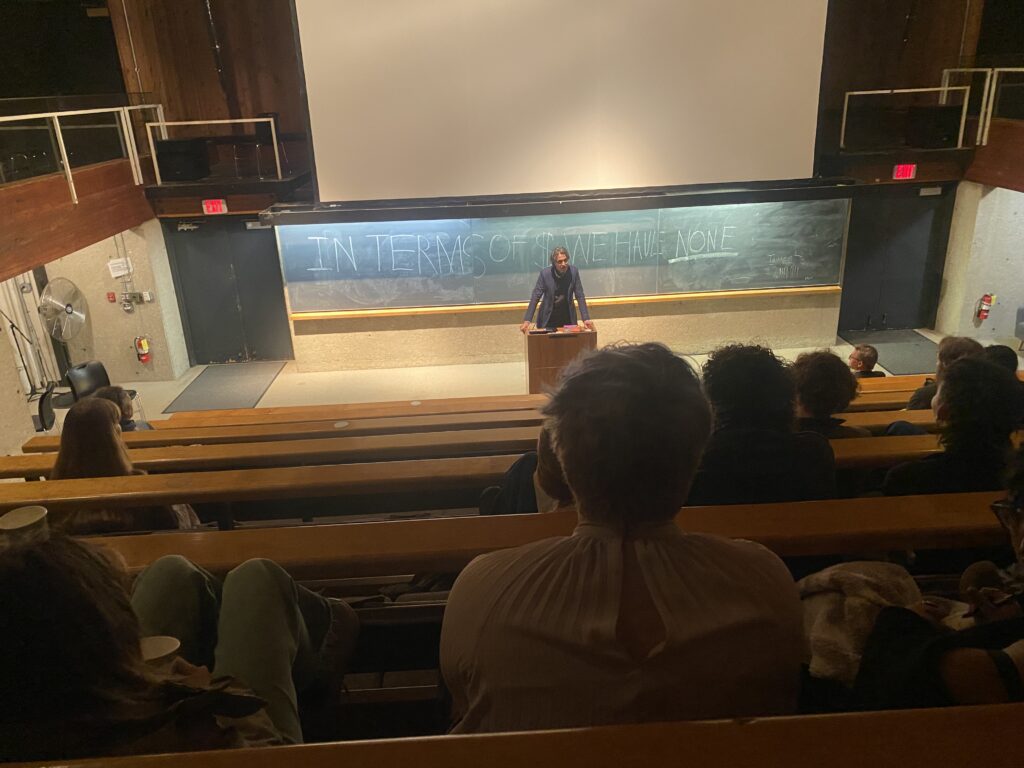
Swedish writer Jonas Hassen Khemiri visited Bennington to promote his new novel “The Sisters” as a part of the Literature Evenings series in Tishman Auditorium on Wednesday October 15.
Khemiri had previously been a Ben Belitt Distinguished Visiting Writer at Bennington in Spring 2023, during which he taught a course called “Writing Life.” He returned to read his novel, The Sisters, which was longlisted for the 2025 National Book Award for Fiction. A prolific writer, Khemiri has previously written several novels, short stories, plays, and essay collections that have netted him the P.O. Enquist Literary Prize, Swedish Radio’s Award for Best Novel, and made him a finalist for the August Award three times.
The Sisters is Khemiri’s first book written in English. The characters—the titular three sisters—would speak in English in Khemiri’s head. The novel was then rewritten into Swedish and English, each translation acting as a new draft.
“If it sounds like autofiction, it’s not,” says Benjamin Anastas, a literature faculty at Bennington while introducing Khemiri. “Instead it’s a novel that shows a deep reverence for lived experience, especially the experience of love and fascination and of being in a family.”
“[It’s] a novel of grand, sweeping authority,” Anastas further stated. The Sisters follows Ina, Evelyn, and Anastasia over the course of 35 years, with the time spent in each era gradually shrinking until we are left with a single minute to ponder in 2035. Khemiri said he was trying to find a structure that comported to how he has experienced time, speeding up continuously. It was his goal to write a book that stands on its own (literally, he said, standing it upright on a podium in Tishman).
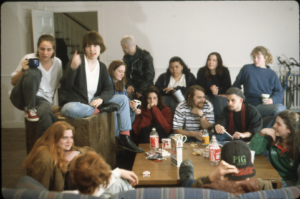
Rather than a traditional reading, Khemiri instead deferred to the audience to ask questions and talk about his process of becoming an author and writing. Speaking in a blunt, European style, Khemiri was careful not to get too deep into his own platitudes, but also realized the power they can carry. He often hit the microphone with his arms when expressing his points.
“How does an author survive on his words when what you say seems to have no value?” Khemiri said on coming to the United States to write his novel. “I’ve devoted my whole life to writing sentences and I’ve come to a place where words don’t matter.”
When talking about writing for the first time in English, Khemiri said that writing in his non-mother tongue, without the use of a dictionary only the vocabulary he knew, was freeing.
“When I went to write in English I went from trying to impress to trying to understand,” Khemiri said.
One audience member asked how the power of English over a much smaller language such as Swedish has affected Khemiri’s view of trying to write in English.
“I feel liberated when I write in English but I also think it’s important to recognize that I come from a position of power when I write. Talking in a Swedish accent gives me a certain amount of power—it’s cute!” Khemiri said. “But what if I started to use an accent that has less power?”
The conversation came with advice: asking the audience to think of 10 people they love and then 5 things you can’t tell them to find ideas and energy in writing; meditations on how the three sisters came to him.
One student asked how Khemiri navigated writing three sisters, a task which required him to take parts of himself and his personality. Writing The Sisters required Khemiri to take away traits and find the base wants and needs of the characters.
“I’ve never met a human who doesn’t want anything,” Khemiri said.


Be First to Comment