This article is the first in a series of theatre reviews at Bennington College this semester.
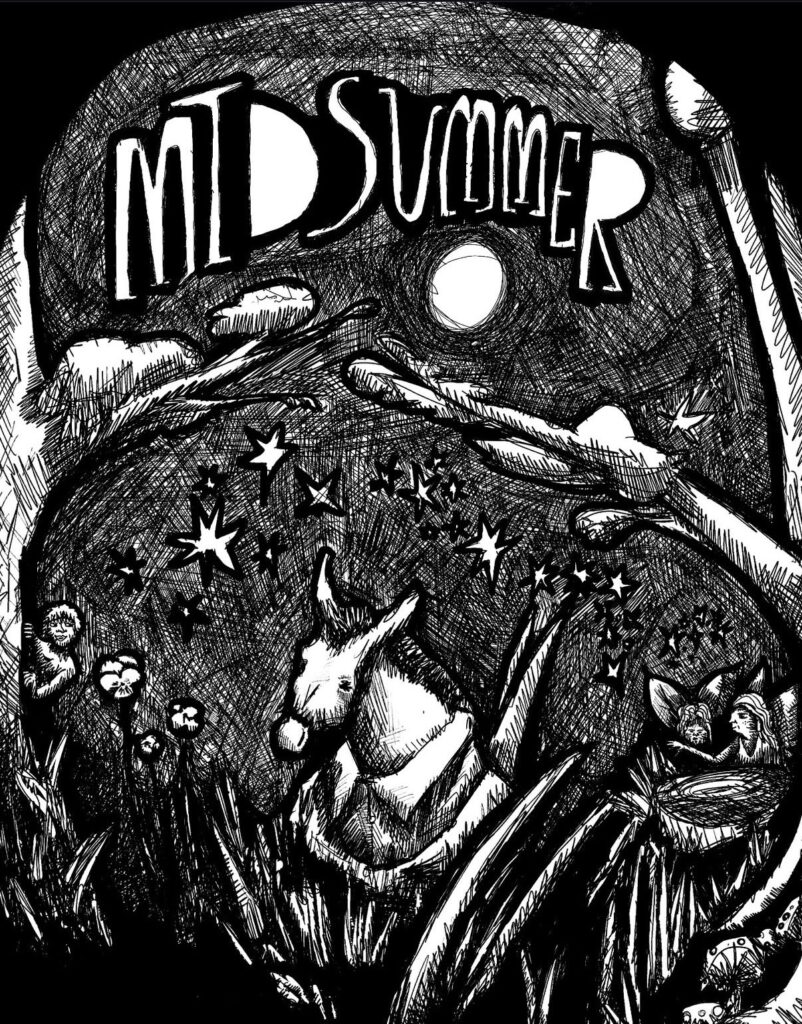
Four young lovers, a fairy king and queen and their minions, and a small theater troupe walk into a forest. The setup to one of Shakespeare’s most famous comedies has found itself on the stage of Margot Tenney theater at Bennington College this semester for Bennington senior William Atticus Parker’s adaptation of A Midsummer Night’s Dream: Midsummer.
The first production of the season was bound to be in high demand, and Midsummer sold out shockingly fast. The Bennington student body is generally passionate about theater, but the true reason for tickets being so hard to come by may be the fact that in an already small theater space, one third of the usual seating was taken up by a large throne set piece. Aside from this, the set created a forest-like atmosphere without being too complex. Hiding spots created by vines were utilized well throughout the play, and a small fountain, while slightly loud, added to the environment (before it was turned off ten minutes in, never to be heard from again).
Midsummer is somewhere between adaptation and abridged re-writing. The play follows the plot, setting, and characters of the original Shakespeare. Most of the adaptation seems to be omission. What is left in the rewrite are the most farcical elements of the play: the confusion, the deception, the mistaken identities. Without the clever punning of Shakespeare’s writing and general coherence of plot, Midsummer often devolves into somewhat tiresome arguments broken up by well-executed stage combat. The choice to leave in elements such as Titania and Oberon’s arguments over ownership of a young “slave” boy, when other plot elements from the original are omitted, feels questionable.
The play’s language flips between a flowery Shakespearean style and straightforward contemporary language. Some lines are real Shakespeare, some are imitation Shakespeare, and sometimes lines such as “And in the wood a league without the town / Where I did meet thee once with Helena / to do observance to a morn of May” become “that clearing, the one we used to hang by.” The original language that is kept in sounds strange next to the casual tone of the re-written lines. The same is true for the cursing and lines like “I was addicted to her, like a drug,” which are more clearly out of place in the same play as “O, how ripe in show / Thy lips, those kissing cherries, tempting grow!”
The side plot of the theater troupe provides comic relief to the rest of Midsummer. Kelton Dumont as Nicholas Bottom makes some bold accent choices, veering from a cartoonish Brooklyn pronunciation of the word “moidered” into a range that is almost Southern. It works, though, as the performance is genuinely funny. There is a distinct tone shift between the theater troupe’s scenes, which play like sketch comedy, and the rest of the production.
Nicholas Bottom’s transformation into a monstrous ass is also notable as a display of talent on the production side of the play. The mask he emerges in after an off-stage transformation, crafted by Maverick Yarger, is genuinely horrifying, in the best way. Seeing Maiya Koloski’s Queen Titania look lovingly at the terrible creature truly prompts chills. Puck’s mask, as well, drew gasps from the audience, with a sort of flayed skin effect emphasizing the terrifying otherworldliness Alice Kandel-Zasloff’s performance brings to the trickster character. Oberon, played by Aidan Ellison, came off as a much more malicious and manipulative character, which was a rewarding choice, but one which could have been done just as effectively through direction, without changing the original Shakespeare script.
With a talented cast, decent stage design, and strong directing, Will Parker’s Midsummer has all the elements to create a very entertaining production of A Midsummer Night’s Dream. Trying to adapt the original into something new but changing so little besides the writing detracted from the talents involved. The viewer finds themselves wondering: if the characters can say “wait up” and “fuck you,” if they can smoke cigarettes for no reason (seemingly a requirement to get any production staged on Bennington campus), why can’t they deviate from the original plot? Why isn’t this new version of a very old play actually saying anything new? There is, in fact, a twist ending, but it comes too late and feels halfhearted. Going to Crossett library and checking out some real Shakespeare may be more worth your time.



Be First to Comment