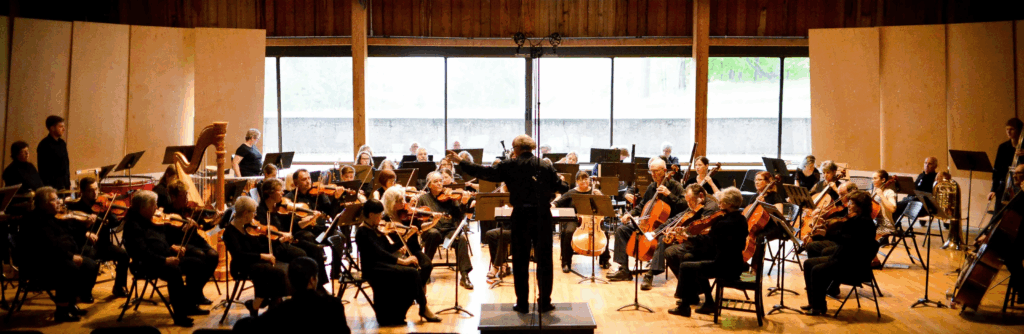
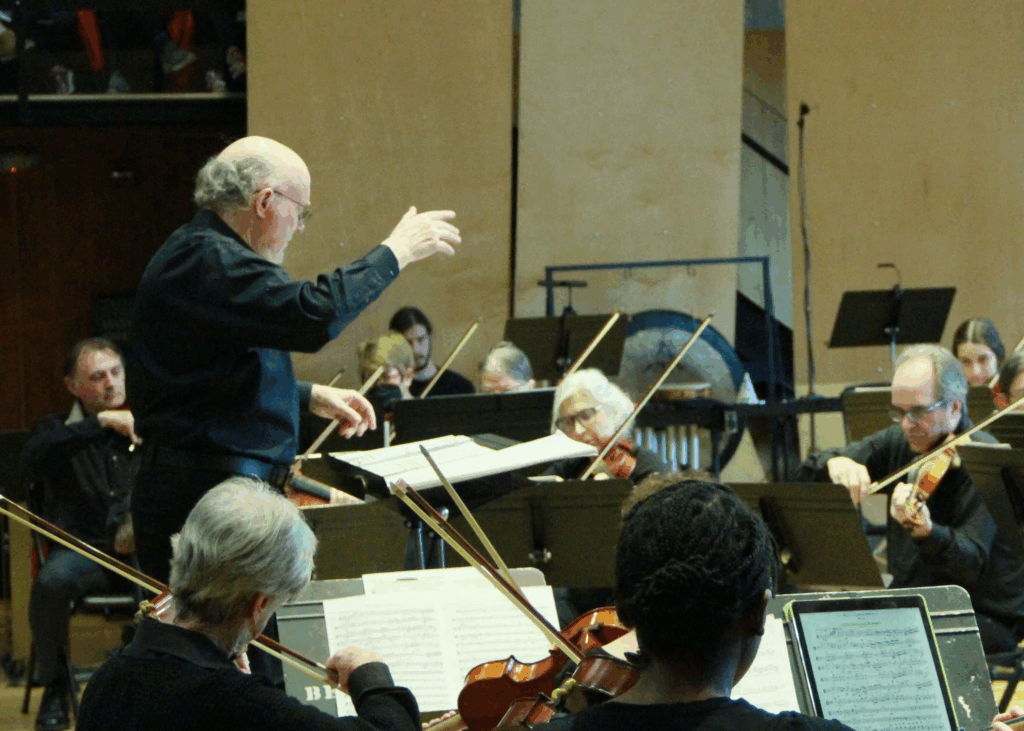
On Sunday, March 8, Michael Finckel conducted his final concert with the Sage City Symphony after 35 years on the podium.
“I realized I need to do my daily weight training,” the spry 80-year-old joked, brushing aside an iPhone notification. Moments later, the first notes of Samuel Barber’s Concerto for Piano, Opus 38 rang through Greenwall.
Finckel grew up in Shaftsbury, Vermont, and taught at Bennington College for 11 years, following in his parents’ footsteps. His father, George, a renowned cellist, spent three decades teaching at the college beginning in the early 1940s, while his mother, Marianne, was an accomplished musician and piano instructor at her alma mater for more than a decade. A graduate of Oberlin College Conservatory of Music, Finckel studied composition and orchestration at Bennington under the tutelage of Sage City Symphony founder Louis Calabro and Pulitzer Prize-winning composer Henry Brant.
Finckel joined the Sage City Symphony as a student cellist, beginning what would become an outstanding career. Although a highly-accomplished conductor and musician, Finckel is equally known for his “dad-joke” sense of humor, bringing levity to rehearsals with a steady stream of quips. “Let’s move on dot com” was one of his personal favorite slogans; “Don’t overbake it” another, although the exact context remains somewhat of a mystery.
The concert also featured the compositions of three Bennington students: Julius Boxer-Cooper ‘26, Charlie Love ‘27, and Lee Peyton Ripp ‘27.
Boxer-Cooper’s Concertino for Tuba in F Major, “The Gentle Giant,” was played first. Melodic and hypnotic, the piece was especially striking given the rarity of works featuring the tuba. Boxer-Cooper wrote the work between October 2025 and February of this year, citing Vaughan Williams’s Tuba Concerto in F Minor as an inspiration. He also performed on flute with characteristic finesse and commitment, memorably saving his breath all day for an unforgettable flute solo at the Sage City Symphony concert last spring.
Love’s piece, “Disentangle,” was up next. Suspenseful and exquisitely discordant, the composition represented a departure from his first featured work last year. This time, Love experimented with the absence of a key signature and a deliberate use of dissonance. His goal, he explained, was to compose “an unsubtle piece, orchestrated with subtlety”, maintaining intensity while avoiding heaviness and giving players adequate time to rest. Maurice Ravel served as a major inspiration; in Love’s words, the composer brought “a lightness to his compositions—no more than needed.” He credits music faculty member Nick Brooke’s orchestration class for providing the impetus and creative space for both his and his peers’ compositions to take shape.
Although he is a long-standing master of the keys, March 8 marked Love’s first opportunity to put down the bass and play the piano for Sage City in the heart-wrenching performance of the Barber’s concerto that opened the evening. “I’m grateful I had the chance to perform it with Michael as conductor,” he said, noting the concerto’s personal significance dating back to his high school years.
As a freshman walking into rehearsal for the very first time, Love recalled being instantly put at ease by Ficknel’s warm welcome, who treated him as if he’d been playing with Sage City for years. Even so, being part of a community orchestra is certainly a time commitment. With only four rehearsals to prepare before the show, the students had to arrive early on campus in order to make the first.
Harmonious and vivacious, Lee Peyton Ripp’s composition closed the set of student works. Aptly titled “Little Woman,” the piece was written as an homage to a student production Ripp’s friend had been a key part of last year. While Ripp played oboe for much of the concert, they took to the glockenspiel for the finale, adding a dazzling personal touch.
Bennington’s vocal coach, Kerry Ryer-Parke, was featured on Finckel’s arrangement of Maurice Ravel’s Cinq mélodies populaires grecques. Her clear, powerful soprano voice spiraled across the auditorium in a truly spectacular performance. Like Finckel, she studied composition with Sage City Symphony founder Louis Calabro while she was a Bennington student, and has been involved with Sage since 1991, when she performed Puccini arias.
Henry Brant’s “On the Nature of Things” closed the concert, an especially fitting end of an era. Strikingly atmospheric, the piece created a surround-sound effect by stationing musicians throughout Greenwall, including one performer positioned deftly on the narrow spiral staircase leading to the rafters.
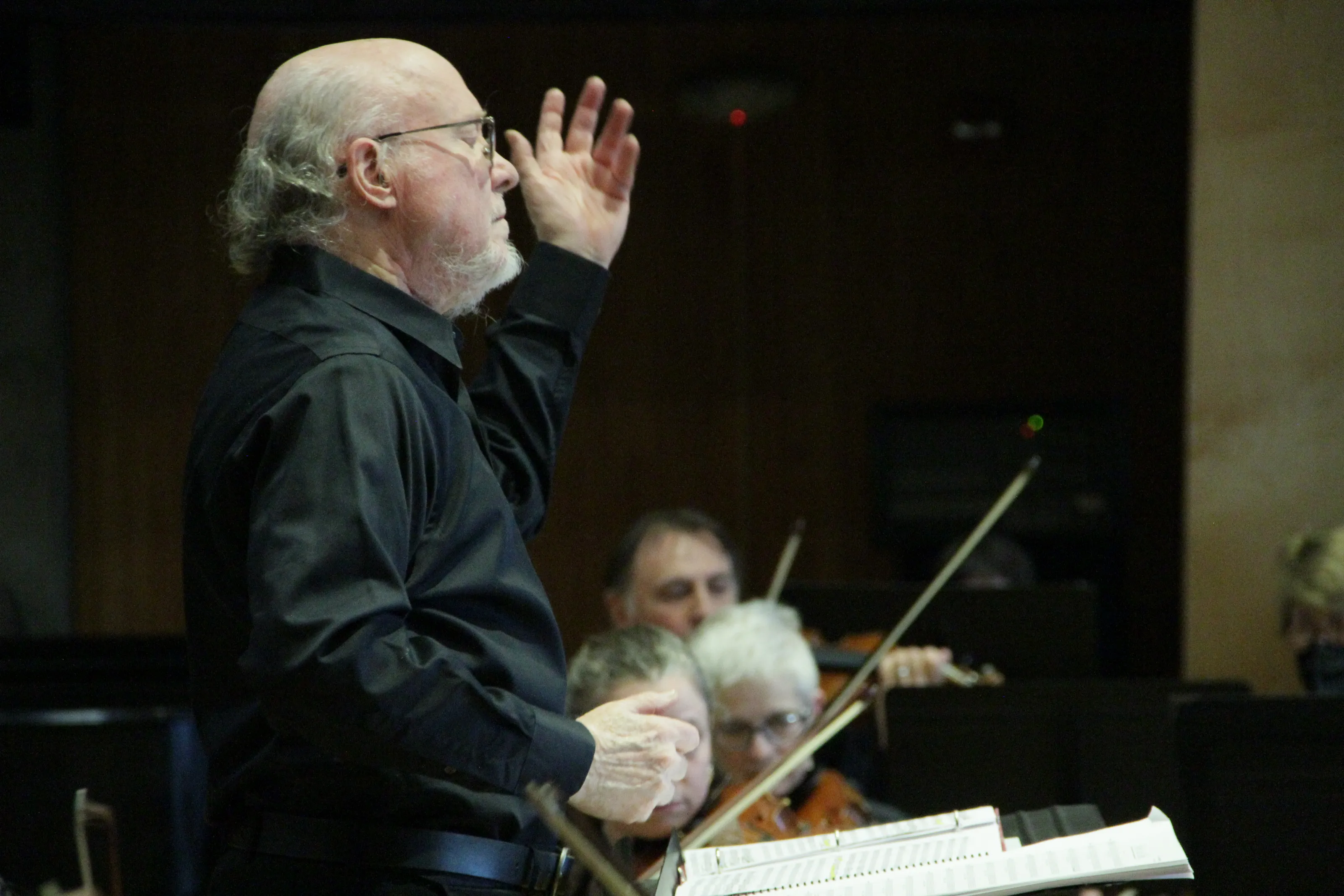
The future conductor of the Sage City Symphony has yet to be announced. Whoever steps onto the podium next will inherit an extraordinary legacy, though no one could quite replicate Finckel’s singular combination of musical precision and perfectly-timed dad jokes.
Though Finckel is stepping away from the podium, Sage City Symphony’s connection to Bennington College remains strong, a testament to all the students and faculty, past and present, who have shaped the orchestra.
Near the end of the program, the staging shifted, giving the audience a clear view of Finckel as he commanded the stage. His face was tranquil and yet determined, contrasted by the mesmerizing display of his dexterous hands. Conducting is clearly an art in itself, or at least Finckel makes it so: an act of fully-embodied expression. He crouched, swayed, and sprang with remarkable vitality.
The concert concluded with a resounding minute-long standing ovation. It was Finckel’s last dance—and what a dance it was.



Be First to Comment