On Saturday, March 28th, the Martha Graham Dance Company (MGDC) made its highly-anticipated return to Bennington College after 85 years.
The momentous event was part of the GRAHAM100 series, a year-long centennial celebration of America’s oldest operating dance company. Founded in 1926 by Martha Graham, Saturday’s performance was a curated production of her Company’s most seminal works.
A distinguished figure in the artistic community, Martha Graham shares a significant history with Bennington College. From 1934 to 1942, Graham helped to establish the Bennington School of Dance, a summer training program that played a role in establishing modern dance as an art form. Each summer she transformed Commons Lawn into her stage, where she choreographed and taught some of her most iconic works, such as Panorama (1935) and Letter to the World (1940).
The celebration’s festivities began earlier that day in the Tishman Lecture Hall, where Janet Eilber, Artistic Director at MGDC, and Norton Owen, Jacob’s Pillow former Director of Preservation, led an open-discussion on rare Martha Graham photographs.
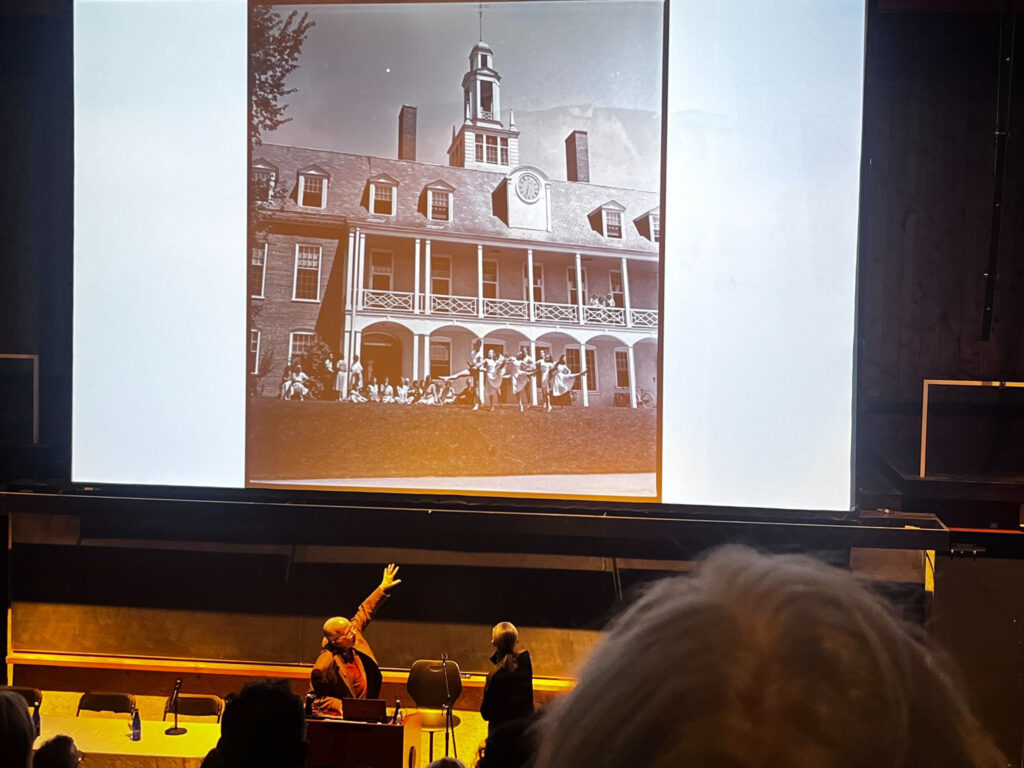
The images ranged from performance shots of Martha Graham to behind-the-scenes pictures of dress rehearsals. As Eilber and Owens guided the audience through the photographs, admiring gasps flooded Tishman.
The conversation focused heavily on the power of archives as a tool for artistic revival, with some works featured in Saturday’s program, such as Immediate Tragedy (1937), nearly lost to time. Owens emphasized the importance of dance as the physical passing of memories. He encouraged the crowd to reflect on the campus itself and to remember that “some greatness walked this ground.”
As the audience began shuffling out of Tishman, Michael Wimberly, Music Faculty and primary event organizer for the GRAHAM100 series at Bennington, bid goodbye and quipped, “Good luck with finding a seat.”
His advice was certainly warranted as an eager crowd had already begun to queue an hour before the performance was set to begin inside the Martha Hill Dance Theater. With the show doors opening concurrently with meal hour, some students opted to have their dinner in line, lest they risk securing a coveted seat inside.
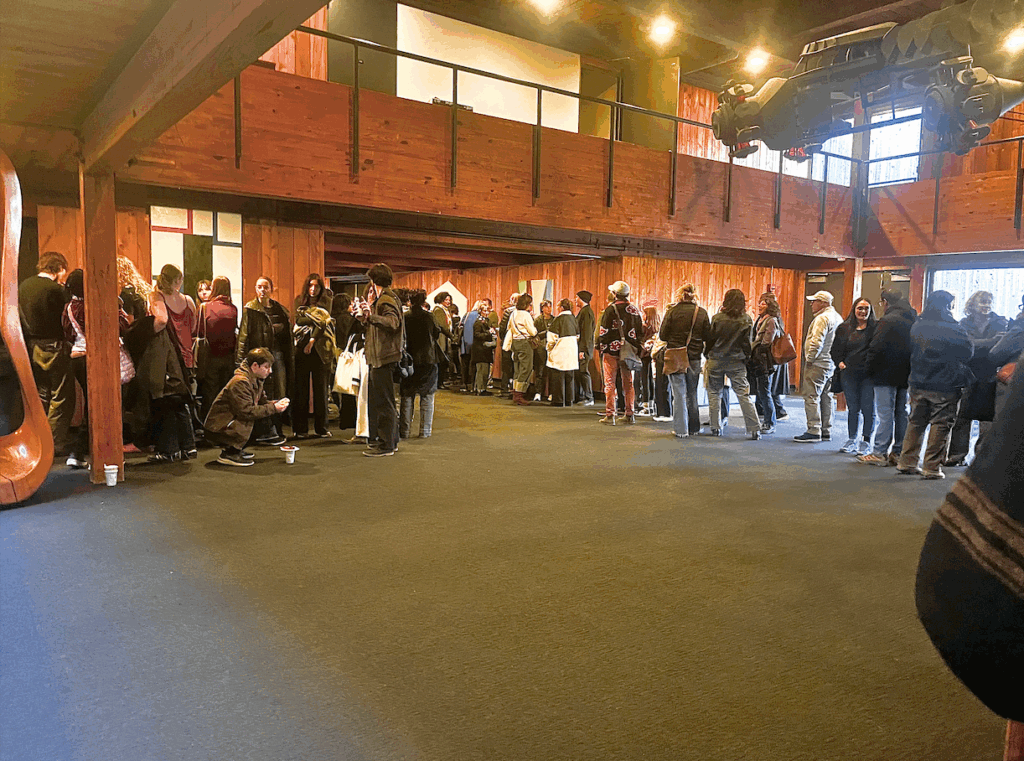
As the line grew increasingly long, eventually wrapping around the room, event staff warned the crowd about limited seating. Some would have to make do with sitting on the floor; this fact did very little to deter people from relinquishing their spot. As the initial rush of bodies into the dark theater subsided and the overhead lights dimmed, silence descended over the crowd.
Lamentation (1930) was performed first. The audience watched with undeterred focus as So Young An, member of the Martha Graham Dance Company, rocked her body under the confinement of purple fabric, stretching her limbs to the point of disentanglement. So Young An encompassed grief in her rigidly desperate movements; it was a quintessential example of the Graham Technique, which places an emphasis on the “contraction and release” of the body. Paired with a hauntingly melodic piano, the crowd was stunned into accepting a quiet resignation in solidarity with An’s defeated bow.
Perhaps the most anticipated piece of the night, Panorama (1935), was performed next. The large ensemble, consisting of twenty-seven Bennington College students, was introduced by Janet Eilber. Providing the historical significance of the piece, a political call to action choreographed by Martha Graham on Bennington grounds, Eilber encouraged the audience to reflect on the relevance of the work today. As the familiar faces of peers marched onto the stage donning striking red garments, an infectious anticipation spread amongst the audience. For a paralyzing eleven minutes, the crowd watched as student dancers switched between high-energy synchronized movements to slower-paced jumps, prances and skips. With a music accompaniment morphing so seamlessly between an anxiety-inducing and optimistic tonality, this piece was an undeniable raw call for unity. The dance concluded with a minute-long standing ovation and roaring cheers from the audience.
The performance was the culmination of a rigorous 8-day project led by Bennington Dance Faculty Cameron Childs and Dana Reitz, working alongside Blakely White-McGuire, former principal dancer of the Martha Graham Dance Company. Rehearsals for The Panorama Project took place over the week of March 7th-13th. The twenty-seven students rehearsed intensely under the guidance of Childs, Reitz, and White-McGuire to master the Graham Technique while under a massive time crunch.
Participation in the project was not strictly limited to BFA or BA Dancers. In a conversation with Childs a few days after the event, he explained that due to the work’s malleability and intense focus on the power of community, it was decided by White-McGuire and Childs that “this is a project anyone can do.”
For Lily Polzin, a second-year student at Bennington, the choice to be part of the ensemble on Saturday was emotionally charged. “In high school, I stepped away from dance. I kind of lost my joy for it and I’ve been rediscovering it here at Bennington. And this experience really helped me in that journey,” Polzin said.
Theme and Variations from Appalachian Spring (1994) followed the student performance. Martha Graham Dance Company members Anne Souder and Lloyd Knight delivered an exquisitely romantic piece. Dancing as a pair, they successfully morphed the lively atmosphere from moments earlier into a tranquil force.
Choreographed by Hope Boykin, En Masse (2025) was in the works for decades. The piece was born out of an unfinished, 49-second long composition by American conductor Leonard Bernstein intended for Martha Graham’s use. Dug out of the Library of Congress archives, the music was believed to have been lost to time and only recently discovered. The finished choreography is a mighty display of the beauty sprung from collaborative action. The dancers paraded quickly across the stage, swapping seamlessly between upbeat body contortions and mesmerizing individual dance breaks.
The solo, Immediate Tragedy (1937), performed by Xin Ying, was absolutely heroic. Being pulled left and right across the stage by an invisible force, Ying nonetheless stood firm in her position on stage, dominating through adversity. It was a fitting segue into the final piece of the night: We the People (2024).
The familiar acoustic sounds associated with the folk genre worked to facilitate the image of a traditional American hoedown. However, with their aggressive and prompting gestures, the dancers clad in denim presented a dynamic protest against latent injustices in our society today. Truly confrontational, the final performance emboldened the audience to find the strength necessary to persevere as a populace.
Dance at Bennington has transformed itself greatly from its humble origins in 1934, going from a six-week summer dance intensive to its most recent development in 2024, a BFA Dance Lab which formed in the wake of the permanent closure of the University of the Arts in Philadelphia.
With Bennington having been once described by Martha Graham as a validating place for her art, Cameron Childs reflected on the endurance of that claim today. For him, dance at Bennington is strengthened by its interdisciplinary practice and its emphasis on self determination.
As Childs puts it, Bennington provides “the choice to be an artist, the choice to be whatever part of yourself, and to explore what that is.”




Be First to Comment