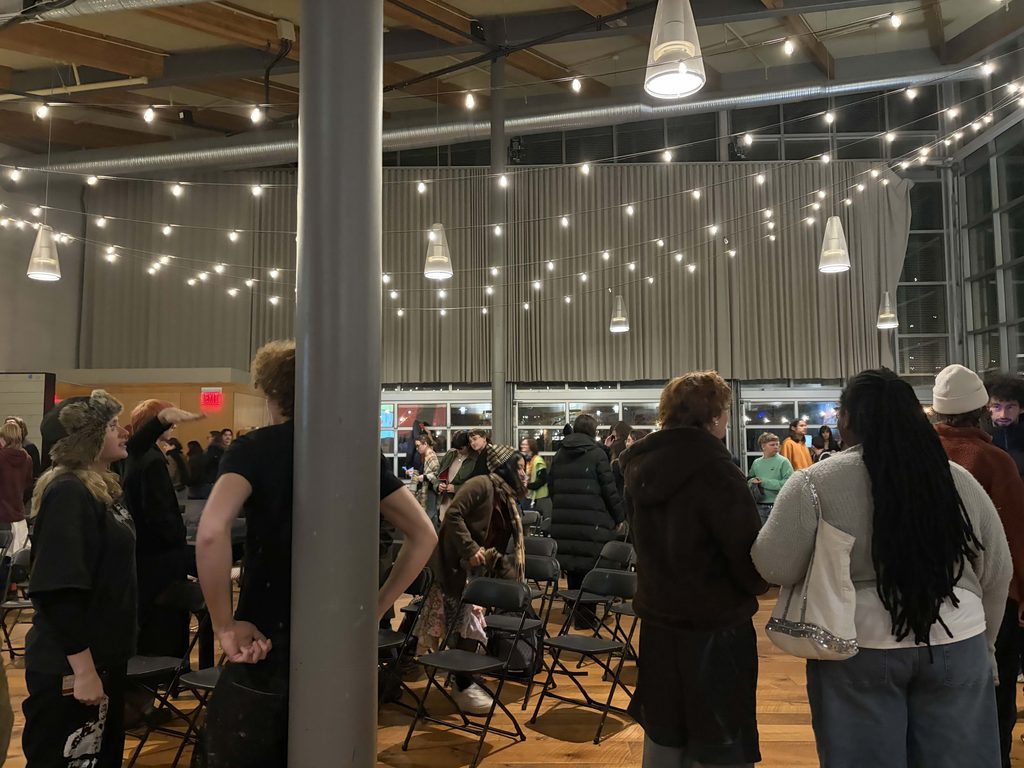
On the night of November 16, more than 150 students convened in the Student Center following a ‘Call to Action’ that had been advertised across campus.
The ‘Call to Action’ came in response to President Danielle Egan’s November 4th announcement that the college would be pursuing a 12:1 student-faculty ratio, in an attempt to make a dent in Bennington’s $18 million structural deficit. The school’s current ratio is 8:1, meaning that the administration is planning to dismiss a third of the faculty. They are currently offering voluntary separation and early-retirement incentives, which faculty have until this Thursday, November 19, to accept. If too few elect to do so, which the college expects will happen, layoffs will ensue starting after January.
Willa Donavan ’26 and Lake Salvatore Palmer ’29 hosted the meeting, and had a slideshow prepared with talking points. They made the case against large layoffs being the correct solution to the college’s financial situation. Salvatore Palmer explained that NECHE, the organization that accredits Bennington, can flag the school, effectively leading to its closure, if it believes it is not financially stable. Salvatore Palmer suggested that large faculty cuts are a symbolic move by the Board of Trustees to show NECHE that this is not the case.
The hosts noted that other strategies which could ease Bennington’s deficit have not been considered, such as reducing hefty executive salaries. Donavan also explained that the school’s lack of endowment puts undue pressure on admissions, and that another way to decrease the deficit and at the same time shift the student-faculty ratio is to boost enrollment.
“We need to exhaust all other options first,” said Donavan, “I believe [Bennington] is this place where we get to have…passion for what we do and that is directly fostered by the people who care for us in this school.”
During the meeting, students in the audience had the opportunity to share how the Bennington faculty is significant to them. One student mentioned that the current student-faculty ratio allows for meaningful relationships between students and faculty.
Dor Ben-Amotz, a current faculty member and Bennington alum, was also at the meeting. “The interactions I had with faculty while I was here formed the way I look at the world,” he said. He shared that faculty feel the same way about the layoffs as the students, but students are in a better place to organize because they aren’t at risk of being fired.
Donavan and Salvatore Palmer also described the historical precedent for the layoffs, referencing what is known as ‘the Purge’ of 1994, when the school fired a third of the faculty. Following the Purge, the college’s enrollment dropped to a record low, and multiple major donors pulled their funding. Even though Bennington was in far dire economic straits than we are currently in, the American Association of University Professors still found that there was insufficient evidence to justify the 1994 faculty cuts.
“The students had no voice in this process,” said Donavan, in reference to the Purge, “we can’t let that happen again.”
Donavan and Salvatore Palmer emphasized that students need to be involved in major changes the school makes. They also wanted to make it clear that they were in no way pitting themselves against the Board of Trustees and the administration, who they know care deeply about the school and want the same thing as the students, to save it.
After the presentation, everyone at the meeting split up into eight different working groups, focused on things like fundraising, outreach, and communication with faculty, staff, the administration, and the Board. Each working group was led by a member of the Student Council. Tasks for these groups included alumni phone banking and talking to prospective students.
“I want to show them that the students can be an integral part of how the school stays alive,” Donavan explained.
Looking forward, she hopes the administration will halt the decision. In the meantime, she and Salvatore Palmer will be holding weekly meetings on Monday nights for students to get together and continue to advocate for different solutions.





Be First to Comment