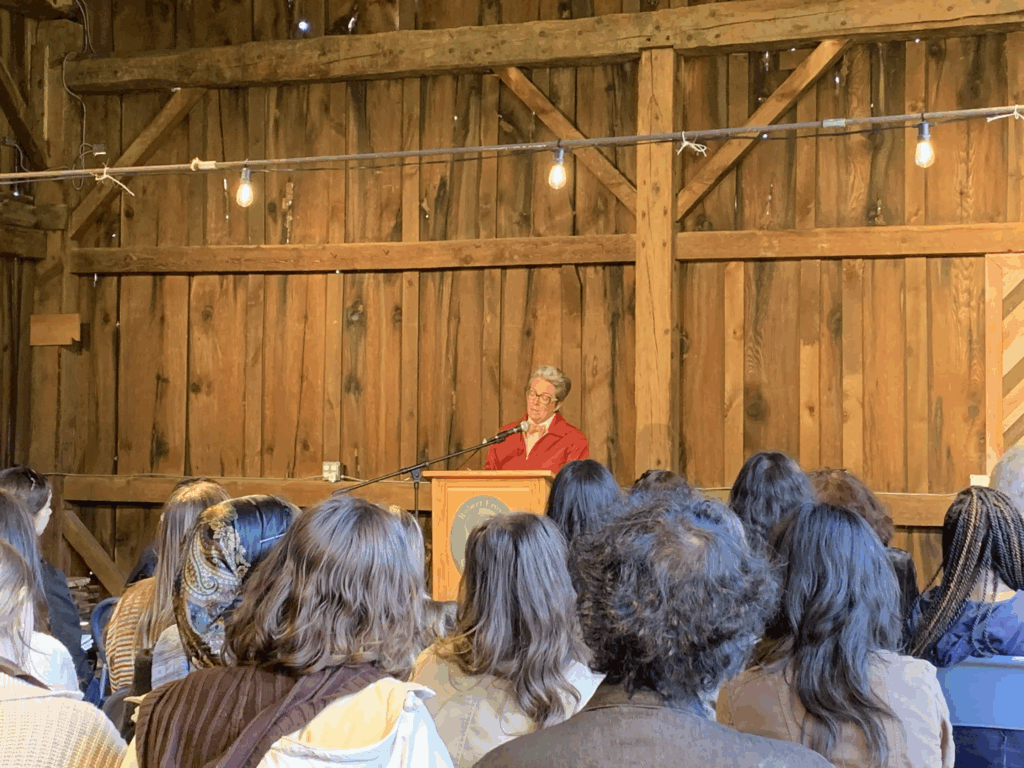
The first lines of my favorite poem read “The days I don’t want to kill myself / are extraordinary.” They’re from Hammond B-3 Organ Cistern by Gabrielle Calvocoressi, who visited Bennington College for a reading with Poetry at Bennington on May 6 and the annual Literature Book Party at the Robert Frost Stone House on May 7.
A former member of the Bennington faculty, Calvocoressi is familiar with many current professors, and spent several minutes prior to the reading making their rounds and giving out hugs. Their glowing intro from faculty member Michael Dumanis spoke to a “singular perceptive way of being in the world” and the use of a poem as a living, breathing organism instead of a machine. To Dumanis, their poetics are firmly grounded in voice even as they bump up against the limits of language.
Calvocoressi did not read from this collection during their visit to Bennington, but when I think of the poet’s purpose to challenge language’s limits, I will always think of their use of the segno (𝄋) in Rocket Fantastic (Persea Books, 2017) as a pronoun to represent a “confluence of genders in varying degrees, not either/or nor necessarily both in equal measure.” It’s pronounced as “the intake of breath when a body is unlimited in its possibilities.” Rocket Fantastic was a 2018 winner of the Audre Lorde Award for Lesbian Poetry. What do we do when existing language isn’t enough? We ask, and Calvocoressi has the answer: invent language that is.
I don’t remember when I first read Hammond B-3 Organ Cistern, but it’s the opening poem of Calvocoressi’s most recent work The New Economy (Copper Canyon, 2025), a finalist for the National Book Award. What I do know is this: they opened their reading with it, and I began to cry. There’s a special sort of magic in hearing a poem you’ve read so many times finally be put to voice by the poet, a magic in finally understanding just what they intended the cadence to be, exactly where they choose to breathe and pause.
Calvocoressi throws their whole body into reading, only ever glancing at the words on the page, always looking outwards, their gray hair reminding me of the crest of some resplendent bird, especially with their signature bowtie around their neck. With their lilting voice, the lyricism of their poems drifts close to song, almost lullaby-like at points.
New England is a familiar place to them, as their mother lived in Manchester. According to them, they’ve read at Bennington more than anywhere else and seemed centered and at home in the space. “I feel like I’m in this space that’s full of ghosts,” they said as they began the reading. “Good ghosts.”
Their second poem of the evening was another of my favorites: Miss you. Would like to take a walk with you. As many of Calvocoressi’s poems do, it deals with grief, reckoning with the passage of time following the death of their mother. “Know I told you / it was okay to go. Know I told you it was okay / to leave me. Why’d you believe me? You always believed me,” they write, striking a chord with all of us who have dealt with the loss of a parent at a young age. Their voice pushes towards desperation as they read, and I sit in the back of Tishman and cry harder.
The single-most prevalent word in Calvocoressi’s poems is “cistern,” the idea of the vessel, the holding chamber, the body as something to be filled and emptied. They imagine the soul as the “light body,” the physical body as the “skin sack.” Skeletons remain skeletons, but the interrogation of what we hold dictating who we are remains. Their poems feel limitless with possibility, these peeks into what other lives can hold, full of vivid imagery and the deepest troughs of sadness, the highest, simplest peaks of joy. Calvocoressi is a master of poetry in their ability to take something so technically complex and make it seem casual, effortless.
The earnestness of their poetry cleaves me wide open. “I’d think how nice it would be / to be so good at something you’d make / everyone stand still and cry. For joy. For / wonder,” they read from Jessye Norman Cistern Time to Dress for Fall, describing loneliness as “it’s like an empty opera house inside me. Like all the chandeliers just shattered on the floor,” and I wonder if they know they’ve realized that thought. Their style of poetry, which rapidly shifts between humorous, imagistic, and deeply reflective, is so effective at cutting to the quick, drawing unexpected surges of emotion to the surface.
Their poetry is honest and exacting, refusing to hide behind metaphor. In My Perimenopausal Body Cistern Disappointing How Surprising, they face the complex web of gender, transition, and paths not taken head on. “I tie my bow tie around my neck that’s not / quite the neck I want. But still: the neck survived: hours on the floor begging for my life,” they read, and I find that all of their poems are underscored by the determination to survive, to write a poem after. To live in/as contradiction, yet not feel contradictory at all.
They end the Wednesday night reading with No Poems Today, which feels a bit tongue-in-cheek, the injection of humor they seem to have mastered arising once more, but not before noting that the audience in Tishman makes them want to read all night. “I can hear your ears listening,” they say, before starting to read a poem of joy. “Let’s be here for the bounty,” they read. “Imagine how nice to hear nothing but the stars.”
In the following Q&A, Calvocoressi meanders as they explain their relationship to the meaning of lyric and legacy. “I came to poetry in a moment where everything is elegy,” they say, not to the room but directly to the question-asker, their attention wholly focused on one person. A professor at UNC Chapel Hill, what was once a reading feels like a class, every attendee hooked.
I linger long after everyone has dispersed to get my books signed and thank Calvocoressi for their poems, which have carried and anchored me through my college experience. I tell them about a poetry class from my freshman year at the University of the Arts, where I was assigned to bring in my favorite opening line of a poem. Of course, I chose Hammond B-3 Organ Cistern. “Here’s to our luminous vessels,” they write in my copy of Rocket Fantastic, and we talk about grief and the body, my yearly meditation on Miss You. Would like to take a walk with you that comes on the anniversary of my mother’s passing, the way that poetry can be so ubiquitous yet so unfathomably personal.
Every time I meet a poet whose work I somewhat revere, I’m always awestruck at how kind they all are, how attentive they are to a reader’s connection to their work.
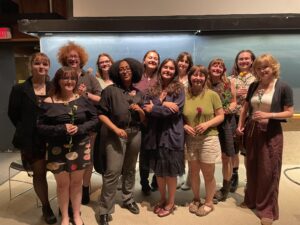
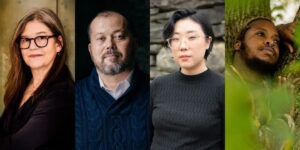
The following night, we gather at the Robert Frost Stone House to celebrate new works by Gabrielle Calvocoressi (The New Economy, Copper Canyon, 2025), Monica Ferrell (The Future, Four Way Books, 2026), and Devon Walker-Figueroa (Lazarus Species, Milkweed, 2025). I brush past Calvocoressi as I meander through the house and they greet me by name, asking how I am.
The reading itself takes place in the barn, though students, faculty, and others in the Bennington community had spent the better part of an hour sitting in the sunshine, eating, talking, and taking in the idyllic little bubble we found ourselves in.
All three poets honored were strikingly similar in their modernity and unflinching gaze on the current state of the world. They read for ten minutes each, but I swore I was standing in the back of the barn (there weren’t enough chairs for the many attendees, who spilled out of the barn and onto the lawn) for what felt like an hour, transfixed. These are poets who are unafraid of their readers, who invite them in, who ask them to get up-close with the words and the people who wrote them.
“There should be a word for it,” Calvocoressi says in Hammond B-3 Organ Cistern, “The days you wake up and do not want to slit your throat.” Their poetry navigates immeasurable grief and the heaviness of living under the tyrannical empire of the United States with relentless grace and optimism, pushing the envelope of what language can do, the meaning words can hold. The work holds a true belief that change is possible, a sincere hope that all beings will one day be free of suffering. “Bring the bass back. Bring the band out on the stoop. Hallelujah!” the poem ends, triumphant in its survival.



Be First to Comment