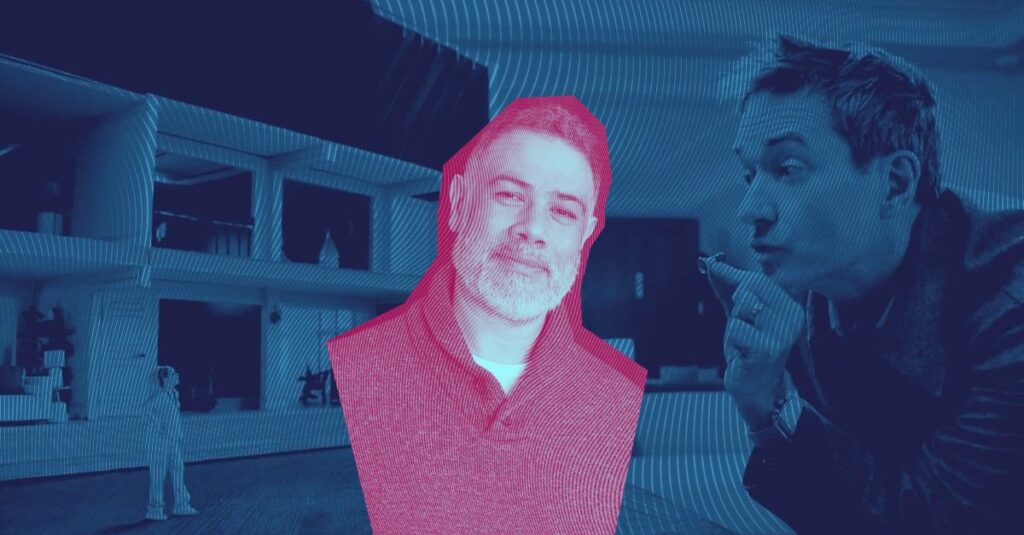
A few weeks ago, I sat down in Cricket Hill with a beloved member of our literature faculty to discuss the upcoming adaptation of his work. The prospect of literary success is a vast and elusive subject amongst the literature students of Bennington College. Many write poetry, many write literary fiction, many feel that adaptations and mainstream successes may not ever be in reach. Thus, a faculty member’s success has been a hushed but constant subject in the hallways outside Literature Evenings.
Manuel Gonzales was kind enough to discuss the optioning process as he experienced it, what initially inspired his story “The Miniature Wife” in 2001, and the idea of what “success” means as a writer.
There are spoilers for the short story and the series on Peacock throughout the interview.
Holland Elisabeth: This can be a very informal interview, and you can talk about whatever you like regarding it. There are just a lot of people on campus who are curious about the process of getting their work adapted.
Manuel Gonzalez: Sure. So long as we know that everything is off the record.
Naturally.
Yes, you can record it, but also it’s all off the record and you can’t say anything.
I’ll keep that in mind. Okay.
It has to be an unnamed source. Close to—
An unnamed source close to Manuel Gonzalez told me this—I will keep that in mind. I mean, one thing that people were wondering about is when you sold the rights to The Miniature Wife?
They [Jennifer Ames and Steve Turner] had it for a year and a half—a year and a half, three years. So that happened probably in 2021 or 2022…I feel like it was before then, because they optioned it for 18 months with the option to re-up for another 18 months without having to renegotiate. And they went through both of those times…like it ended right when they sold it, right when they got it sold to a studio and picked up for a series.I mean, there was like six or seven months in the middle of the second round of the option because of the writer’s strike. And that makes it so that everything is put on hold. All the clocks stop during a strike. So the clock on the option stopped as well. So I think it was probably 2021, 2022.
Right, because there was some debate in the newsroom—and around campus—that you sold it like several years before, and then it just got randomly picked up. I don’t know where this rumor came from.
Oh, yeah, no, I mean, I wrote it several years—I wrote it—
2013, right?
No, that’s when it came out in a book. I first wrote the short story in 2001.
Oh, okay.
So it was a quarter of a century old. It is older than everybody who works at The Lens.
Yes, it is.
My story can rent a car, whereas none of you can.
This is true. No, no, and only some of us can drink. But your story can drink.
It’s been drinking for four years—actually, it has been drinking for longer, but I turn a blind eye.
Out of all of the stories in that collection, and also other stories that you’ve written, is this one that you thought would be adapted?
Oh, obviously horribly not. No, it’s such a weird story. There’s no dialogue in it. It’s all told from the point of view of just this terrible husband. It spans a bit of time, but not a whole lot of time. And it’s all like the story itself…I mean, it can’t be that long. I don’t even remember how long the short story is. And it’s also such a weird conceit. Like, everything seems to be hewing towards safer procedural type narratives, right? I see, like, detective stories or police procedurals popping up all the time right now. And this is a weird story about a man who shrinks his wife to the size of a coffee cup—and there’s no backstory, it’s all just within the action of this guy trying to figure out how to fix it and all the terrible things that he and his wife do to each other during it. Yeah, they were like, we want to option this story. And it was like, I would like you too.
Who are they?
The two writers, Ames and Turner. And I was like—Godspeed. Good luck!
When did they approach you? Did they approach you around 2020, 2021?
Yeah, yeah. And they approached me through Michelle Kroes, who is my film rights agent at CAA. She came to me with the information that they wanted to option that short story.
Have you had any other stories optioned before?
I’ve had a lot of people approach me about optioning a short story that’s in that collection that nobody—but nobody wants to—they just want an informal, like, I want to make a thing. And then if anybody pays me for that thing, I’ll pay you for the thing that I used. And my agent’s like, no, that’s not going to fly.
That’s not how that works.
That’s not how that works. But weirdly, it’s been the same short story called “Cash to a Killing.” Like five or six people have approached me about that story, specifically, and nothing’s ever come about it. And then my novel, The Regional Office, was optioned and had been optioned for a long time…first to be a feature, and then they tried to make it into a show, and that’s where I met these two writers. They were first hired to write the script for it to pitch it.
So I assume that’s how those two writers discovered your work.
Yeah, although Ames, Jennifer Ames, she already had my collection.
Oh, yeah?
Which I thought was interesting. Like, I sent them a copy of it after I first met them and they were pitching me the script idea they had for the novel adaptation—but then she was like, “Oh, thanks, but I already have it.” And then after they finished all of the rounds of writing that they were doing for the novel adaptation, she and her partner were like, “What should we do next?” And she said that she was just looking at her bookshelf, and the—my cover is a bright acid green—and she saw that, and she was like, “Well, let’s see what else Manuel has going on,” and she pitched that idea to her writing partner, Steve Turner, and they decided to put together an idea.
Right, okay. It is a really interesting story to adapt. I’ve read it for a class. I’ve read it for Camille Guthrie’s class twice, so it is the work of yours that I’m most familiar with.
[laughing] Sure.
When I heard that it was being adapted, I was a little bit confused because…they don’t talk.
Sure, yeah.
And also, it’s like, not to say that it’s like hugely metaphorical because they do literally shrink, but I feel like there are a lot of themes that might not be captured on screen very well because everything is so insular in the short story. Based on what you know about the adaptation, how do you think they’ve approached that? I’m not sure if you’ve seen it, but just from what you know now.
I watched a rough cut of the pilot and the second episode, like, back in November and it…didn’t have any music. It was a real rough cut.
Really rough.
They were like, “We finally have it edited, kind of.” And they were excited to let me see it. I like what they’ve done. I’ve read a few of the scripts, I’ve talked to the writers…I was at the writer’s room for a couple of days, two Augusts ago. You know, I think they’re having fun with it. What they did is that they filled in all of the things that are not in the story. They gave the husband and wife names, they gave them a daughter…they gave them like a history, right? Like, the wife is a Pulitzer winning author who had her debut adapted into a movie starring Laura Dern…I saw the mock up poster for it, I think the name of the collection or of the novel was My Rainbow Starts with Black, which is a hilarious and amazing fake title.
The husband is a scientist, right? His main goal, I guess, is like world food and world health. So he wants to use whatever technologies that he can for genetic modification of fruits and vegetables. So he comes across this means of miniaturizing stuff to make it easier to transport and feed more people or whatever. But he can’t get it to come back to the right size without it exploding. And all that, they came up with, right? I have nothing to do with any of that. The daughter is in college, but is about to fail out. The wife hasn’t written anything since she won the Pulitzer, because she just hasn’t been able to get into like—they have their own complications, their own problems, big and small.
Ha ha.
Other characters that are swirling around, they have a whole narrative, around the lab that he works at. And so…it’s interesting, but there’s a lot of the same, too. There’s a dollhouse that she lives in. He miniaturizes other things for her, like a phone, so that they can talk on the phone. She does have an affair with somebody from his office who shrinks himself down to be with her, and he does get discovered, and the husband dips him in honey and bird seed and throws him into the cage with the bird, right? All of the really violent, disastrous things that are in the short story seem to make their way [in] based on what they were telling me.
Which is good. I was worried it’d be less violent.
Yeah, I think the original…they changed it, but in the original cold opening for the pilot, the husband has a patch over his eye because she’s already stabbed him through the eye while he was asleep. And he’s trying to murder her, and then it jumps back in time—but that was an older script that I read a long time ago. Now they have a different way to kind of ease you more cleanly into the story and stuff. But yeah, I feel like they keep a lot of that stuff.
I’m curious how you feel about the casting. Elizabeth Banks and Matthew Macfadyen are big names, especially with Matthew coming off of Succession the past couple years. He’s kind of regained his popularity since his Darcy days. And also, it being on Peacock…how do you feel about that? Because I feel like Peacock is the redheaded stepchild of streaming services.
Oh. Yeah, I mean…what’s interesting is that because [Peacock is] that, they get away with more, because there’s that really great show, We are Lady Parts. Peacock can get away with making it because nobody’s going to be like…they get to slide things a little bit under the radar.
They experiment more.
I mean, they took a risk on this. It’s crazy that they would take a risk on The Miniature Wife. So I’m like, “Well, great!” It was between Netflix and Peacock, at the end, when the final negotiations…and my agent was like, “They’re going out with it, everybody’s very excited,” and I’m like, “Great! Nothing’s going to happen!” Because most of the time nothing happens. You get a thing optioned, people go out with it, everybody gets excited, and then nothing happens. So you have to learn to be like, “Great, good luck, it has nothing to do with me. I can’t really control any of it…so, congratulations on the milestone that you’ve achieved right now!” One of them was like, “Oh, Matthew Macfadyen is attached.” And I was like, “Oh, that’s great! I like that guy. Good luck!” Every time I was like, “Good luck!” But then it got down to Netflix and Peacock…and the reason why they chose Peacock is because Peacock just ordered it straight out. They wanted to pay for a full 10 episodes and Netflix wanted to work to develop a pilot with no guarantee that they would buy it afterwards. So yeah, I was really excited. You know, I don’t know if you know, but Elizabeth Banks is from Pittsfield.
I didn’t know that, no.
I have never met Elizabeth Banks, but I do think it’s interesting that we now live half an hour away. Well, not really, ’cause she lives wherever the hell she lives…I don’t even know.
But she visits a half an hour away.
Sometimes she’s a half an hour away.
Well, I mean, I guess that answers another question. People were wondering if you had met or contacted Elizabeth Banks and Matthew Macfadyen.
No, I saw Matthew Macfadyen while I was on set for shooting last year. And they were shooting scenes with Matthew at the lab. So I saw him, I saw Ronny Chieng was in a couple of scenes. I just saw different people who…I’m very bad at remembering everybody’s names…but I didn’t interact with them. I just watched from a distance, because they were very clearly working. Right? And they were very clearly like, in a thing and I don’t know, some dumb writer fanboying would be real…It would take them out of it, I think, I imagine. Or even if it didn’t, it’d be like, “Well, that was annoying.”
Fair enough.
[laughing] But he was really, really fun to watch. It was interesting, too, because, like…he was in a scene [with another actor], they were doing a scene together. They’d run it again and again to get the right shot, but they were also still making each other laugh every time, right? Because they were both just such good performers, and the chemistry between them in front of the camera was working so well. and they were delivering these lines that are supposed to be funny, but are supposed to be funny to the audience, not funny to the characters. They were still making each other break. And it was just delightful to see that you could work over material so much and still make it [come] alive when you’re doing it, so that you mess up your partner while they’re trying to keep a straight face. So it was a delight. It was a delight to watch everybody work. It was weird. It was weird to see all that stuff happening.
How many times did you visit set?
I was there for, like, four days.
Okay.
I visited set two days, and I went to their studio to see all of the props that they made, and they were in the middle of making an entire restaurant for a bottle episode, a flashback episode that comes…episode nine. And they were like, “It was cheaper for us to make a restaurant than to rent out a restaurant.” They had like 20 carpenters at work making shit for a restaurant that was not real. I was like, this is a weird industry.
Where was it filmed? Was it filmed in LA?
It was filmed in Toronto.
The other thing that people were wondering about, and that I’m curious about, is that there has been a lot of discourse about the title of the show online. I don’t know if you were privy to this?
No, not any of the social media.
Well, if you’d like to know, every single time the show is mentioned—something will come up, a teaser trailer, information about it or something—people will respond basically by saying, “Every show is called ‘the miniature something,’ the smallest, tiniest wife, the darkest something.” Like, everyone will rant about how it’s the stupidest thing they’ve ever heard of, how they think it sounds weird and they don’t want to watch it. I was curious about your perception of that, but obviously this is your first time hearing it.
Well, no, I’ve heard, like, my son and my daughter will sometimes scour [the Internet] and tell me funny things that they find. But yeah, I think what’s interesting is that it was originally called “The Dollhouse.” The collection [draft that later became The Miniature Wife and Other Stories] itself was called “Farewell Africa,” which is another story in the collection. My agent was like, “Anybody who picks up this book and sees ‘Farewell Africa,’ they’re going to expect something entirely different than what they’re going to get.” And I was like, that makes sense, so he was like, “I have another suggestion for the title of the collection.” And I was like, well, what do you got? And he’s says, “The Miniature Wife and Other Stories.” I was like, “Oh, that’s a great title, but I don’t have a short story called ‘The Miniature Wife,’” to which he said, “That brings me to my second point.”
So, that [dollhouses] was your initial thought when it came to the story?
Oh, yeah, like I think one of the first images I had was of a guy in a garage building a dollhouse. And then I was like, well, why is he building a dollhouse?
Do you know how many episodes are dedicated to the dollhouse escapades?
Well, like, she is living in the dollhouse, but we don’t see him building the dollhouse. I think they had…in the show, they already had this very elaborate dollhouse of their actual home for a Christmas party or something like that. I’m not actually very sure, I didn’t read enough of the episodes to know why [they have the dollhouse]. But the dollhouse is just already there. I don’t think we ever see him make it. We do, spoiler alert, see it burn down.
As we should.
I know. That’s good.
They’re keeping all my favorite parts.
That is the thing. I’m like, oh, it’s not like they took away things. They don’t kill a cat because everybody on set liked the cat too much, but they didn’t take away anything. They just added to it to make it a thing that could sustain, I guess, 10 episodes.
Do you plan on watching it? I assume…
Oh, yeah, I’ll watch it. I think we’re doing a screening of the first episode.
I think we are.
April 9th at Tishman, I guess. But yeah, I’m gonna definitely watch it. I don’t know how it’s going to go, I don’t know how people are going to react to it. All I know is that going to see them shoot in Toronto, I was astonished by the amount of talent and money and just sheer competency that was going into the production of this weird thing. All those carpenters, like they’re all just working. They’ve already built so much shit that looked amazing.
They showed me…they made a mockup of an air vent, because she’s at one point moving through the air vents to try and get into the bedroom to stab his eye out. They showed me the bedroom that they built, that they had to…they took a long time to figure out how to flood it, because there’s a moment where the husband floods his bedroom to keep his wife from attacking him while he’s asleep. The guy who was showing me around, he was like, “Yeah, in this story, this takes an afternoon, he just decides on a whim and he goes to Home Depot, [but] it took us four engineers and three weeks to figure out how to make this work.” I was like, it is insane that that’s what you did. Like, that is how your time was spent.
They called scientists, actual scientists, and talked to them to get math that they could show on a big whiteboard, like one of those electronic whiteboards. They wanted the math to be real math.
They have master electricians, assistant directors who are keeping everything going, like everybody is just working so competently and with so much talent and skill. I’m like, holy shit, I don’t know if this is going to be a good show or not, but the amount of work and care that you put into this thing is astonishing, and it doesn’t have to be, like, traditionally, good or well-received for me to feel like, “Oh, I will say yes anytime” [to an adaptation of his work]. Because if this is what you put into it, like the fact that you took this dumb idea of mine and then you took so much care with it…you can do whatever you want to.
I’m sure they all care if it gets picked up for a second season or if it gets well-reviewed. But to me, who cares what other people think? I’m seeing the work that you put into it and you’re doing both good craftsmanship and good art. And that’s all anybody could ask. So I’m really looking forward to seeing what they did. I’m really looking forward to watching it as a show and seeing how it develops over the full season. ‘Cause when I was there for shooting, they were working on episodes seven and eight, because they do them in pairs, and it was being directed by Greg Mottola, who directed Superbad and Adventureland, both movies I remember really enjoying. He directed a lot of Arrested Development episodes.
Oh, okay, yeah, I know him.
So it’s just really interesting, the amount of attention they gave to a story that I wrote 25 years ago. I’m excited to see it. I hope that they get everything that they want out of it. I don’t really have anything that I could want. I wrote my story, and that’s what it is.
Do you know if they used practical effects or more green screen?
They used a lot of practical effects, and then they used green screens for some of it. Like, they built an entire oversized Christmas village, because the show takes place in Christmas, and she’s running through a Christmas village that is on a tabletop, right? They built a ginormous TV remote, and the buttons actually press down—I was able to see it. And they built an enormous tape measure that needed to be lifted up by a crane, because it was just so big, but it also actually works. You can pull the tape out and it all floods back in like a regular tape measure, because she measures herself at one point. They built a lot of stuff. There’s some green screen, especially when Elizabeth and Matthew are interacting with each other.
Well, yeah, yeah.
I think they did a lot of stuff practically, as much as they could.
Which is, I mean, that’s always great to hear because practical effects are dying.
And they look so much better.
The vent that she crawls through, is it proportional to how small she would be in the vent?
Yeah!
That’s crazy. That’s huge.
Yeah, we could have walked through it. They were like, “Don’t,” but we could have. They built a big mock up of the fake dollhouse. And even that, you could, like…it had all of the hallmarks of a dollhouse, which is like, nothing works. It’s all fake. And so there’s not actual wood flooring, there’s not even laminate, but like—
Plastic.
Plastic that looks like wood. There’s not actual light switches. And she’s running through at one point, to get herself out of the dollhouse, because the fly has come in and it’s coming after her, and she’s grabbing a knife out of the knife block, but it’s fake, so the whole knife block is plastic and she’s trying to open drawers, and all the drawers are fake, so everything’s just coming off in her hands. And they really thought of the fact that if you’re in a dollhouse, despite the detail of the dollhouse, it’s all not real.
I’m very pleased that they used practical effects. The other thing people are wondering is if you have any concerns about the adaptation. It doesn’t really sound like you do.
There is a part of me, and it’s like, I really am glad that they are holding on to the things that I liked the most, which are the meanest, weirdest things. All of the vitriol between the husband and wife is very much there. We have a different sensibility. I have my own specific sensibility and they have theirs, the co-writers, who created the show. While there’s a little bit of overlap, there’s also…they’re writing for a specific audience, I was only ever writing for myself.
The last thing that people are always wondering about is the money aspect of it—so long as you’re comfortable talking about any aspect of that, you don’t have to. It’s just the question that’s on a lot of people’s minds.
Sure. When you option a thing, you option it for a certain amount of money, and it depends on the kind of thing. Like, my film rights agent, she has a writer who she’s optioned stories for him for a million dollars before. That is not anything that I have ever gotten for anything, ever, and I really can’t imagine that happening anytime soon. Usually it’s a fairly modest amount from like five to twenty, right? For an option and the same for the re-option, right? I’ve been paid between those two numbers. It’s always a range. Then when you do the option, there’s a lot of contract negotiation that goes into figuring out what the writer is going to be paid, if it gets made, right? You get paid a certain amount of money for it being purchased, and then you try and negotiate, or your agent negotiates for you, as many ways to get you also paid per episode.
[For example] I’m a writing consultant, even though they never asked me to consult. And you just get paid per episode on those. Considering that this is a story that I wrote 25 years ago, it’s a healthy amount of money.
I feel like I am kind of at the pinnacle of what you would want for a good career as a writer. I have a full time job at a college that allows me, and expects me, to spend a certain amount of my time writing, I have two books that I’ve published, a book under contract that I’m trying to write, and a TV show being made out of one of my stories. You can’t get very much more success as just a working writer.
I think it’s always an interesting question [about money]. Yes, the money is there, but even as the money is there, the money is not. Everybody can aspire to be the kind of artist that they want to be. You get into trouble if you start expecting the gains, because they [artists we admire] didn’t know that they were going to get those gains when they went into it. Like, with Spielberg, it was the ’70s, he was making Made for TV movies. He wasn’t, like, “Oh, this is gonna make me rich.” He was like, “This will make it so I can maybe make another one, except for maybe not, because it seems to be really fucking up right now. But at least I can buy ramen.”
I think having a realistic understanding of the goal should be the thing that you want to do, not the thing you can get out of having done the thing you want to do. Then you’re okay. You can be as unrealistic as you want. I remember when I was going to leave Austin to go to graduate school, I used to play in bands and so I knew musicians and they were like, “Oh, what do you want to do?” And I was like, “Oh, I’m going to be a writer.” And these musicians, they went, “Right, there’s no money in that. Writing. That’s a really hard thing to break into, isn’t it?” And I’m like, “I guess so, drummer.”
It seemed unrealistic to everybody, and it’s fine because I didn’t have any expectations other than I wanted to become a better version of the thing that I wanted to do. I didn’t know what I was going to make out of it. I just knew that I couldn’t stop doing it. So why not be better at it?
The Miniature Wife is now available to stream on Peacock.









Be First to Comment