I downloaded Twitter for this.
All literature students at the college are familiar with Manuel Gonzales, resident professor infamous for reminding us all we begin to die at twenty-five.
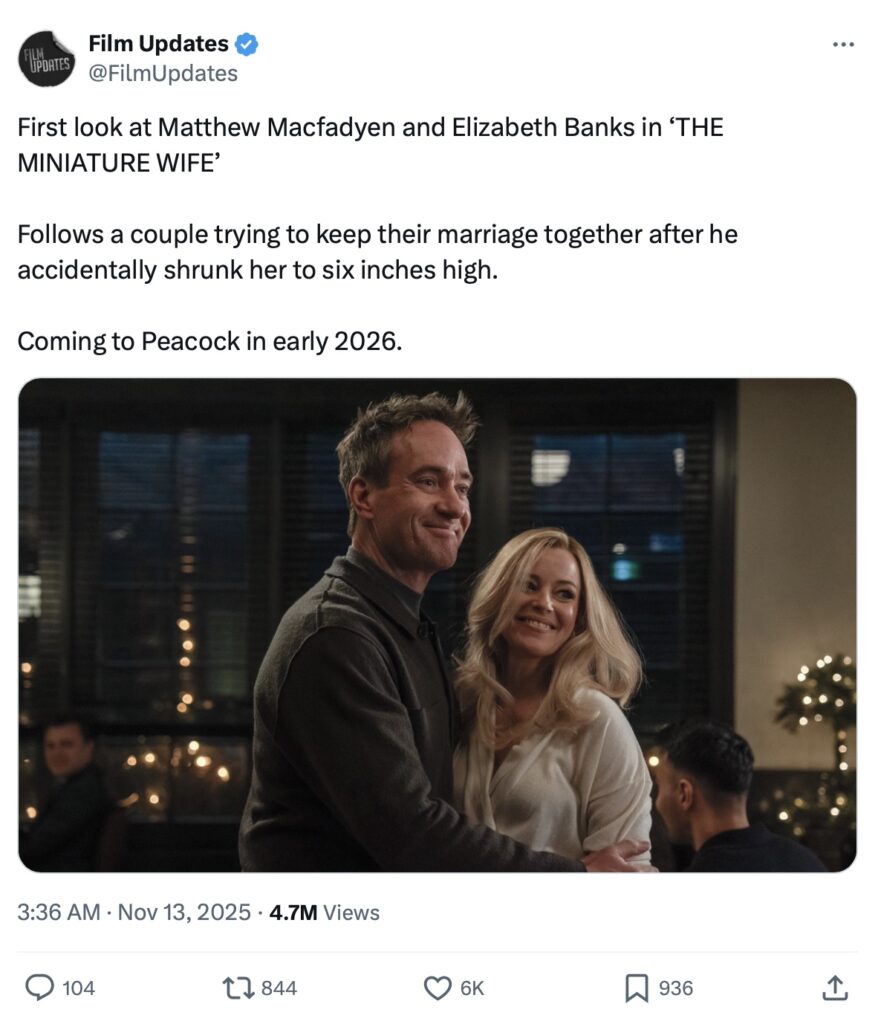
A few years ago, it was announced that his 2013 short story The Miniature Wife was in production at Peacock, and now, with an increasingly close release date, the world beyond Matthew Macfadyen Twitter stans and gossipy Bennington Jodel-users are hearing about the series and its inspiration. The response on Twitter has been, to say the least, an interesting glimpse into the contemporary literary landscape.
The majority of quote-Tweets and replies to Film Updates’ November 13 post of a still from the show reference Twitter user @ameliaelizalde’s July 2022 Tweet: “every book is called ‘the tiny things we know to be small’ or ‘the darkest wife.’” Amelia Elizalde is not a literary critic, but a comedy writer, whose IMDb credits include being an uncredited production assistant on American Horror Story and a writer on the TV series Stephen Colbert Presents Tooning Out The News. She mostly works as a copyeditor these days, with a focus (one gathers from her LinkedIn) on film/TV media companies.
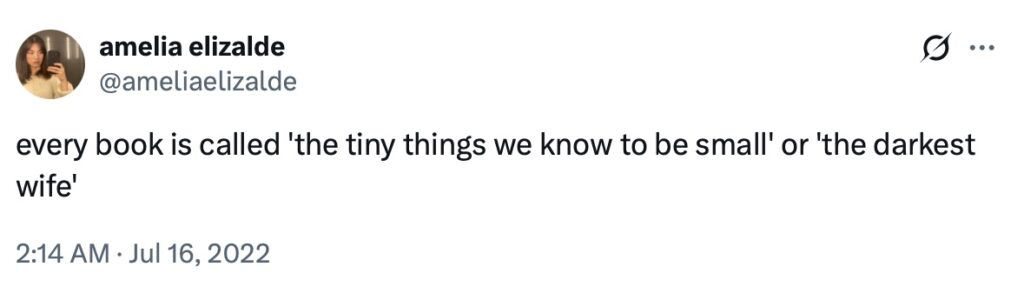
I don’t describe who Amelia is to say that her opinion is invalid, but to express how much of an opinion, an off-handed thought her initial Tweet had been. Opinion, devoid of critique, has overtaken the way we consume and understand media we’ve yet to engage with. Gone are the days of in-depth opinion pieces in the New Yorker unpacking the plot and creative choices of a particular text. Goodreads and Letterboxd encourage quippy responses summed up by a number of hearts and stars. The likes of Twitter, Instagram, and TikTok concern themselves with concise consumability and omnipresent irony.
Outside of repackaged versions of Amelia’s 2022 Tweet, the replies to Film Updates’ post include a plethora of dick jokes (see Twitter user @Tango_Returns “Six inches is not small. It’s not”) and various misunderstandings of the plot surmised from the title (Twitter user @AlexQueue: “So they made ‘would you still love me if i were a worm’ into a movie”).
Manuel Gonzales’ short story follows the plot of a woman who is literally shrunk by her husband. It is a toxic marriage—she is stepping out on him, he desires control over her, refuses to bring her back to her regular size, and the end leaves us with an unclear but foreboding future of a battle of the sexes.
Twitter user @anistotle_: “Title is really doing a lot of heavy lifting when it comes to the symbolism of emotional labor.”
Is it? I kept my synopsis of the story snappy so as to avoid spoilers, but I’ve read it several times for classes whilst at Bennington, and emotional labor was never a key aspect of the symbolism brought up in class discussions. I won’t deny that it can be read into the story—the husband is blatant about the fact that “she has no power” upon his wife shrinking. But emotional labor and domestic labor are not overt themes in the text. Rather, the metaphor seeks to display the turmoil of the relationship as a whole. Yes, she is small, but the second half of the story is win after win on the wife’s part. She burns the dollhouse he constructed for her, she tortures him physically. She breaks him to the point where he shrinks himself in order to find her and reconcile (or fight). This is not a story, not entirely, about the labor of women so much as it is a story about the nature of heterosexual relationships within a broader patriarchal society.
Looking at her tweets, Ani (@anistotle_) is not an ill-read person, nor is she the ire of my displeasure, just as Amelia had not been. Ani’s quick response to the announcement of Peacock’s The Miniature Wife is an educated guess written to seem more educated. ‘Doing a lot of heavy lifting’ reads as sarcastic; the Tweet reads as a passive “this story is too surface level for the likes of me, the ever deep Twitter user with a Carraviago as my background.” Ani runs a Substack titled Not Your Typical Finance Bro, with her first post’s variant title being A Manifesto Against Slop. This is a common theme in accounts such as Amelia and Ani’s. They desire to distance themselves from the online culture of consumption over engagement, as we all do.
But just as we all do, they still consume slop. Their tweets, and the way people use their Tweets, are evidence that they are swimming in the slop amongst us. To use a post, not even your own, as a mode of delivering an irony-pilled, jaded take on the state of contemporary art/literature/television is precisely what has made us view all art as content first and creation second. This view, the content mindset, is the slop mindset. You can, and many do, dress it up in classical portraiture and photoshoots at museums, references to the likes of Dostoyevsky, but we are all in the same space, here. Literary critique in casual culture is dead, and no one is exempt from that.
I find that this typically takes two forms. The examples above are the pastiche of the well-read (not to say that the women above are not well-read, but I am using them as one-dimensional pins). This form of slop-critique employs an attitude of being too well-read to engage with contemporary culture, particularly literature. The result is irony-laden Substack essays about the nature of art and how very good Dostoyevsky is. Why is it always Dostoyevsky?
For the record, this is the category I would place myself in. I have a Substack and I am shamelessly judgemental of much contemporary literature. I try to catch myself, though, because this sort of surface-level response to books or series I have not read or seen is precisely what creates an insular and unengaged person. To be unengaged with the world around you is to be unable to engage in true critique.
The second form is the “it’s not that deep” variety, the “you must be fun at parties,” the “let people enjoy things!” This type of person typically consumes a lot of popular art—they spend a great deal of time online, they enjoy Taylor Swift, and they believe very much that in their high school English class, the curtains were just blue. They likely haven’t read much fiction since high school. There was a lot of this under the announcement of The Miniature Wife, too, though not as much as the well-read pastiche.
What do I mean when I say true critique? I mean close-reading. I mean reading multiple times. I mean acknowledging the good and bad of a text without allowing one to overtake the other. I mean having an active conversation about a text. I mean treating literature, and other art, as art. I mean not consuming. I mean waiting until the damn adaptation is released next year before deciding you understand the meaning of a television series despite having never read its source material.
Not every announcement requires a response that creates an image of you being either an intellectual or nonchalant.
I came to this article with the intention of it being a short piece looking at the funny responses to our professor’s television series, one starring Matthew Macfadyen and Elizabeth Banks. Big names; a lot of eyes are on our professor and his work right now. What became clear was how much everything in our lives is merely content, something to consume and discard. I think to truly critique, we first need to actively engage with art, even if we hate it—hate and love often inspire the same passion. The general response to The Miniature Wife across the internet was one devoid of passion. The goal was to get someone to click on their feed, not respond. No one cares. We should care!
I have been reading a lot of Simone Weil recently as a part of my senior work. Attention and Will is a necessarily religious text, but I want to focus on a singular idea she writes on:
“Attention, taken to its highest degree, is the same thing as prayer. Absolutely unmixed attention is prayer. Extreme attention is what constitutes the creative faculty in man.”
Attention and concentration, according to Weil, are not absentminded tasks. When we treat art and literature as content, they become so. And then we Tweet.











Be First to Comment