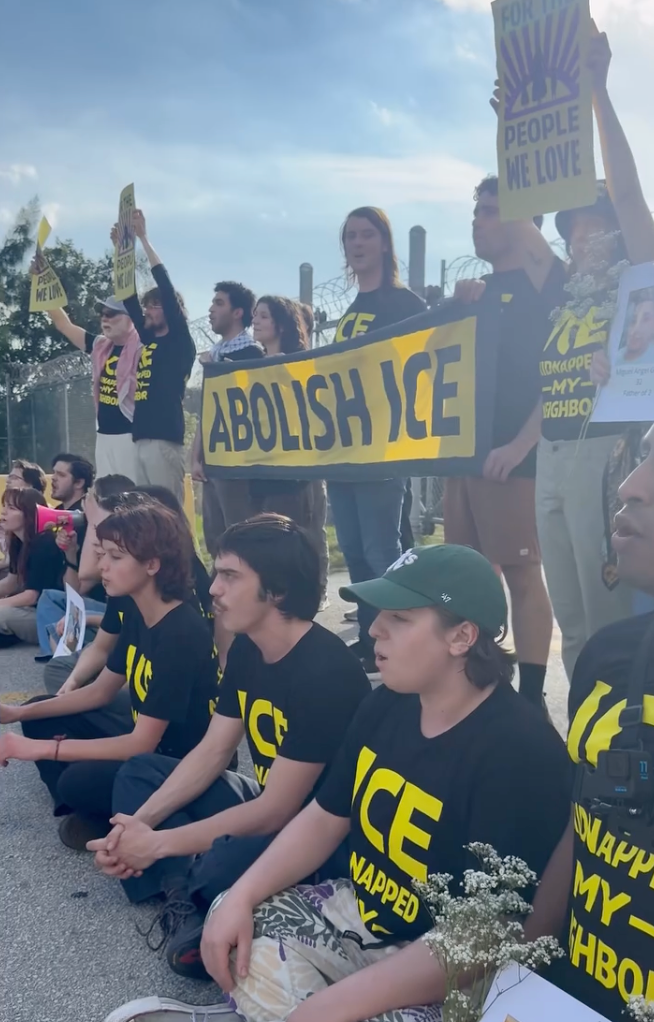
On November 20, Bennington College students Alex Libby and Kai Bjork traveled to Ochopee, Florida to protest ICE’s South Florida Detention Facility famously known as “Alligator Alcatraz.” Libby had been alerted of the protest by a collection of Indigenous groups who had sent out a call-to-action. The facility is illegally built on Miccosukee tribal land in the Everglades.
The protest was broadly organized by the Sunrise Movement, a climate action organization. On November 22, 60 to 70 people gathered outside the detention facility, 29 of them prepared to be arrested, including Libby and Bjork. They created a blockade in the road with their bodies and remained there for over an hour, preventing numerous vehicles from entering.
The police eventually removed the group from the road and arrested them, as well as a journalist who was covering the protest. They were kept on the sidewalk in handcuffs for about six hours. The police had closed down the road in order to make the arrest, which meant that vehicles were still unable to enter the facility during that time.
All through the blockade, and after they were arrested, the protesters continued to sing. Their demonstration was modeled on the Civil Rights Movement, which many of the songs were drawn from. “For me, one of the biggest takeaways from the action itself was how much power you have when you are willing to fight for justice and resist physically these unjust laws,” Libby shared. “It really shows you how much power that 30 young people managed to shut down these ICE facilities for like seven, eight, nine hours just with our bodies and singing. I think it really goes to show the power we have when we’re willing to break a rule we don’t think is right.”
Another technique they adopted from the movement was packing the jails. Once the 30 of them reached the Miami-Dade jail that night, they spent many hours being processed. They were kept in a large booking room with the rest of the jail, some of them for seven hours, others for nine. Libby described how they made friends with many of the people who were also waiting to be processed: “A lot of people in the jail with us were very interested in what we were doing. One of the people I made friends with best, his brother had just been deported a week prior, so he obviously had a lot of negative feelings about ICE, and we were able to take that to start the conversation.” They were all getting along so well that the guards eventually put them in solitary confinement.
Libby was kept in a cell from 5 a.m. on November 23rd to 3 p.m., when he was released. Bjork, who was put in a cell at 7 a.m., was not released until 4 a.m. on the 24th. The protesters who had not been arrested the day before had spent the time since phonebanking to raise money to make bail for those in jail. They were able to raise $40,000 dollars in only 24 hours. Most of the donations were from family and friends and those within the activism community, but there were also some more high-profile donors, including actress Hannah Einbinder and some of the cast members of the show Severance.
It was important to the demonstrators that footage of the protest was spread on social media. They wanted young people to see what was happening and hopefully be inspired to get involved themselves. Libby mentioned that young people are feeling hopeless, and this is preventing them from mobilizing. The protest at the detention facility was a way to tell them that they’re not alone in feeling that way, and that there are things they can do about it.
“Obviously, organizing that stuff is difficult. It takes a lot of work,” he said. “But it’s easiest to do when people are looking for others to connect with. I think this is opening a lot of people’s eyes to what is happening. I mean, we’ve had millions of social media likes now and tens of millions of views on this. And for the small amount of people who are like, ‘this is performative, this isn’t doing anything,’ there are millions more who are seeing this and going, I could be one of them. I mean, that’s how I got involved in this. I saw it on social media one day and went, oh, those are just normal people like any of us, I guess I could do that.”
Most of the protesters arrested were young white kids like Libby and Bjork. But many of the people they met in jail were from marginalized communities: people of color, those who were queer, unhoused, mentally ill, or addicted to drugs. Libby and Bjork quickly became aware of the privilege they had in the situation. Whereas they knew they would be returning to school with fairly no consequences, others in the jail had been arrested for minor reasons and would be missing work, not getting paid and were at risk of losing their jobs altogether.
“In jail you very quickly learn that the framing of jails and prisons as a place for rehabilitation is just completely wrong,” Libby expressed. “Once you experience the other side of that, the side that isn’t so visible, you very quickly realize that the idea that we have is completely wrong and that these places are just there to punish poverty, to punish mental illness, to punish being a person of color in this country.”
The silver lining was the solidarity they found with their fellow inmates. A lot of people they met supported the work they were doing to protest ICE. They showed Libby and Bjork around, told them what to do and not to do, and how to stay out of trouble. One of the men Libby met explained that while it was great he could show him the ropes, it was also incredibly painful to reckon with the fact that he could only do that because he was so familiar with the jail system and had spent so much time behind bars.
For both Libby and Bjork, it was hard to accept that they were able to walk out of the jail while so many people remained inside, some probably for a long time. Not to mention the people who were in detention facilities like the one they were protesting. “We were detained for a day, two days, and then we’re out,” said Bjork, “But, obviously, people going through the ICE system are detained and then deported to who knows where. They’ve been dehumanized and then disappeared. And then there are no reports. We had people working outside for us. Putting it into perspective, the reason behind what we were doing is more important than what happened to us.”
“Our experience, while horrific, was the best-case scenario,” Libby added.
If Bennington students are interested in getting involved in this kind of work, Libby says they should feel free to reach out to him. He is part of a local ICE watch group in Bennington. During the break, he encourages people to find out what is happening in their home communities or wherever they are spending Field Work Term, and get involved with a local organizing group or a mutual aid program in the area. He also recommends checking out direct-action organizations like Sunrise, Code Pink, Climate Defiance, and Planet over Profit.
“I think something that stops a lot of people is they get caught up waiting for permission to do something,” said Libby. “And I think one of the beautiful things about direct action is it shows that you don’t need to. If there is something you see as an issue, you can just go about fixing it yourself. And I think that’s a really beautiful and powerful thing. And I think that once you do it, it kind of changes the way a lot of these problems seem to you.”



Be First to Comment