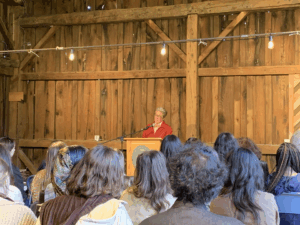
On Wednesday, October 14th, Literature faculty member Franny Choi read from their newly released essay collection, We Radiant Things: Notes on Being Alien and Becoming Cyborg, in Tishman Auditorium.
“We named her Rosie,” Choi began, smiling fondly at the memory of their broken-down Roomba. They chose to read from the essay “I, Roomba,” which explores the history of Asian American labor and the stereotype of the subservient Asian maid in relation to lovability and domestic roles. Like the collection as a whole, a blend of literary memoir and cultural criticism, the essay is propelled by the interplay of Franny’s lived experience and scholarly background in race, gender, sexuality, technology, and disability studies.
Moments of humor and lightness surfaced throughout the reading (including a GIF of a cat sitting atop a Roomba), reflecting the multifaceted voice that runs through We Radiant Things: critical and tender, probing, curious, and achingly self-aware. Choi describes Rosie the Roomba with an air of nostalgia and sobering honesty: “Sublimely unaware of her ridiculousness, she bounced from wall to wall, distracting everyone from her real job: to help me avoid the humiliation of using my own body to keep up the house, well cast as it was for the role.”
Notably, the table of contents is a “Table of Robots,” with each essay framed around a central figure. For “I, Roomba,” it is “Mia/Anita,” the robot maid from the British Channel 4 series Humans–the ‘title’ robot, if you will. The synopsis frames this structure with a pointed question: “Just why is it that whenever artificial intelligence is represented, a sexy but unfeeling Asian woman enters the frame?” Still, this is but one question Choi seeks to answer.
Each essay is given a supporting cast of equal importance. In “I, Roomba,” that cast includes broken-down Rosie, who kept things “civil with the cat;” Gemma Chan, the Chinese British actress who disappears when “Anita the synthetic swings into view;” and the hundreds of Asian women who post ‘auditions’ on platforms like the now-defunct MaidCV.com in hope of securing domestic work across borders. There’s Choi’s partner, the poet Cameron Awkward-Rich, who carries the history of Black domestic work; Choi’s mother “putting her goodness back together” by performing household ‘duties’; and, of course, Choi themself.
The result is an essay collection that refuses to shrink its subject and subject matter down to a singular experience or lineage. These collective voices represent an array of human experiences finely attuned to current cultural and political dynamics, contextualized by their complicated histories.
At the Q&A, many questions focused on Choi’s research process for We Radiant Things. When writing from lived experience, Choi explained, their poetic sensibilities took the lead; theory informed the work broadly, and research was threaded in afterward. Often, they would read entire books only to end up with a quote or two in the manuscript, an outcome shared by many of their other investigative projects. With a smile, they recounted the multiple tech conferences they attended and the interviews they conducted, none of which were ever directly referenced. Nevertheless, their efforts were not in vain. Choi maintained that these learning experiences and the material an artist absorbs become part of their identity, adding to a base of knowledge reflected in and inseparable from the writing itself.
The evening made clear that these “Notes on Being Alien and Becoming Cyborg” are not mere jottings. For the audience, they offered not only insight into the book but also a unique example of how a writer expresses all they have taken in.
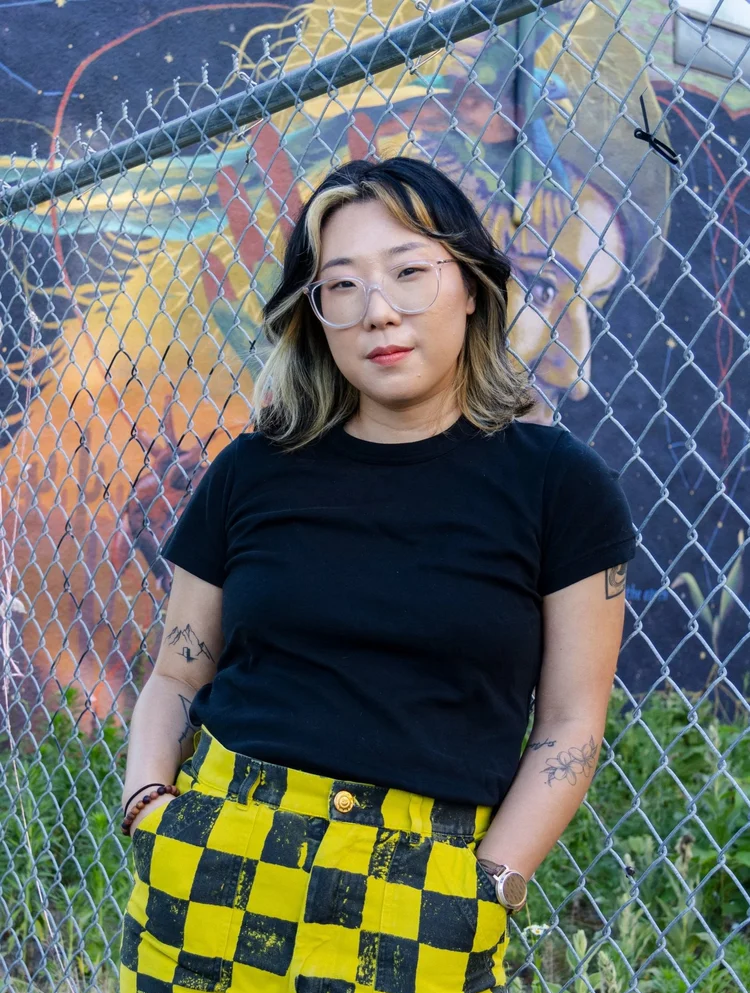
Franny Choi (they/she) is a poet and essayist. They are the author of the essay collection We Radiant Things: Notes on Being Alien and Becoming Cyborg (Ecco, 2026) and three collections of poetry, including The World Keeps Ending, and the World Goes On (Ecco, 2022) and Soft Science (Alice James Books, 2019). They also co-edited the anthology We the Gathered Heat: Asian American and Pacific Islander Poetry, Performance, and Spoken Word (Haymarket Books, 2024), and their work has appeared in The New York Times, The Atlantic, The Paris Review, and elsewhere. Franny is a member of the Literature Faculty at Bennington College and the founder of Brew & Forge, a project that builds connections between writers and social justice movements.




Be First to Comment