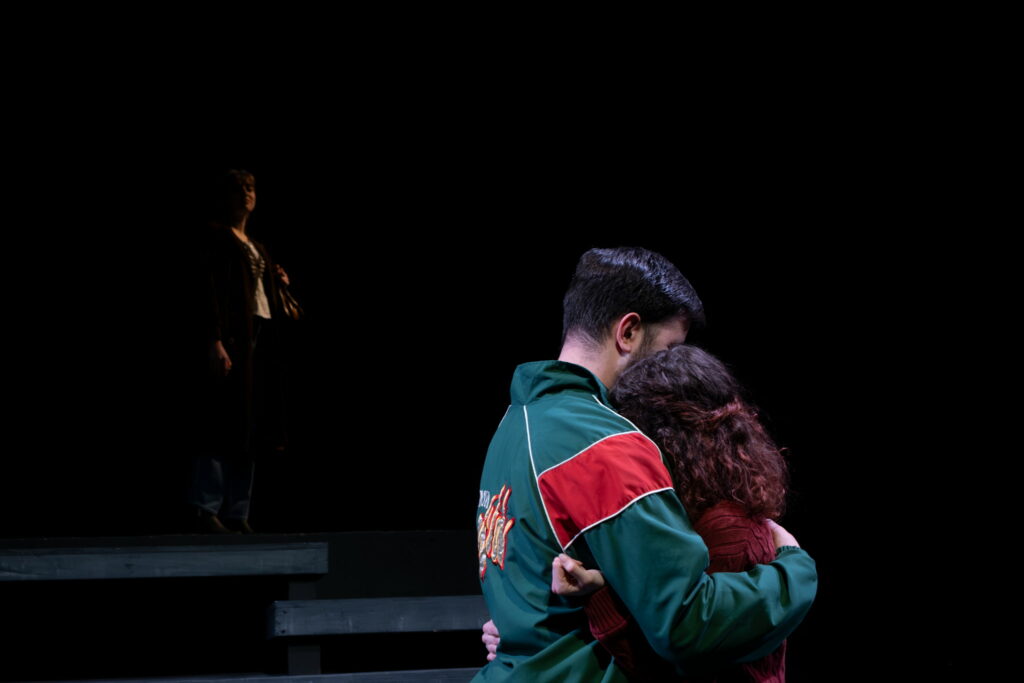
I arrive at Newman Court right at seven, hoping to snag some last-minute tickets. It was the final night of the show, and my name was just another on the waitlist, though I swear this time I was “on it.” While wandering the lobby, I watched clips of hockey games projected onto the hardwood walls (perhaps to soothe jittery souls such as me). In the end, I was able to snatch a seat at the back—the perfect view for what turned out to be one of the most spectacular Bennington Drama Student Productions.
“The Rink,” written by Timmy Torinus and directed by Maeve Hamilton, was made possible by the efforts of fellow students, the Drama faculty, and the College at large. Yes, the stars of “The Rink” are hockey moms (a particularly “hot” topic as of now), but replace hockey with any sport, and “The Rink” would still be the masterpiece it is.
From the writing to the production itself, everything was simple on the surface. But calling “The Rink” simple would be an injustice. The dialogue was natural, the delivery immaculate. As soon as they stepped onto the stage, the actors ceased to act. Tucked away in a dark corner–it felt voyeuristic, in a way, and I loved it.
A news report opens the show…but it really begins when hockey mom Kristy (Hannah Hall) enters stage right, smoking a cigarette. Now it’s a Bennington production.
The range of emotion throughout the show was striking. Each actor was just beyond me, but Judy (Megan Reid) gave a standout performance. From hockey-mom gossip, brutal honesty, and the fragility people assume when approaching the grieving, “The Rink” was an authentic portrayal of life hurtling on.
The premise: the son of hockey mom Jocelyn (Naomi Schneider) has died in a tragic mudslide on a field trip. Kristy’s sister, Judy, was a parent volunteer, but, to our knowledge, he wasn’t in her group. Spoiler: he was, and he was getting testy–Judy sent him off for a moment and returned too late. But before the big reveal, there’s an affair, a potential lawsuit…the entire soundtrack of a poor rendition of a child singing the national anthem that had me in tears at the end (I mean, you can’t even imagine).
Scenic designer Katie Hanson’s concept is simple but brilliant: a structure built of platforms painted to match the stage. But the intricacy was mind-boggling: everything was, quite literally, a moving piece. Platforms stacked to form bleachers, a staircase, and two sliding blocks shifted into a table; rather than a traditional set, the entire landscape adjusted with each scene.
There were many subtle, striking moments, too. Jocelyn walks down the bleachers, looking for a place to sit (it’s as anxiety-inducing as junior high lunch). Later, Judy sits down beside Kristy for a sister-to-sister moment, their legs dangling off a ledge, swaying like twin pendulums. Full circle, it’s summer again: Kristy lies on her back, sprawled out on the table, while Judy circles her, picking up candy wrappers, her son’s birthday party remnants.
And then, the plot twist: Judy throws herself up the stairs, begging her sister to stop as she casually fishes through her purse. Why is she so desperate? Why has she been so desperate to help Jocelyn the whole time?
It falls from Kristy’s hand. Jocelyn’s son’s missing medical bracelet is in the spotlight.
Kristy steps away from her sister, mute, expression unreadable. Judy sinks to her knees–her guilt and empathy, fully embodied. While she’s desperately trying to explain, a figure walks onto the back of the stage. It’s Jocelyn, ready to pick up her younger son. She sees Kristy and Judy, she sees her son’s bracelet, she’s standing there in all her godliness: a hockey mom, the other woman, a grieving mother.
“I couldn’t save him,” Judy confesses, “but I could do other things.”
Steam envelops Jocelyn’s figure as she witnesses the confession. She’s almost gone now, an apparition—and yet, that intensity. The shock on her face begins morphing into something more as the theatre goes dark.
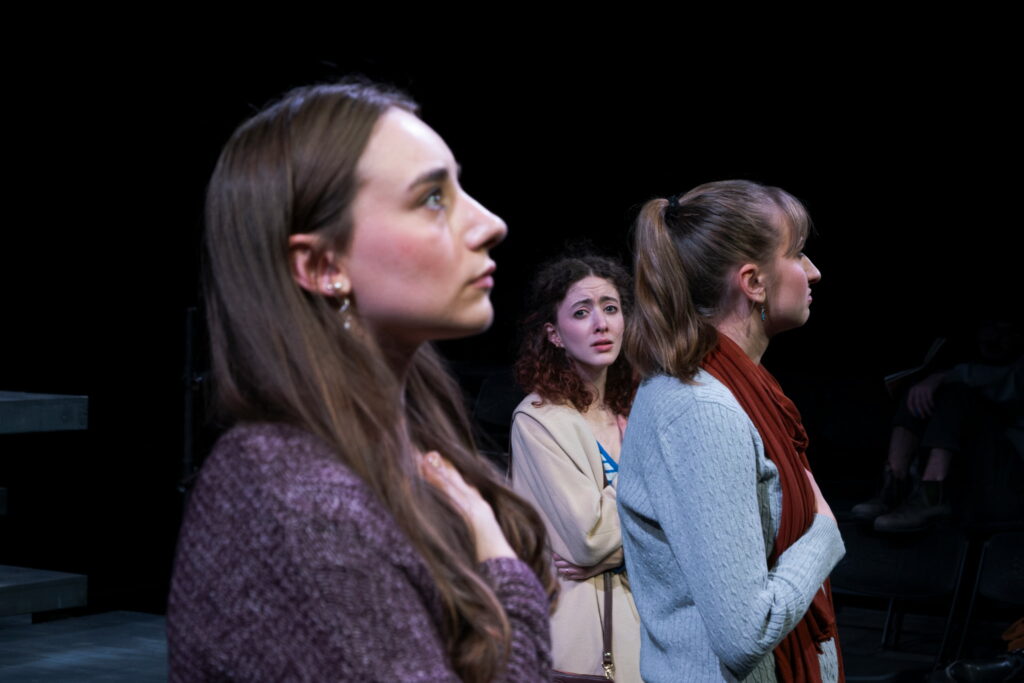
In the age of short attention spans, it was a no-intermission kind of affair, a production that leaves you turning over everything that happened in that dim room. Part of the experience is the time you take to untangle precisely what that something is.
“Our skills of patience and empathy are routinely tested in a world that increasingly values convenience over connection. I hope that this show can serve as a vessel of empathy and connectedness, in a moment that can feel devoid of both of those things,” Timmy Torinus writes in the Playwright’s Note.
“The Rink” certainly accomplished that and more. Hockey moms, a trope with many cliches and potential pitfalls, was approached with real care and understanding. In her Director’s Note, Maeve Hamilton emphasizes the significance in today’s political climate, writing “As this play examines the complexities and dualities of women, especially mothers, the cracks in our socialization begin to form…The ‘women of the Rink’ are more than multifaceted, but utterly powerful in their determination to support one another. ”
But I could do other things.
Here’s where I’d admit I lied, and, like Judy, I’ve learned something too. I wasn’t “on it” with the tickets. Despite having friends who sent out reminders, poured their time and effort––their love––into the project, I got caught up in my own little helix. Productions like “The Rink” are born through student initiative and brought to fruition from the College—acts of collaboration and camaraderie despite an increasingly nihilistic forecast. It’s time we do what we can when given the chance to see what other people are creating here, out by the End of the World.




Be First to Comment