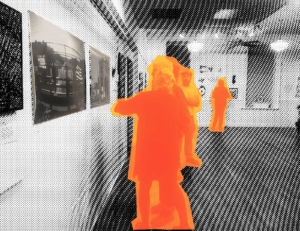
On Monday, March 9th, the Usdan Gallery at Bennington College debuted Carmen Winant’s “Double Jeopardy” exhibit. The exhibition included window installations of video stills, framed collages, and three videos projected and played on monitors with acrylic filters. Winant paired the opening of Double Jeopardy with an artist discussion on project development, craft, and personal research the following day in Tishman.
In the words of Winant, “Double Jeopardy” is a term used by feminists, particularly in anti-violence work, to signify twin threats. “I heard it often in videos referring to the precarity of class and gender, but it also can refer to gender and race, especially Blackness. In other words, if you’re poor and a woman, or a woman of color, you are in this state of precarity.,” she shared. The word “precarity” describes a state of instability, and in these situations, a life without a safety net. This includes housing that could disappear, income that isn’t guaranteed, and legal protection that isn’t assumed. For the women displayed in this exhibition through photographs and videos, that instability is rarely the result of a single factor.
Winant began her project by digitally scanning hundreds of hours of footage from the National Coalition Against Domestic Violence (NCADV) archive in Denver, Colorado. Alongside original material produced by the NCADV, the archive contains content from news media and popular culture outlets; law firms, shelters, and family advocacy groups; as well as corporations and governmental bodies, including the White House, the Ford Foundation, Polaroid, and Blue Cross Shield of both California and Georgia. There are reenactments of violence: recordings of group therapy, and taped full-length plays, movies, and music videos that address or depict domestic violence.
The Exhibition
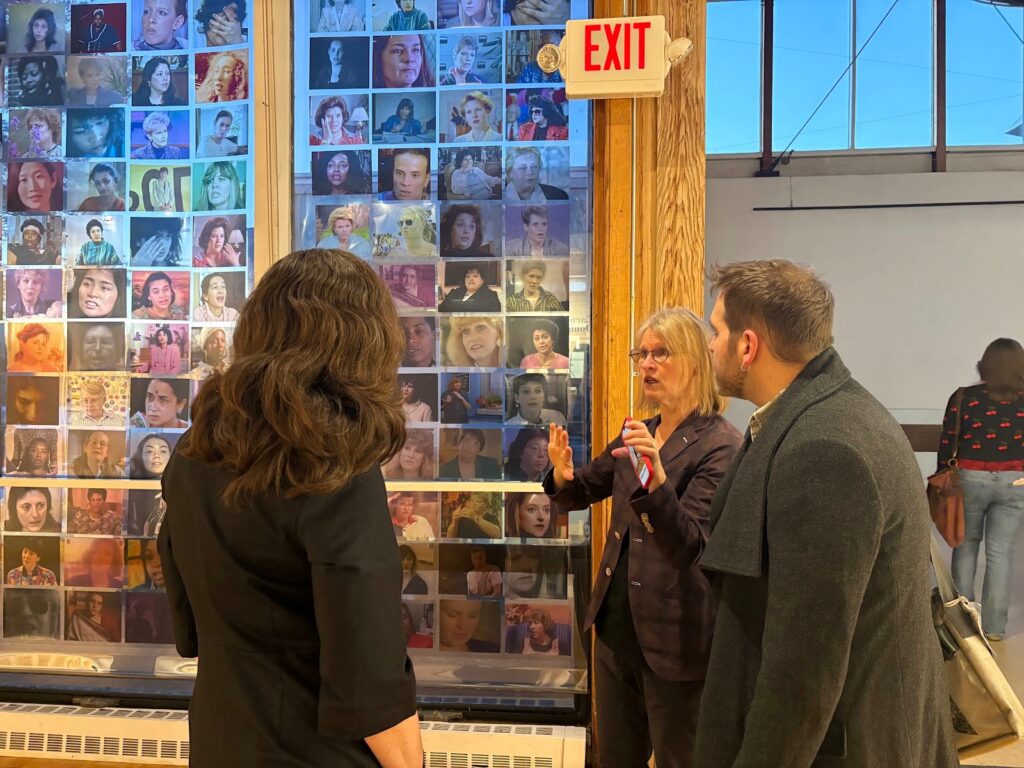
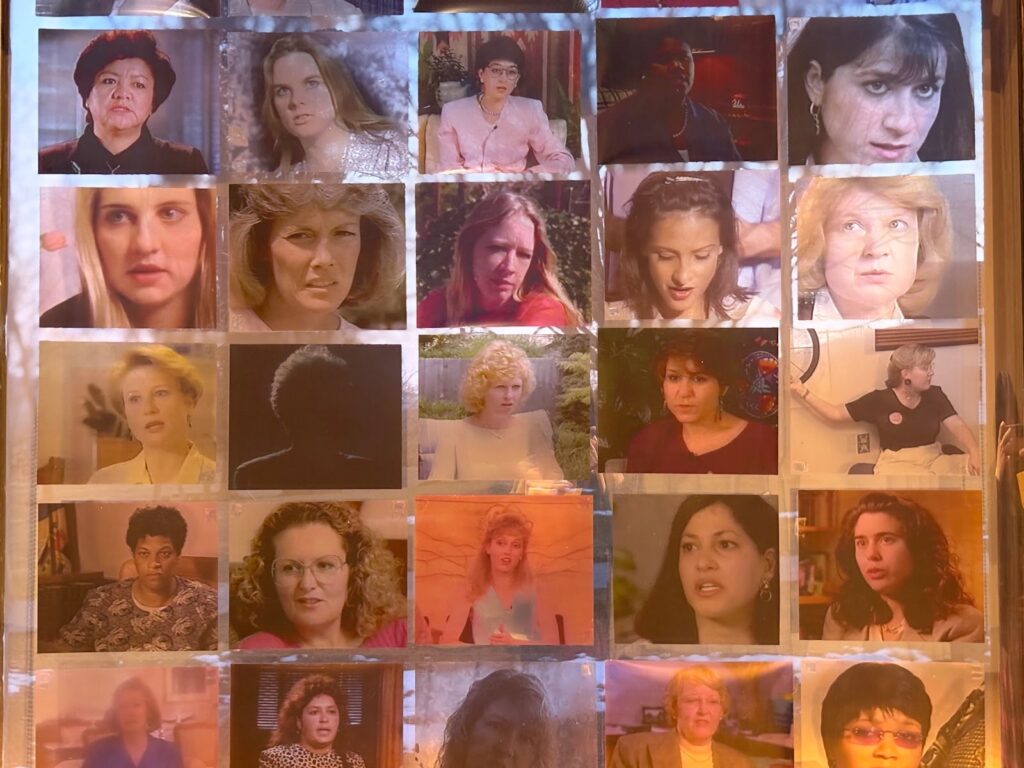
Upon entering the gallery, I was confronted with dozens of video stills installed on the windows. The images are highly pigmented and printed on transparent film, showing the faces of women telling their stories, many looking straight into the lens. These video stills are derived from footage in the NCADV archive. Many of these stills came from VHS tapes featuring news content, including segments on women who killed their abusers, coverage of the O.J. Simpson case, and reporting on female officers handling domestic violence cases. The archive includes global material with UN and aid organization videos from South Africa, Israel, Japan, and Namibia featuring survivor interviews.
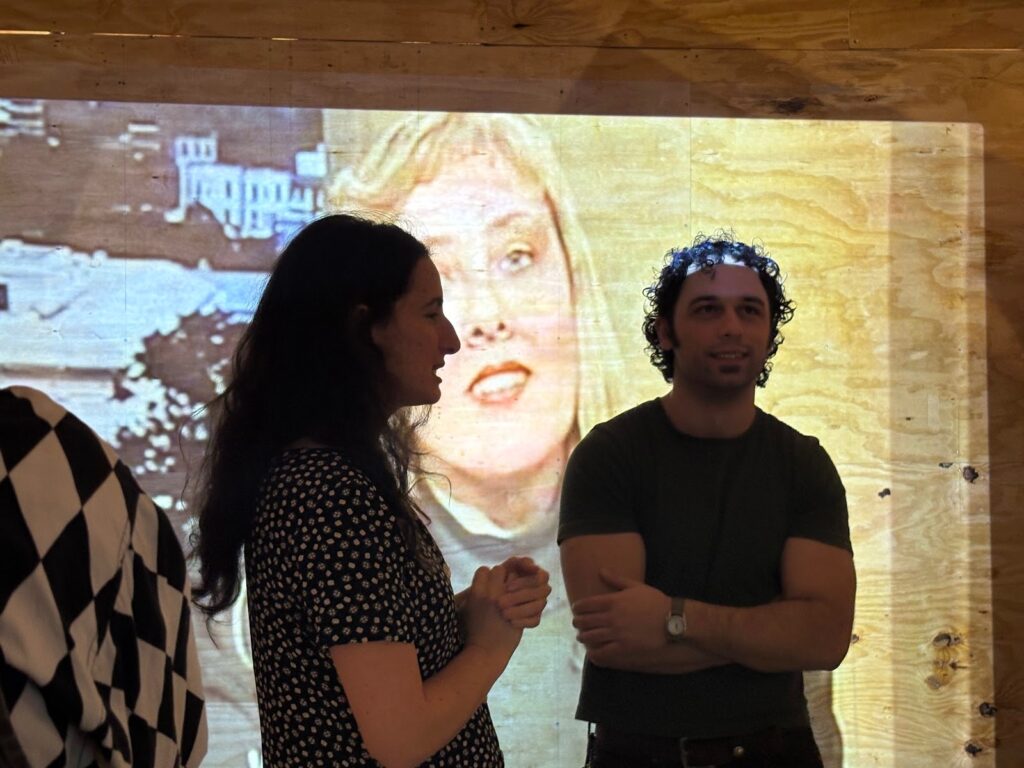
In the middle of the Usdan Gallery sits a house-like structure made from standard plywood. Inspired by prior projects of hers, including work about lesbian separatists presented at the Cleveland Museum of Art, Winant felt compelled to build another architectural structure reminiscent of the “home.” Additionally, it served as a solution to the problem of how to show multiple videos in a condensed, concentrated way that didn’t feel overcrowded and obscure the videos. The outside appears as a box house, unpainted and lit from inside. Inside there were two components: one large-scale projection on the interior with ambient audio audible throughout the gallery, and on the other side, a screen displaying men’s group footage through a textured acrylic layer. The screen displays pieced-together footage of men’s groups discussing family histories and the cycles of violence they internalized as children. Much of the footage displays group therapy reenactments made for training purposes. Winant expanded on the pieces in the Usdan catalog: “Primarily, they talked about masculinity, often without explicitly calling it as such: how they took out their frustrations on their wives, how their violence came from a place of perpetual unrelenting insecurity and immeasurable fear. These group ‘training’ sessions are not quite group therapy, but also not quite anger management.”
“It was eerie to be faced with the perpetrators, knowing what they’ve done,” a student told me. On the other side of the interior, full-scale projects show people listening to accounts of domestic-violence experiences, perpetrations, and conditions. These audiences appear in news media environments including issue-driven daytime television programs and popular talk shows.


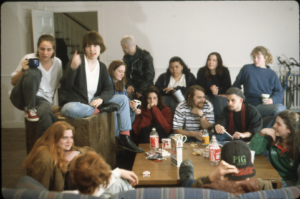
On the exterior of the house, sharing the wall with the men’s group footage, there is footage of several women’s group and daytime television segments about domestic abuse. Edited and collaged together were videos showing women’s support groups, survivors sharing their stories, how they stayed, how they got out, and how they coped with abusive situations. Others document workers and activists discussing training and logistics. These two “categories” begin to collapse as you realize many of the women running the movement and contributing to this work are survivors themselves. These two pieces in contrast with one another are hands-on visua, and auditory experiences. Viewers are invited to sit in chairs and put headphones on to hear the audio, listening for as long as they please. “It was an emotional experience and transfixation of time, I found myself sitting there for 15 minutes slowly tearing up,” one student said.
Surrounding the outside walls of the house-like structure were six framed collages. Winant collaborated with activist Yolanda Bako to present an intimate portrait of one woman’s life in the movement. The collages pair excerpts of Bako’s words with photographs of her personal archive, captured during a visit Winant took to her Bronx apartment, with images that include background surfaces like folders and tables and occasionally Winant’s own fingers. Every piece in the exhibit was anonymised except the collages about Bako. The collages share a slice of what it’s like to be a part of domestic violence work and what drove Bako to begin. Her experiences in the domestic violence movement are revealed through photographs of larger-scale meetings, rallies, and intimate gatherings alongside text generated by Winant.


The Process of Creating “Double Jeopardy”
In her hour-long talk, Winant described how the initial project began in 2021 with research in the NCADV storage unit in downtown Denver. As an introduction, she began with June Jordan’s 1980 poem “Poem About My Rights,” a piece that encapsulates the all-encompassing experiences of racial identity, violations of bodily autonomy, and experiencing sexual violence. After years of relationship-building and working closely with the NCADV, Winant acquired access to the archive. There she encountered 110 boxes, most of them unlabeled.
Using the term “unsexy,” Winant described the archival work that was necessary to create the large interactive exhibition. She described orchestrating the digitization of roughly 200 unlabeled VHS tapes by hiring people to help in archives when she couldn’t travel, and triangulating between multiple parties, including legal and administrative offices that oversee the archives. The digitization process took about three months and Winant emphasized that these tapes had to be played in real time, meaning there were hundreds of hours of footage to examine and analyze. Some tapes were three minutes; some ran two hours. “I often feel, as an artist working in archives, that I’m treasure hunting while trying to be responsive to the material, and sort of clued into what I wouldn’t even expect would be there,” she said. Once digitized, Winant would watch the material after her children went to bed and between work meetings. She began arranging the footage into estimated categories based on content. This included office work, news shows, reenactments, training videos, daytime talk shows (such as Sally Jesse Raphael, Donahue, Oprah, and Ricki Lake), children’s PSAs, and more.
What caught Winant’s attention was footage in which women sit directly in front of the camera and speak, calling it “Women to Camera.” “There’s a category that I was calling ‘Women to Camera,’ and it was really so striking to me. To see how many hundreds — indeed, thousands — of women in these videos, which as I mentioned, are coming from all different sources, are sitting down and talking to the camera. They’re not being passively filmed. They are directly turning to the audience and sharing.”
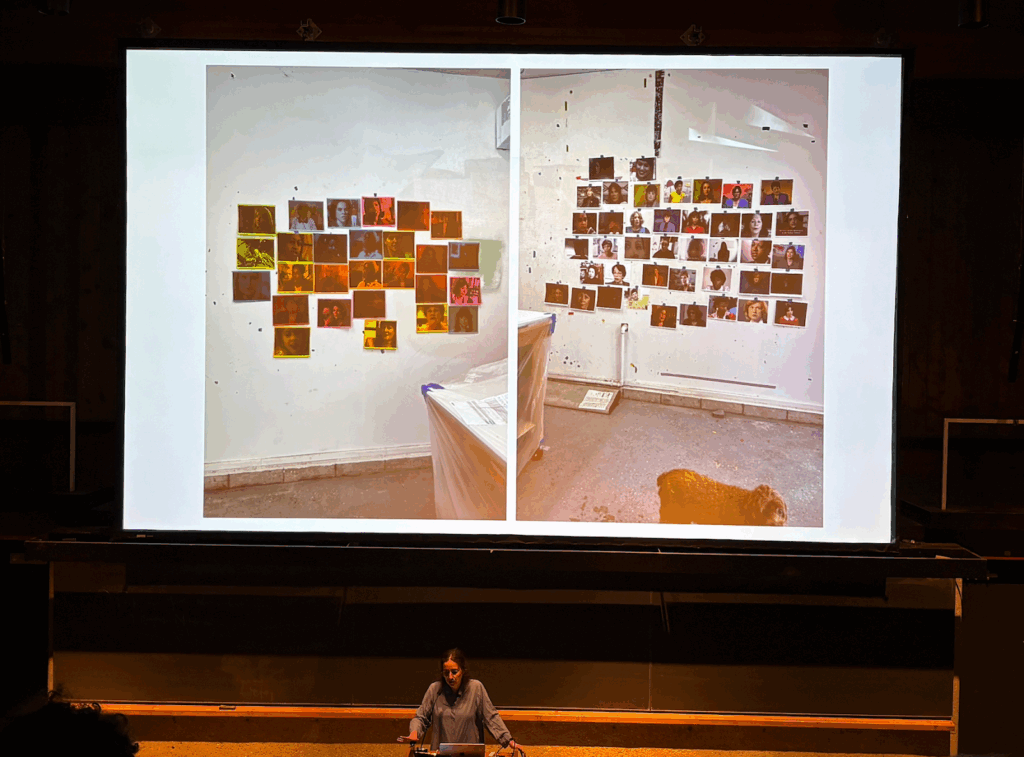
After reviewing all of the source material, Winant sat in her studio, located in the garage at her house, speculating on how to incorporate the still images of women into the project. She printed them on colored paper, tested different scales and densities, and restrained herself from overanalyzing the task. Ultimately, she printed the images from VHS footage onto cheap laser-printer transparencies and taped them in the window of her house overlooking the backyard. Resembling stained glass, the imagery had vivid pigments on the inside and nothing on the outside. “That struck me. So utterly photographic. Hold negative light to see it, all the inversions, dark light.”
In her work, Winant is sensitive and attentive to the subject matter’s relationship to consent and the exposure that archival footage commands. She aimed to honor the people who appear in the archive without putting specific individuals on display. “This felt to me like an ethical way to show people speaking, to listen to people speaking about their experiences, without centering visual action on their faces. Like putting their very subjectivity, their very body, in front of us to consume.” To preserve people’s privacy and expand the viewing experience, she developed a method of presenting the videos through textured acrylic, a material that dulls the images without completely cloaking them.
After the gallery showing, I discussed the content of “Double Jeopardy” with Usdan Director Anne Thompson, who curated the exhibition. Thompson explained that the house was designed and built by visual arts faculty John Umphlett and Phoenix Malanga inside the gallery. We discussed the importance of the exhibition at a time of political uncertainty and the relevance of Winant’s highlighting domestic violence organizations and services. “ I think this is an important thing to think about right now,” Thompson said. “How does revolution happen, how does organizing happen, how do you get people together? What are the nitty gritty logistics of getting a movement going on? These questions are central to Carmen’s work and of particular urgency today.”
Winant’s art serves as a series of documentary pieces that represent and remind us of the deeply-ingrained reality of domestic violence around the globe. In her lecture, Winant discussed being a didactic artist, explaining that she takes pride in making art that influences and highlights underrepresented narratives. Didactic art essentially means that the artist is trying to tell the viewer something specific using art as their means of communication. This meaning can be explicit or implicit, and can be in any media form. I asked Thompson what Winant being a “didactic” meant to her.
“As Carmen said in her talk, which in large part was aimed at students in the audience, being didactic is often frowned on in art school. You don’t want to make work that might be too literal or too quickly understood. She’s pushing back at that idea by holding up the value of a direct and clear presentation of information,” Thompson said. “The trick—the brilliance—of Carmen’s practice is that her presentation of existing materials from the archive is direct but nonetheless complex. She complicates and mediates information through strategies of display such as repetition and scale. It’s slow work that requires time to digest.” With subject matter like domestic violence, it is important to put survivors on the front line, expressing the realities and normalcy of abuse in the patriarchal system. Confronting the public with this artwork, it allows victims to have their voices heard, and counteracts the vicious narratives, laws, and systems that have historically silenced and failed them.
After its installation at Usdan Gallery, “Double Jeopardy” will travel in the fall to the Radcliffe Institute for Advanced Study.
“Carmen Winant: Double Jeopardy” is on view March 9-April 25. Usdan Gallery is open to the public Tuesday-Saturday, 1-5 pm, and by appointment.
If you or a loved one is experiencing domestic violence call here: 1.800.799.7233 or text BEGIN to 88788.





Be First to Comment