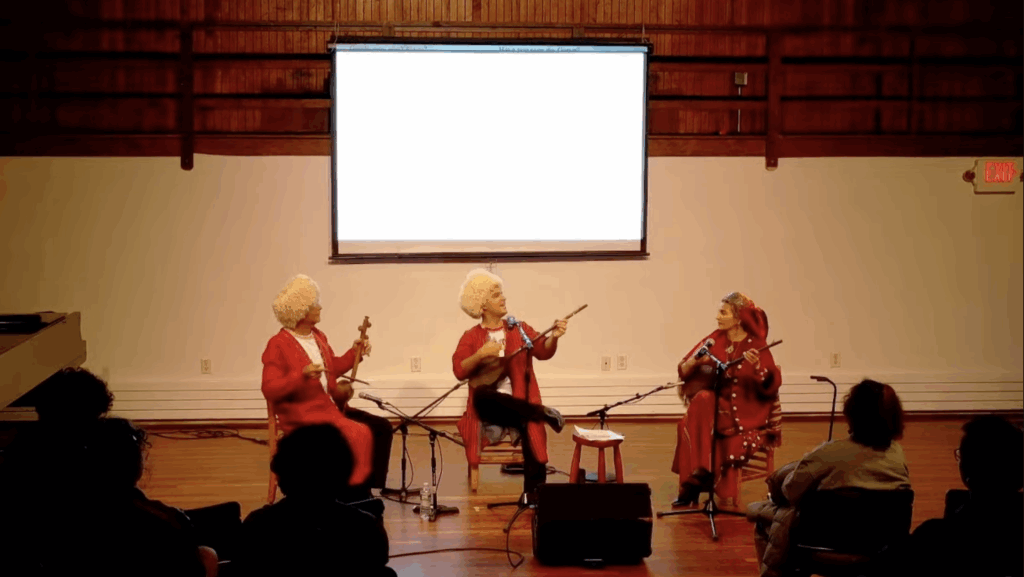
Master dutar player Oghlan Bakhshi, alongside his father Abdolghaffar Geldinejad and wife Zyyada Jumayeva, performed a series of traditional Turkmen pieces in the Deane Carriage Barn on October 22.
On a projector image which appeared before the trio came on stage, the three musicians sat on the vivid green steppe behind the chairs they would soon occupy, the green plains contrasting with the soft red spotlight engulfing them. Music faculty Joseph Alpar welcomed Bakhshi for a second time to Bennington College (his first performance took place in the spring of 2022). The musicians proceeded to the front, taking their seats.
Introducing himself to the audience as his birth name, Mohammed Geldi Geldi Nejad, Bakhshi explained that he received the title “Oghlan Bakhshi” from a master dutar player for developing great skill at a young age. Bakhshi described how, when young musicians are “blessed by their masters,” they are not only tasked with spreading the bardic tradition, but also with bringing their own contributions to the style. They announced that the concert would be the first time Turkmen music was performed in a trio.
The performance took the shape of a traditional nomadic wedding, beginning with songs in a lower register and progressing toward a focus on the highest zone of the dutar. Behind the seated semi-circle of the three musicians, the words of 18th and 19th-century Turkmen poets—the lyrics of the songs performed—were projected alongside their English translations. The poems ranged widely in content: there were heroic epics about face-offs on the battlefield, laments from young brides telling mothers not to miss them when they marry, and duets between lovers sung by Bakhshi and Jumayeva.
At the performance’s start, Bakhshi directed the audience to “pay special attention to the unique guttural embellishments” in the pieces, capable of conveying moments of peak intensity in the poems. Before each piece, Bakhshi would begin strumming, looking right, at his father adjusting the tuners on the gyjak, and then left, at his wife tweaking the pitch of the two-stringed dutar. Tuning turned seamlessly into song, Bakhshi would pull up his sleeves and begin the piece with the first strum.
The tempo of the pieces evolved throughout; at moments of intensely detailed playing, the vocals would subside for a moment, then pick back up again. During vocally complex moments, Bakhshi’s hand would simply hover over the body of the dutar, strumming with only slight movements of his fingers. At other times, he strummed percussively, dropping his wrist with force and hitting the side of the dutar with his thumb.
In each song, Bakhshi said that the “nomadic lifestyle’s affect [on the] the singing” could be heard, the “calls and exclamations reflecting the barking dog” and the “strumming imitating the galloping horse.” Tilting his head away from the microphone, he sang long, sustained notes. Coming closer, his voice’s exact fluctuation in a series of guttural embellishments built intensity with each repetition.
Before playing the song “Şalyk bilen” (“With Royalty”), Bakhshi spoke about the poet and philosopher Magtymguly Pyragy, who wrote the lyrics, and “in the last verse, returns to himself and asks questions of himself.” The purpose of this performance was not only to preserve Turkmen culture, gesturing to the past, but to ask questions of it, developing the craft of Turkmen music and experimenting with new techniques. At the performance’s end, the trio received a standing ovation.



Be First to Comment