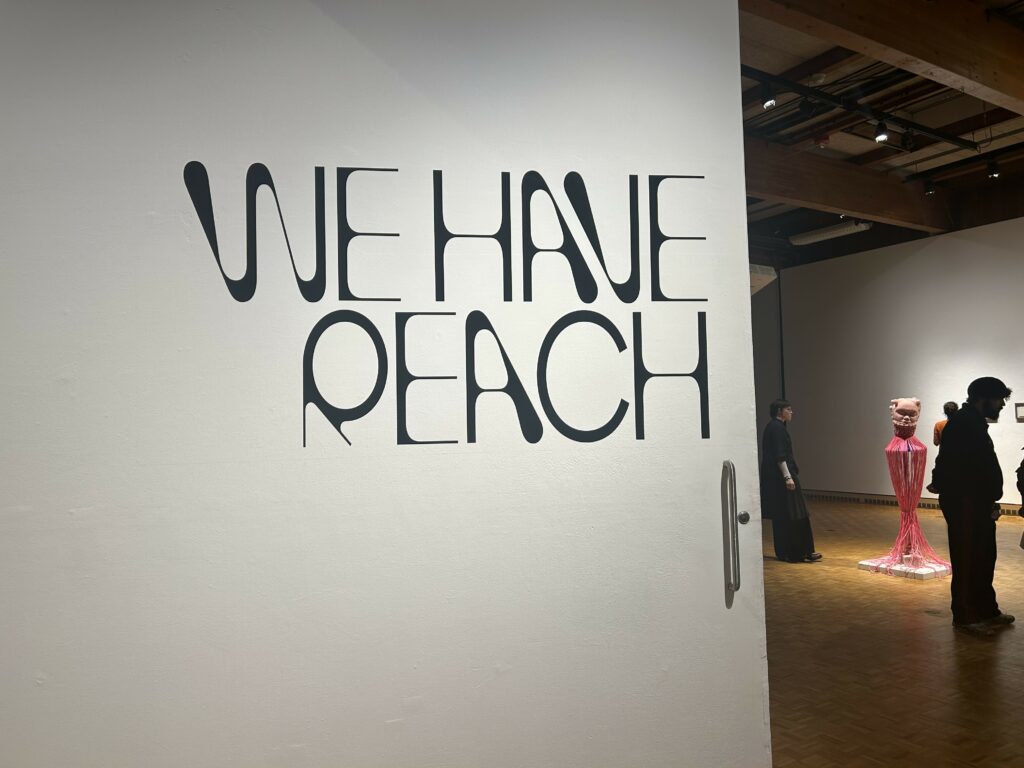
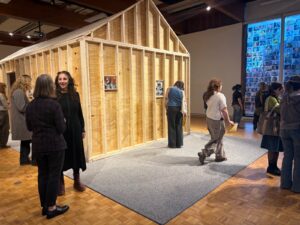
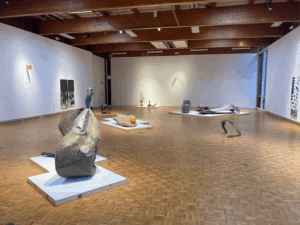
The gallery inscription promises a transformation throughout space and time. I was not partial to the phrasing, “space and time,” because by default, every transformation is throughout space and time– they are the only way in which we can conceive of our existences. Nevertheless, each piece of the exhibition shows how bodies move in time and space. They converse because they can juxtapose each other and there is almost a movement. One can encounter one body in time and space then another. This creates movement– a hard task considering the meanings of each piece are very distinct.
The exhibit contains various mediums from sculpture and paintings to film and oration. It is difficult to bring an assortment of artists and mediums together; a theme is difficult to conjure with so many moving parts. Every piece is going to be created with a distinct message in mind, so collecting them under one message can hinder the piece’s ability to be direct because of the viewer carrying ideas from one display to the other. The umbrella that contains all the pieces under it can be stretched thin. The message could be shallow in order to cram a lot of pieces in it. The solution to this problem is having each piece be in dialogue with each other. In the exhibition, I believe this dialogue was achieved mainly by the presentations on opening day. Because these presentations equip the audience with the vocabulary which the pieces use in dialogue with each other. I will catalogue a few which hold the spirit of the show.
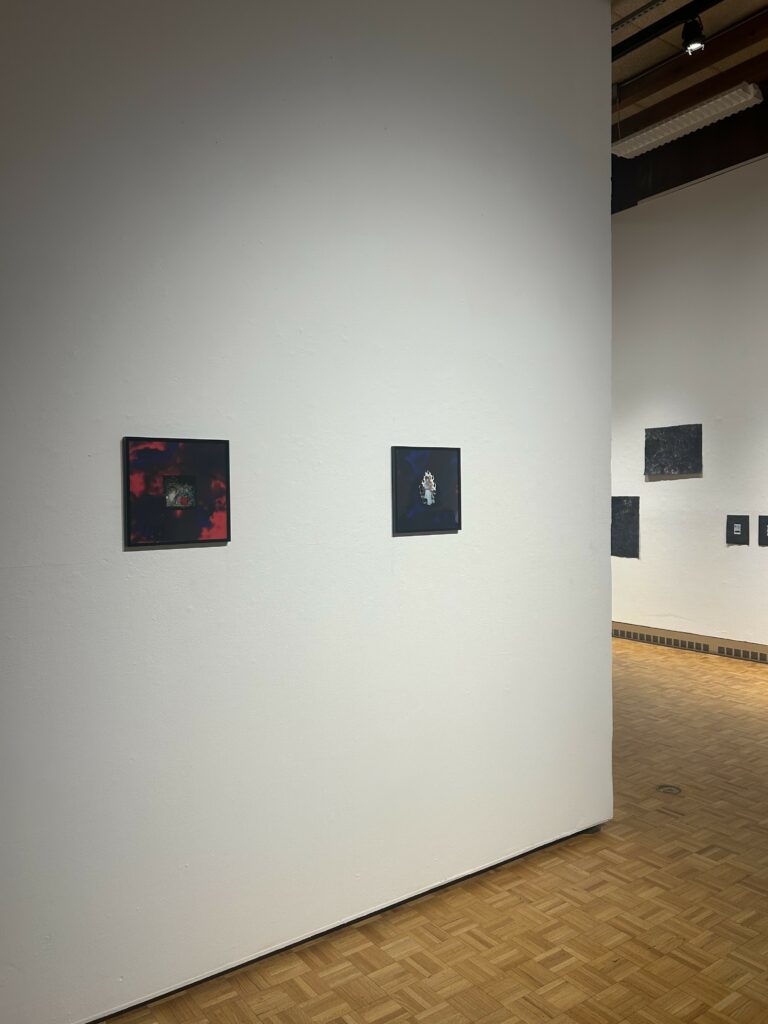
The central exhibit of the show was not what is on the walls, but the performances which enlarged and contextualized the art. For example, First Embrace and Illuminated Cares do not grip the eye of the viewer on their own. They are very small pieces on a large wall in a focal point of the exhibition. When arriving at them, I was confused why such real estate was allotted to small pieces that do not seem as radical as the works surrounding them; however, in context with Zoe Butler and Sherae Rimpsey’s presentation they feel as though they radiate to the size of the wall itself due to the story of the woman centered.
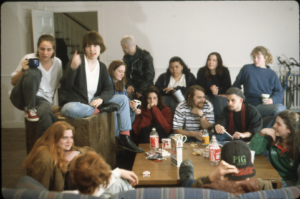
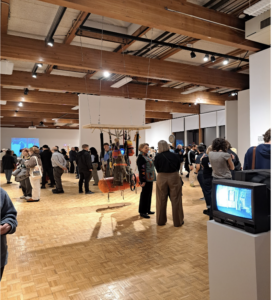
The first presentation was an essay done by Zoe Butler. The setting was a large open space with a black wooden rocking chair next to the projected image of an old woman caring for a child. During the reading, the image it presented was now complete. There was a small crowd of people sitting down, and coupled with the rocking chair conveyed the image of a classroom or an educational talk from an elder– but, there was a giant space between her and the crowd. This gap was even more prominent when the next speaker began by moving through the crowd whilst beginning her poem. There was an awkward distance between where the stage was and the audience formed a circle where they assumed to sit. If people were seated closer to the stage to integrate the audience, it would not just convey the faint image of this educational setting. It began with the story of her grandmother. Immediately relaying it to the piece opposite of her already mentioned. Then the audience learns that this is a family picture. She begins to compare her grandmother to the creature name, a Ole Higue folktale of a shapeshifter. It shapeshifts through fire which explains the fire imagery. This creature is irritated by salt, which she then uses as a parallel to the cruel colonial means of attaining salt. Then she analyses how light and the philosophies which use light as an imagery for knowledge.
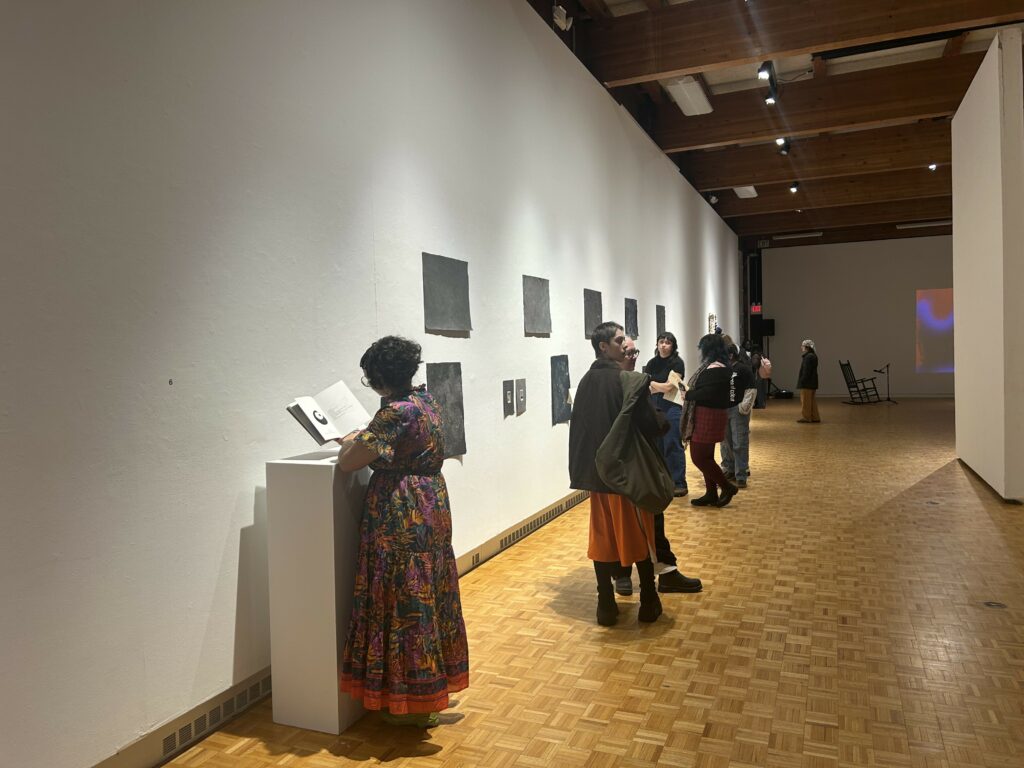
Sherae Rimpsey read “_what is it about particulate?” an excerpt from her coming novel *bluetooth. It was a long stream of consciousness, which was a contrast to the very succinct reading preceding it. She began moving through the crowd; moving out of her way as if she was parting the red sea. During the first moments of the poem, Rimpsey turned on a projector showing a video of Jennifer Holliday singing, “His Eye is on the Sparrow,” We felt our bodies when she moved throughout, although the confusion to sit or stand did make her path limited. The poem– in the context of the show– has such gripping language and style that one feels their body. The poem acts like a magnifying glass which goes back and forth between the body of Jennifer Holliday, the narrator, and the viewer. Yet, it doesn’t read like a list of biological normalities and abnormalities because of the stream of conscious form, which was excellently communicated with grammar on the page. The poem asks, “What would my body do without me? […] how did I become such a person […] What’s in this thing? What’s after?,” reading like a more stream of consciousness, Heideggerian-ontological inquiry. The poem is frequently directed at the viewer, asking one, “You can address the scope of Black // performance, expressivity, personhood, thought, being” – the piece urges the reader to personally explore internally and find answers to the questions asked. At first, getting this demand made me think I’m supposed to find it in the art around me like a scavenger hunt. On reflection, my first instinct was juvenile. Nevertheless, these ideas give the viewer the tools to put the show in context. If this is taken as a prescriptive review, and if you’re at the gallery: read it.
In both presentations we see a break from the Kantian disinterested contemplative state. In the essay, Zoe Butler critiques Schopenheaur’s usage of light. I think it is also important to mention another of his concepts (although not originally his) he uses extensively in his philosophy: the disinterested state of being required to judge the beautiful he borrowed from Kant (it would be a misreading to assume I am equating beauty with art– that has been disjoined for a while now). In summary, one must abandon their personal inclinations and self to judge the beautiful. When seated for the presentation, I had a feeling of being integral to the oration. Every speech requires an audience– sure, nothing new– but the aforementioned chair and the poet parting the crowd are just two examples of how the audience is forced to examine their position. We, the viewer, are forced to move, and with every movement we are reminded of the itchy state of the Ole Higue due to the heat of the lights, and heavy coats worn– due to the bitter cold weather outside. What this does not allow is for the audience to be disinterested and contemplative. What is discussed in the show is not meant to be contemplative– it is meant to make us think about our own bodies.
“These Boots were Made for Walking” by Anina Major is one of two films shown at the gallery. It first catches the viewer with its striking angle which one can only stubble upon in foot fetish content and Tarantino movies: a medium shot of just the feet. The second thought when viewing– as joked by fellow Lens writer, Jace Foster: “now, those boots aren’t coming off,” because the black ankle boots have two zippers and three buckles securing it. With those initial remarks aside, investigating the piece finds a story. The feet are trampling shards of porcelain in a meandering level and speed up and lapse throughout. The porcelain reminds one of a homely setting of kitchen bowls and plates on wooden shelves. This is juxtaposed by the boot itself– which has a tapered heel along with the superfluous ornaments of a Winged Hussar– which is out of place in a domestic setting. The wearer clearly does not want to be buckled into this place. This feeling of irregularity is why watching the wearer enact their will and stomp out the shards of porcelain feels like a cathartic rebellion against a domestic space.
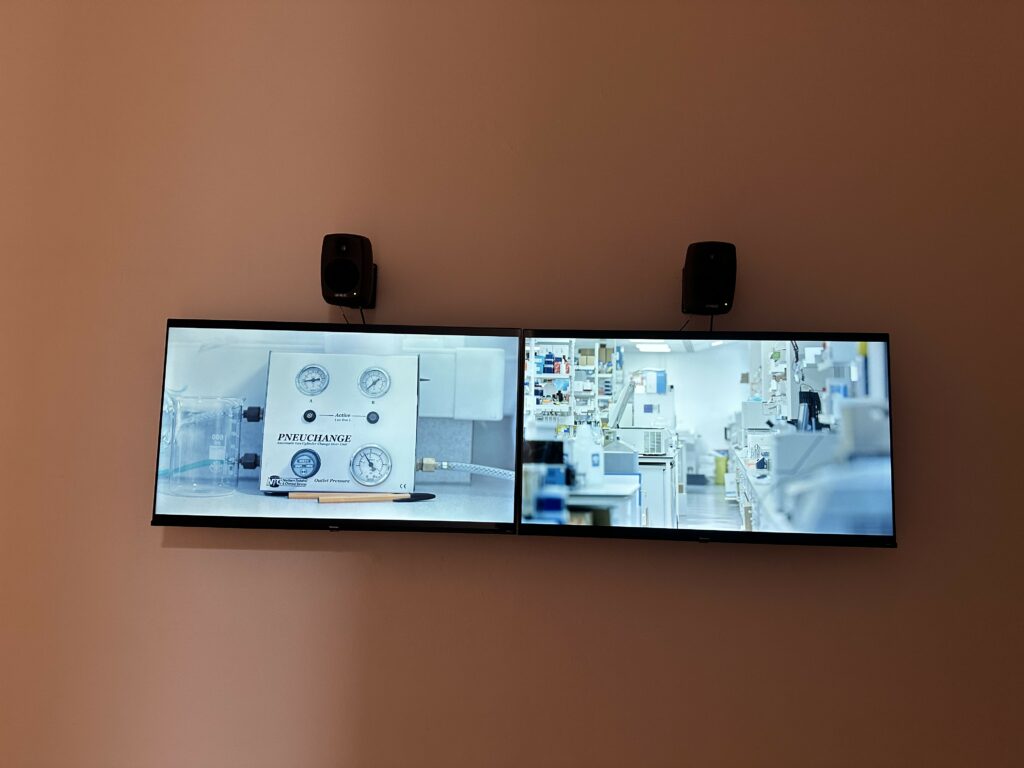
The piece “Action>Potential” by Sonya Dyer was a short film. Primarily, it was a dance. It begins in a lab where two scientists doing, as an uneducated viewer could only describe as: pressing buttons on oversized cookware. It is revealed through unnatural small talk, delivered well, that they are conducting an experiment and notice the blood cells’ resilience. The main character in a leotard appears. She was green screened into the lab, while the others were on set in the lab. Although the greenscreen breaks any verisimilitude present at the beginning, the dance’s subject matter is a real event. The piece draws inspiration from the story of Henrietta Lacks, a black woman who died from cervical cancer in 1951 whose cells were collected without her consent by Johns Hopkins surgeons. Her cells were responsible for 80,000 scientific publications and were also the first immortalized cells. They allowed for invaluable breakthroughs in science, but they were a piece of her body harvested without her consent. We can see the dancer’s shock in the lab and the movement of the dance upon a cosmic screen that highlights an uncomfortability with the aforementioned fact. The sound played over the dance emulates the tactile commotion of the lab equipment. “Come home,” is the first thing the cell says. The cell then absorbs her and takes her into the cosmic– however, there is no home to return to.
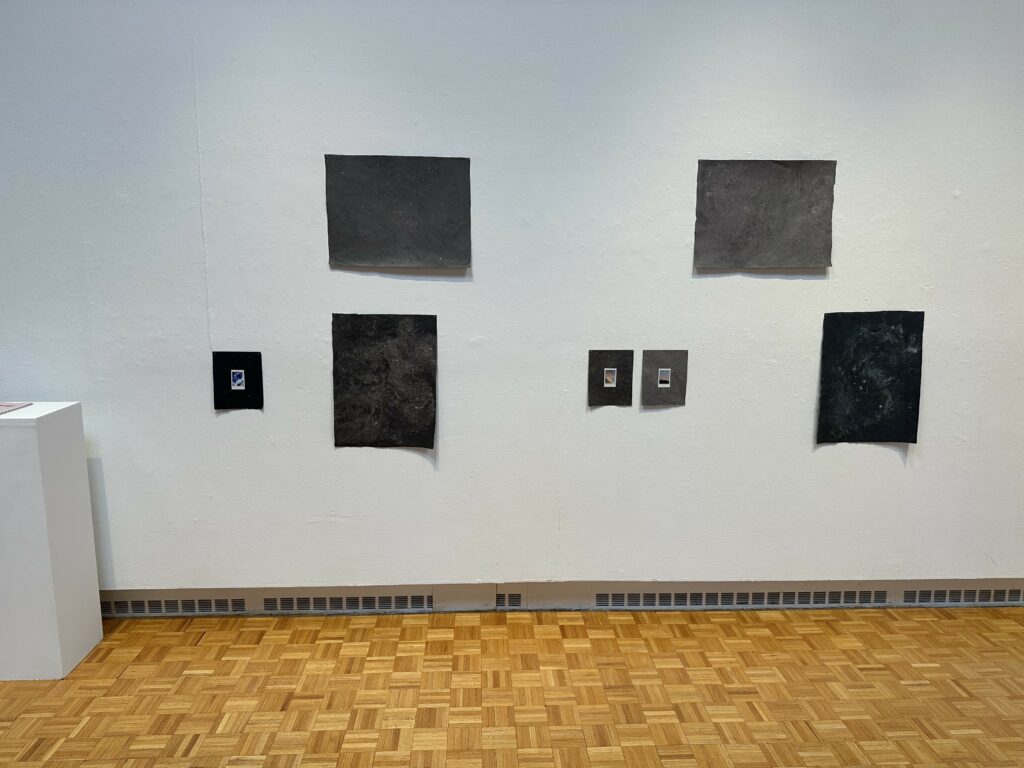
“wistful and Bold” by Keren Alfred were simple paper assumedly taped to the wall which looked messy. Perhaps this impression was only due to the adhesive used to stamp them to the wall–they were peeling off. The construction paper is black with white dots and colorful swirls imitating the cosmos. In between large cosmic swirls were smaller paper which had polaroid photos of day time. The geometric layout on the wall was eye-catching, but under further examination it fell short. It has a special awareness I suppose, but it feels a little lackluster to be in concert with so many amazing pieces. It fails to uphold a conversation and instead awkwardly stammers about the weather.
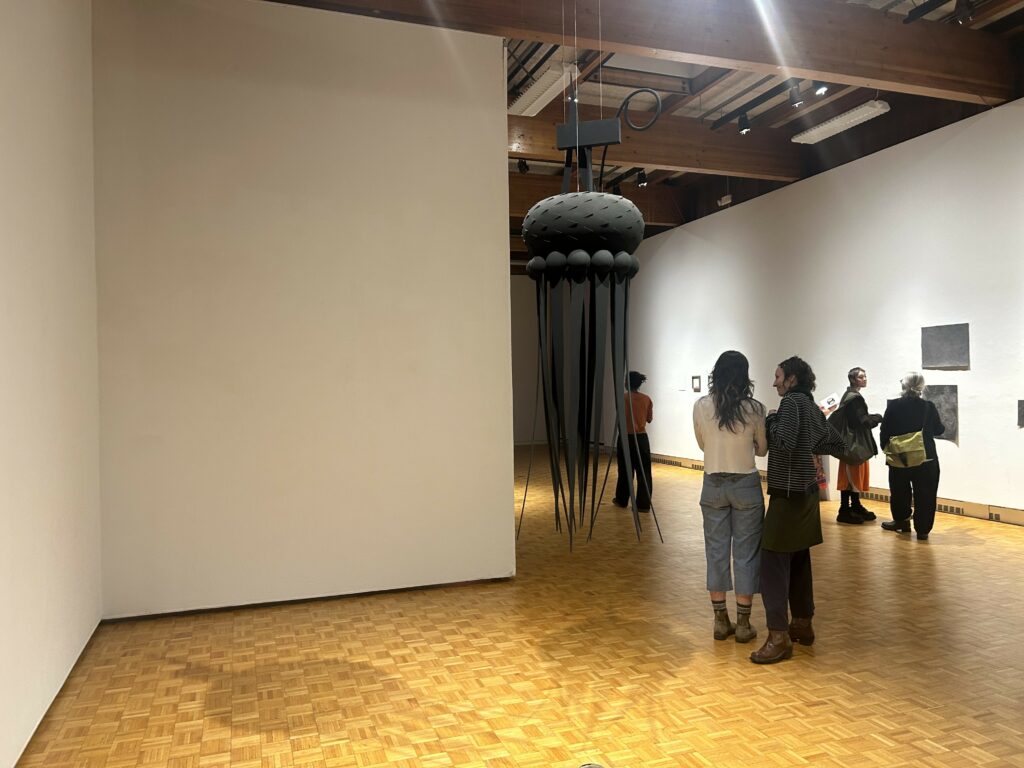
The woven baskets immediately evoked a type of plurality and natality through an example of the body with an assortment of sculpted heads falling down the side of them. The medium itself is steeped in traditional femininity norms tied to the body, but it examines it in a new way. In my opinion, the heads looked like a collection won from the battlefield.
There are a few pieces in which I did not touch on. This does not mean they were any less important, instead, I just felt that these pieces held an easily transcribable spirit of the show. Being to show bodies and space as reactions to oppression. I believe the message itself is further proved by the presentations ability to reach out and make us feel our bodies. This has the effect of the viewer instantly relating to the art on the walls.



Be First to Comment