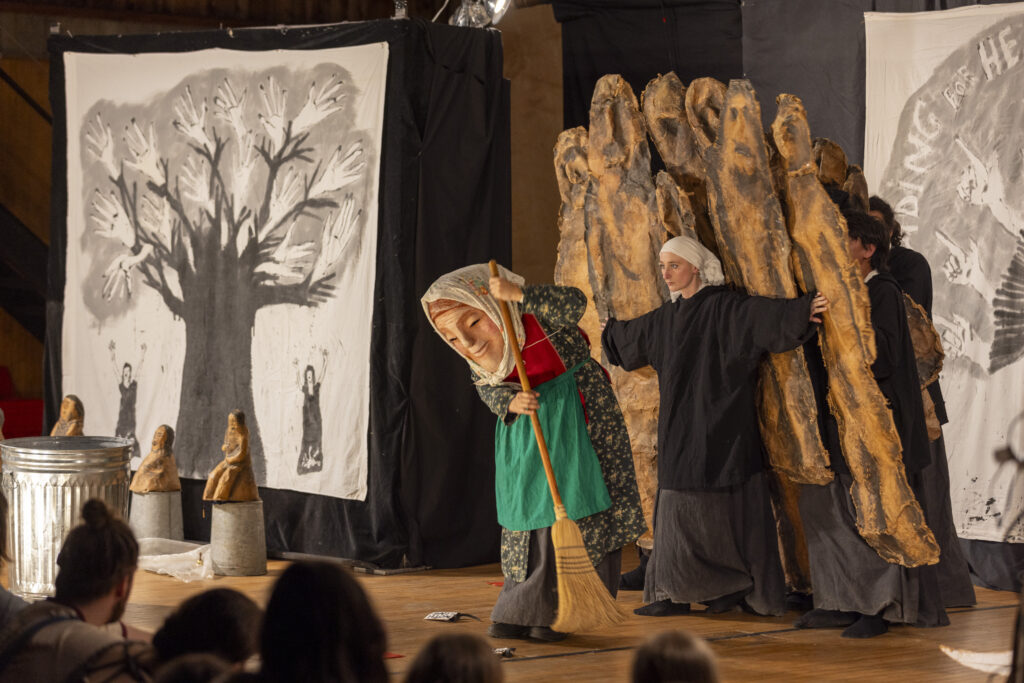
Last Thursday, for the first time since 1989, Glover, Vermont-based Bread and Puppet Theatre returned to Bennington College. Their performance of “The Obligation to Live,” which is currently touring throughout the eastern United States, was met with a packed crowd in VAPA’s Greenwall Auditorium.
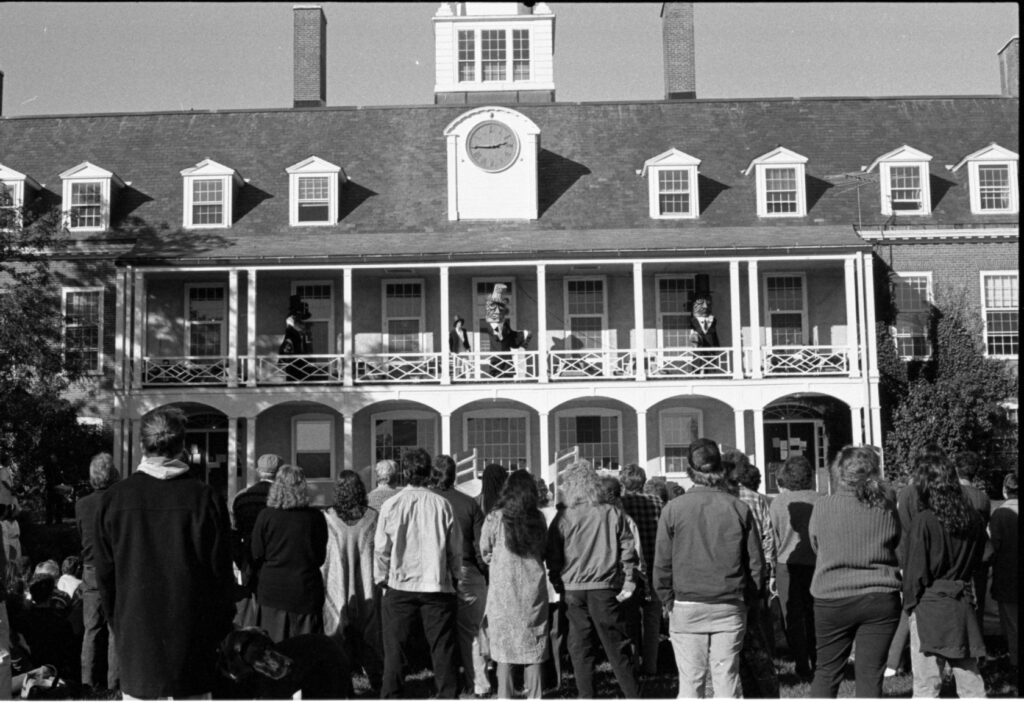
A press release from the first time Bread and Puppet performed at Bennington in 1967 wrote that “The Bread and Puppet Theatre seems to be a distinguished exception to the rule that political protest makes for inferior art.” Almost 50 years later, that core of the political and the theatrical still runs deep in Bread and Puppet’s DNA.
The stage set for “The Obligation to Live” was three black and white tapestries made in the signature chunky Bread and Puppet “cheap art” style that foregrounded all action throughout the show. From the opening “The Ultimate Decline of the Capitalist Empire Brass Band” espousing rhythms before the performance, to the actual play, a wide-ranging fantasia that is eclectic, thought-provoking, and technically impressive all in one.
According to the cast, “The Obligation to Live” was made in two weeks, born out of the director, Peter Schumann’s epiphany: the name of the play should be “The Obligation to Live.” Every Bread and Puppet, founded in 1963 in Schumann’s New York City apartment, acts as a response to its political context: from the Vietnam War, to issues of immigration, capitalism and Palestinian human rights. The plays also combine philosophical texts, the art made by the Bread and Puppet Press, and, of course, puppetry. “The Obligation to Live” opens with a scene dedicated to the mass-deportations underway in the United States under the Trump administration, which has arrested 32,000 people in its first 50 days, often without due process and outside US jurisdiction, and taken to detention centers in El Salvador and Guantanamo Bay.
Some of those detained include Mahmoud Khalil, a Columbia University graduate student whose student visa was revoked for his leadership during Pro-Palestinian encampments on Columbia’s campus and Rumeysa Ozturk, a Tufts University student who published a Pro-Palestinian op-ed in the school newspaper. Bread and Puppet takes these political scenes and evokes them in artistic interpretation: the performers hold up a banner displaying “The shadows of ICE detention,” hands blurred in a mass, all grasping for the edges of their canvas.
There is very little dialogue, but instead the performers’ bodies contort and shape to communicate the reality of their sparse words, usually spoken in verse. Puppet hearts beat while their feet shuffle and speak in onomatopoeia; An elderly woman collects humanity’s hearts and minds to be thrown in a trash can. The puppets themselves, a repertoire that ranged from the height of the stage all the way down to paper-mache gods of the day that stayed on the stage, are both handmade but technically manipulated in extravagant ways.
Although the show is full of themes and politics that can be hard to grasp, students on campus enjoyed the performance. Sadie Burch, a freshman, said, “It was definitely striking and intense from the beginning and I feel like they just knew exactly how to get what they wanted out of an audience.”
Burch had heard of Bread and Puppet in high school but didn’t quite know what to expect. What she saw, changed how she thought about political art: “I’ve been having a lot of conversations about this in my classes, especially poetry, like sometimes art that is political can feel kitschy, overly performative, and sometimes just to be controversial. I think here you can definitely feel the heart of concern that this company has for the harm that’s being done in the world.”
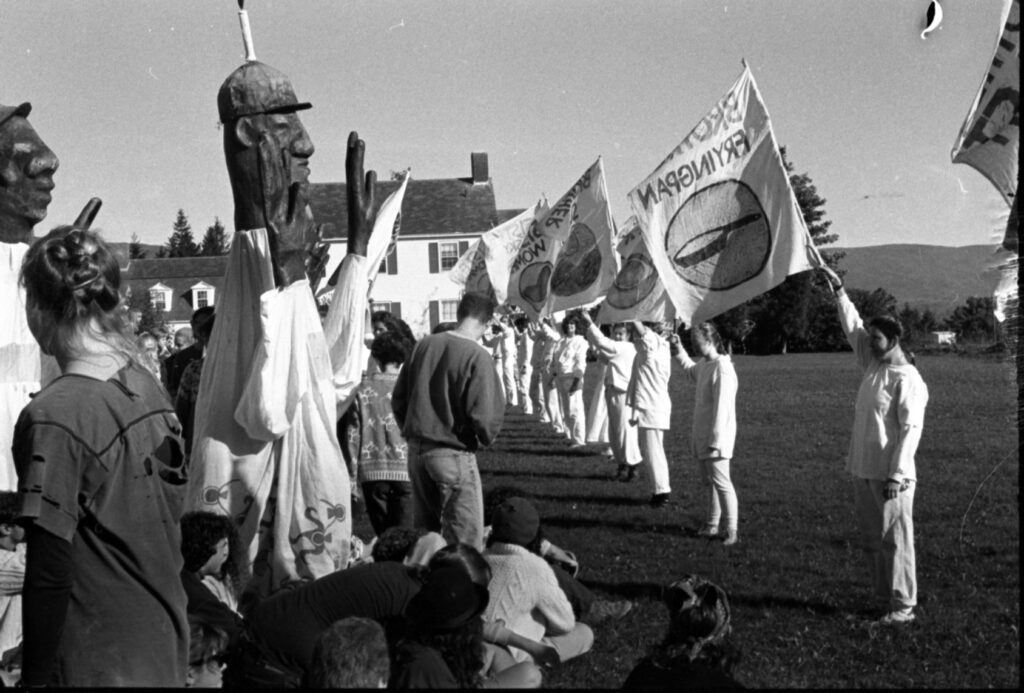
Willa Donovan, whose mother saw Bread and Puppet’s 1989 performance on Bennington’s campus, thought the show could be enjoyed and understood by the entire audience. “I was sitting next to a couple kids and thinking about how this show was deeply impactful for me but this show was also just as impactful for the children,” Donovan said, “it was at a level of comprehension that they were able to grasp.”
Despite its heaviness, the message of “The Obligation to Live” is just as its title states. It calls upon “possibilitarians… to plant garlic in the rubble of the empire.” To remain engaged in the political context of our time and not shrink from despair but instead, for the audience’s sake, live.



Be First to Comment