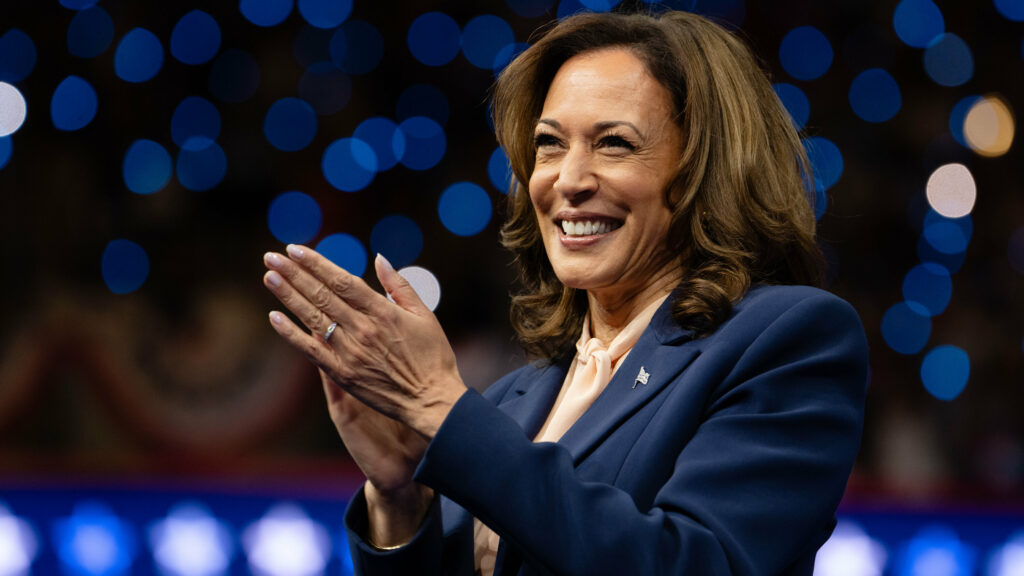
With the presidential election fast approaching, The Bennington Lens endorses Kamala Harris to be the 47th president of the United States.
There are a myriad of reasons why Harris is the only fit choice for office: her robust support of reproductive rights, future-oriented policies on climate change, and plan to implement more safeguards against gun violence are among them. It is also worth mentioning that her opponent, Donald Trump, poses a serious threat to U.S. democracy and global welfare. Since the Lens is dedicated to serving Bennington College, however, it behooves us to highlight the implications of a second Trump term regarding the one identity we all share—as college students.
“When I return to the White House, I will fire the radical left accreditors that have allowed our colleges to become dominated by Marxist maniacs and lunatics,” said Trump in a campaign video last year. “We will then accept applications for new accreditors who will impose real standards on colleges once again and once and for all.”
According to Trump, these standards include the removal of diversity, equity, and inclusion (DEI) initiatives, and the threat of fines “up to the entire amount of their endowment” for colleges that practice affirmative action, which aims to favor marginalized applicants in admissions—something he refers to as “discrimination under the guise of equity.”
Such speech has consequences: it was Trump’s policies and conservative appointees to the Supreme Court which allowed for last year’s SCOTUS ruling effectively ending affirmative action. This led to an immediate drop in the number of marginalized and particularly Black students admitted to colleges across the country. Trump has also made clear his intention to overturn the Biden-Harris administration’s recent Title IX changes, which were enacted to protect LGBTQ+ students from discrimination based on sexual orientation and gender identity.
While in office, Trump has threatened to significantly scale back federal financial aid: he proposed the elimination of the Public Service Loan Forgiveness (PSLF) program and cuts to the Pell Grant program. During his campaign, he has stated his intention to shut down the Department of Education—70% of the Department’s $224 billion budget goes towards federal student aid.
Although Trump claims that one of his primary concerns regarding colleges is protecting free speech, he stands in vehement opposition against the free speech of students, telling donors in New York that he would deport pro-Palestine protesters. “One thing I do is, any student that protests, I throw them out of the country,” said Trump. “You know, there are a lot of foreign students. As soon as they hear that, they’re going to behave.”
For Bennington College, which has significant LGBTQ+ and international student populations, an operating Office of DEI, and where 77% of students receive need-based financial aid, Trump’s policy proposals legitimately threaten the school’s central tenets and student body.
Harris, in contrast, is a longtime supporter of student loan forgiveness. She was one of five co-sponsors on a bill proposed by Bernie Sanders in 2017—the College for All Act—which would have made all public colleges tuition free for people making less than $125,000 per year. The Biden-Harris administration has reportedly forgiven over $144 billion of debt for Americans. The administration’s initial attempt to cancel student loans for 43 million people was overturned by the Supreme Court, but the Department of Education (a department that Harris does not plan on cutting, by the way) rolled out a number of options to forgive loans for 25 million borrowers this past summer.
During her career as attorney general and California Senator, Harris prosecuted for-profit colleges that were committing fraud, advocated for more oversight concerning false advertising, and pushed for students of said colleges to receive financial compensation for their debt. Having graduated from Howard University, one of the historically Black colleges and universities (HBCUs) in the U.S., Harris understands the importance of funding HBCUs—the Biden-Harris administration has invested $16 billion into these colleges.
Harris may not be a perfect candidate; concerns over her lackluster policy on Palestine, for example, cannot be overstated. Harris is also the only viable candidate who has promised to uphold democracy, a system which allows precious—insufficient, perhaps, but precious—room for public protest, civic engagement, and leader accountability. These are necessary considerations in an election with stakes so high: Trump has promised to be a dictator on his first day in office, and is again hinting at his unwillingness to accept election results and observe a peaceful transfer of power. Do not allow the perfect be the enemy of the good—and if you do not believe Harris to be a good candidate, then do not allow the perfect be the enemy of the necessary.
Bennington’s own Abraar Arpon ‘26 (who studies computer science) has created the website myballot.info, which provides readily available and accessible voting information by state, including instructions on how to register and vote by absentia. The Bennington Lens encourages all readers to get out and vote however they are able.







Be First to Comment